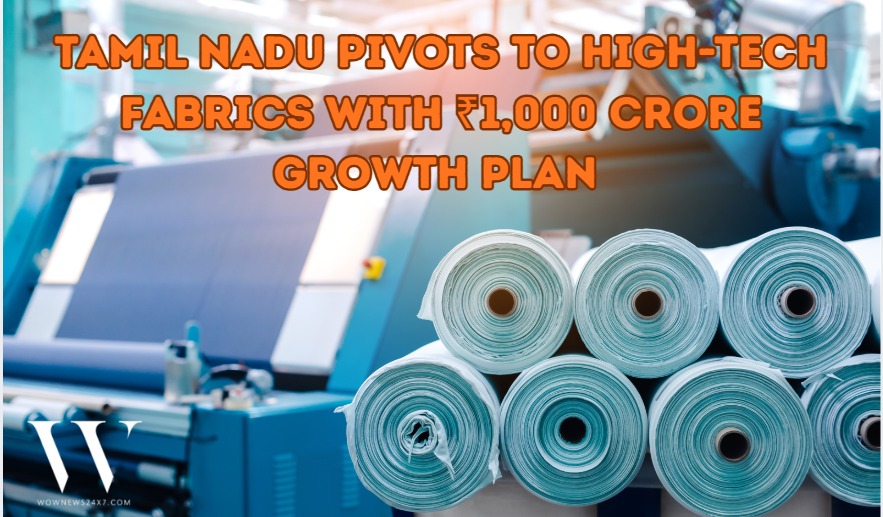
Tamil Nadu has launched a campaign to attract ₹1,000 crore in technical textile investments by 2030. The strategy promotes diversification into high-growth sectors like meditech and sporttech, with ₹123 crore in initial investments already committed. The state aims to boost its $8 billion annual textile export capacity through innovation and modernization.
COIMBATORE — The Tamil Nadu government has unveiled an ambitious strategy to attract ₹1,000 crore (approximately US$117 million) in new investments within the technical textiles sector by 2030. This initiative, announced on June 25, 2026, aims to transition the state’s manufacturing base toward high-value functional materials, reinforcing its position as a global leader in the textile value chain.
The announcement was made by T.N. Venkatesh, Principal Secretary of the Department of Handlooms, Textiles, Khadi, and Handicrafts, during an industry conference in Coimbatore. The state’s strategy focuses on incentivizing Micro, Small, and Medium-scale Enterprises (MSMEs) to diversify from traditional cotton spinning and weaving into specialized sectors including healthcare, automotive, sports, agriculture, and construction textiles.
Strategic Focus on Functional Textiles
As Tamil Nadu aspires to reach a US$1 trillion economy by 2030, the technical textiles sector has been identified as a critical pillar for industrial growth. Currently, the state contributes roughly 22% to 23% of India's total textile exports, with an annual export value of approximately $8 billion.
The government’s new roadmap focuses on six key segments, categorized under the state’s “T³M” (Tamil Nadu Technical Textile Mission):
Protech: Protective gear and safety equipment for defense and industrial use.
Meditech: Healthcare materials, including surgical gowns and implantable textiles.
Indutech: Advanced industrial fabrics, filtration, and geotextiles.
Hometech: Smart and fire-retardant home textile solutions.
Sporttech: High-performance athleisure and sportswear.
Mobiltech: Automotive components such as airbags and interior fabrics.
Immediate Industrial Commitments
The investment drive has already seen early success, with several industrial establishments signing Memoranda of Understanding (MoUs) with the state government for a combined investment of ₹123 crore. These projects are expected to be commissioned by the end of 2026. Furthermore, the state plans to establish at least five new technical textile manufacturing units across its four major industrial regions over the next three years.
To support this shift, the government intends to launch a dedicated Centre of Excellence (CoE) focused on athleisure products. This facility is designed to foster innovation, product development, and skill enhancement for manufacturers looking to compete in the premium global sportswear market.
Perspectives from Industry Leaders
While the government’s target has been met with optimism, industry associations are calling for specific fiscal adjustments to ensure the goals remain achievable.
During the conference, Durai Palanisamy, Chairperson of the Southern India Mills’ Association (SIMA), suggested that the state should enhance its financial support by converting current interest subventions into a 15% capital subsidy for technical textile projects. He emphasized that while cotton remains the backbone of the state’s textile heritage, manmade fibers and functional textiles are essential for long-term growth and competitiveness.
Official Sources
According to the Department of Handlooms, Textiles, Khadi, and Handicrafts, the investment drive is part of a broader vision to revitalize the sector. Officials stated that the department is committed to "making the technical textile sector in Tamil Nadu a model for the entire world" by providing technical handholding and "concept to commissioning" support for new and expanding enterprises.
Why It Matters
For businesses and investors, this move signals a pivot away from low-margin commodity production toward high-value, research-driven manufacturing. By encouraging MSMEs to upgrade their machinery and adopt technical standards, Tamil Nadu is positioning itself to capture a larger share of the global functional textiles market, which is increasingly focused on sustainability, performance, and specialized industrial applications.
Key Facts at a Glance
Investment Target: ₹1,000 crore in technical textiles by 2030.
Current Progress: ₹123 crore in MoUs already secured; projects expected by late 2026.
State Export Profile: Currently accounts for ~$8 billion in annual textile exports.
Planned Infrastructure: Establishment of at least five new industrial units and a Centre of Excellence for athleisure.
Core Objective: Scaling value-added manufacturing to contribute to a $1 trillion state economy.
Frequently Asked Questions (FAQ)
1. What are technical textiles?
Technical textiles are functional materials engineered for performance rather than aesthetics, used in sectors like medicine, defense, automotive, and construction.
2. How does this initiative support MSMEs?
The government is providing "concept to commissioning" support, including technical handholding and financial assistance, to help small businesses transition from traditional weaving to technical manufacturing.
3. Will this affect traditional textile production?
No, the goal is to diversify and add value. While traditional sectors remain strong, this initiative encourages players to expand their capabilities into high-growth, high-margin segments.
4. Where will the new manufacturing units be located?
The state plans to distribute at least five new units across its four major industrial regions, leveraging existing infrastructure to ensure efficient production.
Source: The Hindu, Department of Handlooms, Textiles, Khadi, and Handicrafts (Government of Tamil Nadu), Southern India Mills' Association (SIMA), Textile Excellence.