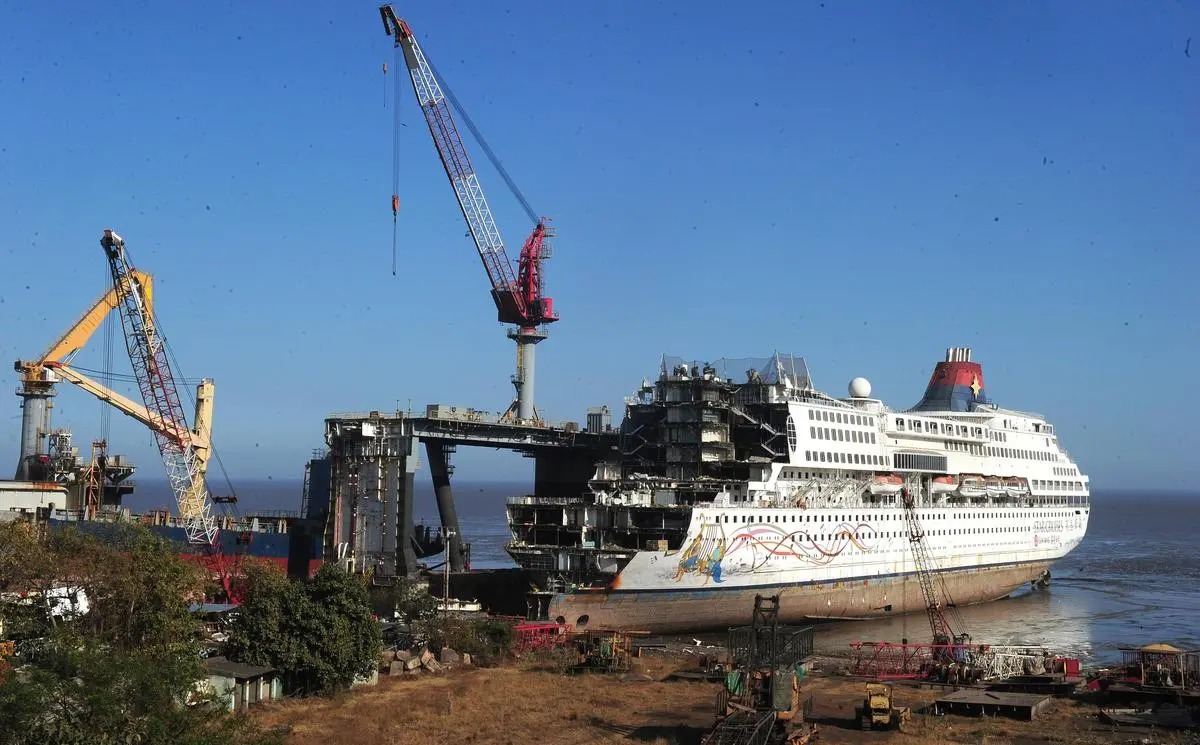
Union Minister Sarbananda Sonowal announced that India aims to recycle 16,000 ships over the next ten years, supported by an $8 billion financial commitment. Partnering with the European Union via a new Joint Working Group, the initiative will upgrade domestic infrastructure to secure international green certifications and double Alang's processing limits.
NEW DELHI — In a major development for the global maritime industry, Union Minister for Ports, Shipping, and Waterways Sarbananda Sonowal announced that India aims to recycle nearly 16,000 decommissioned vessels over the next decade. The aggressive expansion campaign is backed by an multi-billion dollar state funding injection.
Speaking after official bilateral maritime discussions in New Delhi on Wednesday, July 1, 2026, Sonowal confirmed a formal financial commitment of $8 billion (approximately ₹67,000 crore) to support the growth of the country’s domestic shipbuilding and sustainable ship recycling infrastructure. The development follows recent United Nations data establishing India as the world's leading ship-breaking hub. The massive allocation will accelerate deep regulatory upgrades designed to clear western compliance filters, aiming to capture the bulk of incoming European fleet retirements.
Strategic Realignment to Meet Transnational Green Rules
According to the official communique issued by the Ministry of Ports, Shipping and Waterways, the capital deployment intersects with high-level coordination with the European Union. Sonowal met with the European Commissioner for Environment, Water Resilience, and a Competitive Circular Economy, Jessika Roswall, to expedite the integration of domestic yards into Western supply chains.
The two leaders established a dedicated Joint Working Group (JWG) to ease the recognition of Indian breaking yards under the strict European Union Ship Recycling Regulation (EUSRR) framework. To date, more than 30 specialized Indian facilities have formally submitted applications for European certification. Three front-line yards have already completed comprehensive technical compliance reviews, positioning them to dismantle EU-flagged commercial vessels.
Infrastructure Capacity Duplication at Alang
According to statistical estimates compiled by the United Nations Conference on Trade and Development (UNCTAD), India's share in the worldwide ship recycling industry surged from 30.1% in 2024 to 35.4% in 2025. Total processed tonnage rose by 60%, climbing from 1.86 million gross tonnes (GT) to 2.99 million GT over the twelve-month reporting period.
To maintain this growth, the Ministry of Finance is working alongside the Gujarat Maritime Board to execute a structural master plan at the Alang Ship Recycling Yard. The project aims to nearly double Alang's operational limits, raising total processing capacity to approximately 9 million light displacement tonnes (LDT). The infrastructure upgrades focus on zero-pollution containment blocks, including heavy-duty effluent treatment plants, automated steel shearing fields, and scientific hazardous waste storage facilities.
Economic Incentives and Enhanced Worker Protection
The government’s master layout pairs infrastructural funding with direct supply-side operational benefits. The active Ship-breaking Credit Note Scheme awards domestic shipowners an incentive equal to 40% of the scrap value of an end-of-life vessel dismantled locally. This credit note can offset up to 5% of the construction costs for a new vessel built within an authorized domestic shipyard, linking the ship-breaking sector directly to the domestic shipbuilding industry.
Simultaneously, the regulatory framework introduces strict requirements for labor operations. In compliance with the Recycling of Ships Act and the global Hong Kong International Convention, all participating facilities must maintain dedicated residential housing complexes, provide multi-specialty healthcare units managed by the Red Cross Society, and submit to unannounced third-party safety audits to protect field personnel.
Official Sources Section
The maritime funding data, international agreements, and capacity indicators used in this report are verified by official administrative logs:
Ministry of Ports, Shipping and Waterways Briefings: Formal ministerial updates issued via the Press Information Bureau in New Delhi.
UNCTAD Maritime Transport Reports: Annual global shipping registries tracking worldwide fleet recycling market shares.
European Commission Environmental Registers: Compliance logs tracking EUSRR yard verification pipelines.
Quote Section
"Under the leadership of Prime Minister Narendra Modi, India has consolidated its position as a global hub for safe, environmentally sustainable, and responsible ship recycling," stated Union Minister Sarbananda Sonowal during the bilateral forum. "Expanding the number of internationally recognized recycling facilities will contribute significantly to the global circular economy while creating thousands of specialized industrial jobs."
Why It Matters
For global shipping corporations and maritime insurers, India's $8 billion infrastructure commitment provides a reliable, scale-ready solution for responsibly decommissioning aging fleets in compliance with international green mandates. For the domestic manufacturing sector, doubling Alang's capacity provides a steady, cost-effective source of high-grade recycled steel scrap, reducing reliance on expensive imported iron ore. Furthermore, the alignment with EU standards ensures that international financing channels remain open to Indian maritime developers during this major circular economy transition.
Key Facts at a Glance
Massive Capital Injection: The Central Government committed $8 billion to accelerate infrastructure development across shipbuilding and recycling yards.
Ambitious 10-Year Goal: India plans to handle nearly 16,000 ship retirements over the next decade, tapping into an anticipated global wave of vessel retirements.
Global Leadership: Backed by recent UNCTAD statistics, India leads the global ship-breaking sector with a dominant 35.4% market share.
European Alignment: A new Joint Working Group has been formed with the EU to accelerate the inclusion of compliant Indian yards under Western green regulations.
FAQ Section
Why is India investing $8 billion into ship recycling and shipbuilding?
The funding is designed to modernize domestic yards, double total processing capacity at Alang, and upgrade environmental defenses to meet strict international green shipping regulations.
What is the significance of the EU Ship Recycling Regulation (EUSRR) for Indian yards?
Gaining formal inclusion on the EU's approved list allows Indian yards to legally dismantle European-flagged commercial vessels, unlocking access to high-value Western fleet retirement contracts.
How does the Ship-breaking Credit Note Scheme benefit domestic shipbuilders?
The scheme allows ship owners to apply 40% of a recycled ship's scrap value as a credit note, covering up to 5% of the cost for new vessel construction at an Indian shipyard.
Which international safety standards do Indian yards currently follow?
Indian ship-breaking facilities operate under the Recycling of Ships Act, which aligns with the Hong Kong International Convention for the Safe and Environmentally Sound Recycling of Ships.
Source: Ministry of Ports, Shipping and Waterways Press Information Bureau, United Nations Conference on Trade and Development Portals, European Commission Environment Directorate Updates.