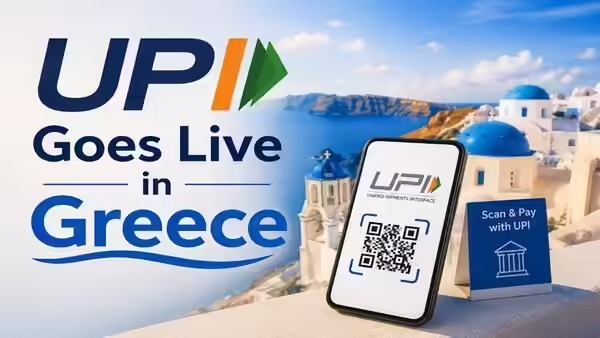
India's Unified Payments Interface (UPI) has officially launched in Greece through a partnership between NPCI International and Eurobank. The integration allows Indian travellers to make instant, real-time mobile QR payments at participating merchants, lowering transaction costs and eliminating the heavy exchange fees tied to international cards.
ATHENS — India’s global digital payment expansion hit a primary milestone on Tuesday, June 30, 2026, as the Unified Payments Interface (UPI) officially went live across Greece. The structural financial rollout marks a major step forward for international Digital Public Infrastructure (DPI) interoperability.
The formal introduction was announced by Union Commerce and Industry Minister Piyush Goyal during an official state visit to the Greek capital. Goyal, alongside Eurobank CEO Fokion Karavias and Fairfax Digital Services CEO Sanjay Tugnait, witnessed a live demonstration of the digital payment architecture at Eurobank’s corporate headquarters in Athens. Facilitated via a strategic partnership between Eurobank Greece and NPCI International Payments Limited (NIPL) the cross-border arm of the network integration transforms how Indian tourists, corporate professionals, and students manage retail expenses abroad.
Eurobank Partnership Streamlines Cross-Border Settlement
The mechanical backbone of the rollout relies on direct integration between India's immediate retail clearing networks and Greece's legacy banking infrastructure. By partnering with Eurobank, one of Greece’s four systemic banking pillars, NPCI International has established a direct settlement mechanism that bypasses conventional international merchant networks.
According to financial specifications detailed by the Ministry of Commerce and Industry, the system enables eligible users to execute instant, mobile-based QR code transactions directly from their existing Indian bank accounts. The primary structural benefit for travellers is a drastic reduction in cross-border transaction costs. Traditional international credit card swipes or foreign exchange cards routinely attract markup fees ranging from 2% to 4.5%, alongside static transaction charges. In contrast, the direct UPI network processes peer-to-merchant settlements at a fraction of conventional costs, providing real-time currency conversion rates linked directly to interbank forex fixing levels.
What Indian Travellers Must Know Before Departure
While the introduction of the payment system simplifies physical transactions from the ancient streets of the Acropolis to the beaches of Mykonos and Santorini, specific operational guidelines govern the early rollout phase. Travellers must ensure that their preferred domestic mobile payment applications—such as BHIM, Google Pay, PhonePe, or Paytm—have their international transaction profiles manually activated before departure.
Financial compliance experts note that international UPI usage requires a linked smartphone operating with an active Indian mobile number capable of receiving international SMS notifications for automated one-time password (OTP) verification routines. Furthermore, because merchant terminal provisioning will scale up incrementally across the Mediterranean country, tourists are advised to maintain standard backup payment options, including international debit cards or physical euro banknotes, to manage transactions in remote regional provinces.
Strategic Free Trade Focus Drives Bilateral Innovations
Greece’s integration into the Indian digital network makes it the 10th country globally, and the second within Europe after France, to officially accept the payment format. The technical launch coincides with broader trade discussions aimed at concluding the comprehensive India-European Union Free Trade Agreement (FTA).
During the India-Greece Business Forum, Deputy Foreign Minister of Greece Harry Theoharis emphasized that modernizing financial connectivity serves as an important pillar for doubling bilateral trade volumes by 2030. By allowing seamless consumer spending, both nations aim to expand numbers in the hospitality sector. Tourism registries show that Indian tourist inflows to Europe have expanded by more than 18% annually, making frictionless retail networks a vital asset for local European businesses seeking to capture high-value destination spend.
Official Sources Section
The operational frameworks, banking partnerships, and government directives detailed in this report are verified by formal administrative records:
NPCI International (NIPL) Corporate Briefings: Operational parameters governing the Eurobank technical agreement signed in Athens.
Ministry of Commerce and Industry Filings: Official statements issued via Minister Piyush Goyal's diplomatic delegation logs.
Eurobank Greece Regulatory Disclosures: Institutional declarations outlining merchant terminal integration timelines for the European circular economy.
Quote Section
"With UPI now live in Greece, eligible customers can transfer money instantly, securely, and seamlessly, with transaction costs reducing drastically to a fraction of conventional transfer costs," stated Union Commerce and Industry Minister Piyush Goyal following the system demonstration. "The increasing global acceptance reflects the trust in Prime Minister Narendra Modi's vision of building technology-led solutions that create value beyond borders."
Why It Matters
For everyday Indian holidaymakers and business travellers, the rollout removes the security anxieties and steep conversion markups associated with carrying physical cash or buying short-term forex cards. For Greek merchants and hospitality providers, it opens immediate access to the high-spending Indian tourism demographic by offering a familiar, frictionless check-out experience. On a macro level, the system's entry into a major Eurozone economy demonstrates the global scalability of India’s open-source financial technology.
Key Facts at a Glance
European Footprint: Greece officially becomes the 10th nation globally, and the second in Europe, to integrate India's UPI network.
Banking Alliance: The system operates through a direct structural partnership between NPCI International and Eurobank Greece.
Cost Efficiency: Transactions processed through the link entirely avoid standard international credit card markups and foreign transaction fees.
Pre-Travel Requirement: Users must manually activate the international merchant payment setting within their mobile apps before transacting abroad.
FAQ Section
Can I use my standard Indian UPI app to pay for items in Greece?
Yes, you can use major UPI-enabled applications linked to your Indian bank account, provided you have enabled international merchant payments within the app before your trip.
Will I be charged high foreign exchange transaction fees?
No, one of the primary benefits of this integration is that transaction costs drop drastically to a fraction of conventional international credit card or forex card fees.
Do all shops and hotels in Greece accept UPI immediately?
No, the service is currently rolling out across Eurobank’s merchant network. While major tourist hubs in Athens and Santorini are adopting it quickly, it is recommended to carry a backup international card.
Is a local Greek SIM card required to make these digital payments?
No, you can use your domestic Indian SIM card via international roaming or local Wi-Fi, but your phone must be capable of receiving verification prompts linked to your registered Indian mobile number.
Source: Ministry of Commerce and Industry Press Releases, Eurobank Greece Investor Relations Desk.