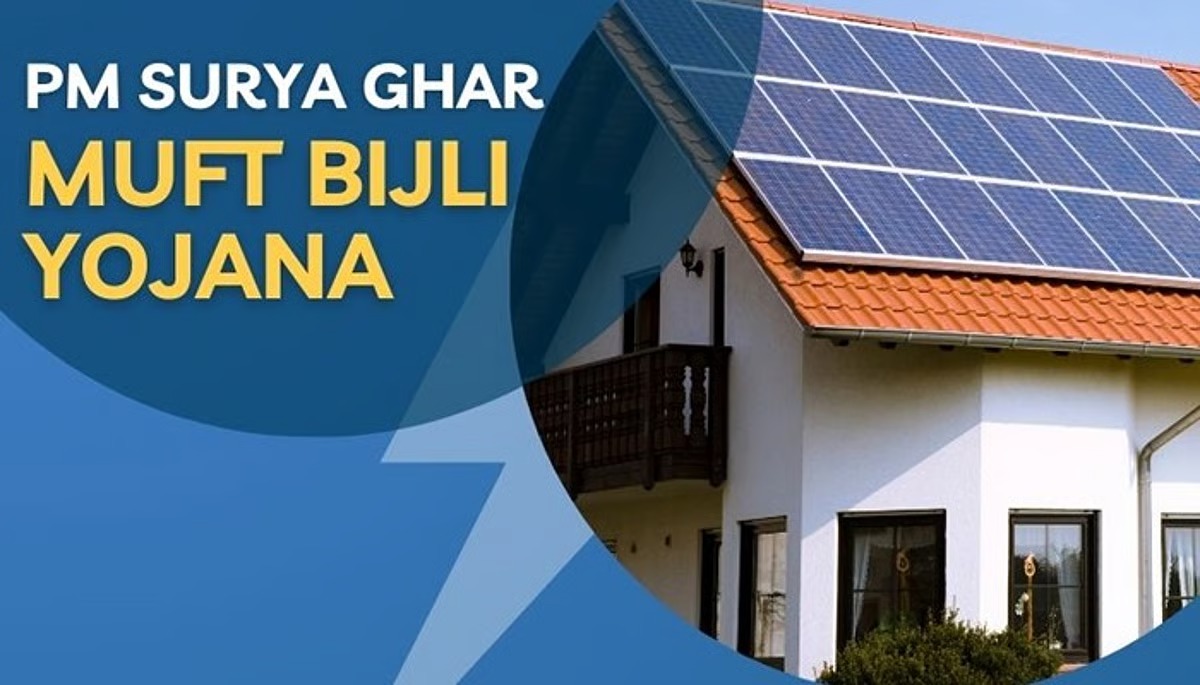
Nagpur has ranked second in India after installing 89,255 rooftop solar units under the PM Surya Ghar Muft Bijli Yojana. The district's strong performance helped Maharashtra secure eight national awards from the Ministry of New and Renewable Energy, with the state crossing 6.05 lakh total homes solarized.
NAGPUR — Nagpur district has established itself as a premier national hub for clean energy, securing the second-highest position across India for residential solar adoptions. According to institutional data released at a national renewable energy convention in New Delhi, Nagpur completed a massive total of 89,255 rooftop solar installations over a 24-month operational window.
The extensive rollout was executed under the central government’s flagship green energy program, the Prime Minister Surya Ghar Muft Bijli Yojana. Launched by the Union administration to transition residential grid reliance toward decentralized micro-generation, the program's localized success in Nagpur has anchored the district as the absolute frontrunner within the state of Maharashtra, outperforming larger industrial metropolitan zones including Pune and Mumbai.
National Rankings Position Nagpur as a Clean Energy Powerhouse
The technical evaluation finalized by the Union Ministry of New and Renewable Energy positions Nagpur directly behind Lucknow, which secured the first rank nationally with approximately 120,000 active installations. Nagpur’s massive volume of 89,255 residential completions proved critical in positioning Maharashtra as a dominant territory on India's changing renewable map.
The widespread consumer transition monitored across Nagpur’s assembly constituencies directly propelled Maharashtra to claim a record total of eight distinct national awards during the institutional conference at the Atal Akshay Urja Bhawan. Beyond Nagpur's second-place podium finish, two additional Maharashtra districts successfully penetrated the national Top 10 list: Jalgaon clinched the ninth spot with 42,574 systems, while Pune ranked tenth by finalizing 42,151 residential installations.
State-Level Standings and the May Operational Surge
While Nagpur led local district data, the overall state-level tracking revealed a competitive race for green energy dominance among India's industrial states. Over the trailing two years, Maharashtra successfully commissioned rooftop solar infrastructures on a total of 6.05 lakh households, locking down the second-highest state ranking in the country.
| State Tier | Total Residential Installations (Cumulative 24 Months) | National Rank Placement |
| Gujarat | 6.81 Lakh Homes | First Place |
| Maharashtra | 6.05 Lakh Homes | Second Place |
| Uttar Pradesh | 5.64 Lakh Homes | Third Place |
The momentum behind Nagpur's grid expansion peaked during a dedicated administrative campaign dubbed the "Month of Solar" in May 2026. During this single-month push, state power utility firms processed 65,786 applications and rapidly cleared 54,246 local field installations.
The peak of this technical deployment occurred on May 29, 2026, when engineering teams installed a record-breaking 15,000 rooftop systems across India in a single 24-hour window. State utility tracking confirmed that Maharashtra alone accounted for 4,700 of those single-day completions—representing more than 31% of the entire country's output.
Technical Auditing and Safety Infrastructures
To manage the heavy volume of new micro-generation assets without triggering regional transformer overloads, state distribution engineers scaled up localized technical safety inspections. State teams successfully completed standard performance and safety audits on 69,156 active installations across the territory, ranking first in national compliance speed.
Furthermore, to protect household consumers from low-quality materials and technical errors, the regional power authority built a robust commercial ecosystem by registering 413 authorized alternative energy vendors. These registered businesses are required to deploy certified, weather-resistant structural mounts capable of withstanding local storm patterns before accessing the centralized subsidy clearing desk.
Official Sources Section
The verified installation metrics, state rankings, and regional allocation tallies are drawn directly from the institutional progress ledgers hosted on the national portal for the PM Surya Ghar Muft Bijli Yojana. Strategic compliance targets and state utility performance reviews were systematically made public via the communication channels of the Maharashtra State Electricity Distribution Company Ltd (MSEDCL).
Quote Section
Technical directors credited the rapid local adoption to simplified administrative procedures and substantial reductions in household monthly utility spending.
"Nagpur's strong performance reflects the growing acceptance of rooftop solar systems among households and the extensive efforts undertaken by the utility to facilitate installations and consumer participation. The district has consistently remained among the leading regions in the state since the launch of the scheme," stated a senior official from the Maharashtra State Electricity Distribution Company Ltd (MSEDCL).
Why It Matters
For regular household consumers and commercial small businesses, shifting to a decentralized solar array provides an immediate economic shield against rising power tariffs. By feeding excess daytime power generation back into the local grid via a bi-directional net metering mechanism, families can effectively secure up to 300 units of free electricity per month. This reduction in overhead costs frees up discretionary household capital, while simultaneously lowering the peak distribution load on state coal-fired generation stations during intense summer heatwaves.
Key Facts at a Glance
National Standing: Nagpur district secured the second spot across India by installing 89,255 residential rooftop solar units.
State Achievement: Maharashtra finished second nationally with 6.05 lakh homes solarized, trailing Gujarat’s 6.81 lakh completions.
Single-Day High: On May 29, 2026, Maharashtra accounted for 4,700 out of 15,000 installations completed across India.
Subsidy Incentives: The central framework provides fixed baseline financial incentives, offering subsidies up to Rs 78,000 for standard 3kW residential configurations.
FAQ Section
What financial subsidies are offered under the PM Surya Ghar scheme?
Under the current central guidelines, residential consumers receive an immediate financial subsidy of Rs 30,000 for a 1kW system, Rs 60,000 for a 2kW system, and a maximum capping limit of Rs 78,000 for configurations rated at 3kW or higher.
Which Indian city currently leads the country in rooftop solar adoptions?
Lucknow, the capital city of Uttar Pradesh, currently holds the first rank nationally, having completed approximately 1.2 lakh residential rooftop installations.
How does net metering affect a consumer's monthly power bill?
A bi-directional net meter tracks the exact units of solar energy your home exports to the grid during sunny hours against the electricity you draw at night. Your monthly bill is calculated strictly on the net difference, often reducing expenses by up to 90%.
Source: Union Ministry of New and Renewable Energy (MNRE) National Portal, Maharashtra State Electricity Distribution Company Ltd (MSEDCL) Corporate Desk, Press Briefing at Atal Akshay Urja Bhawan (June 4, 2026).