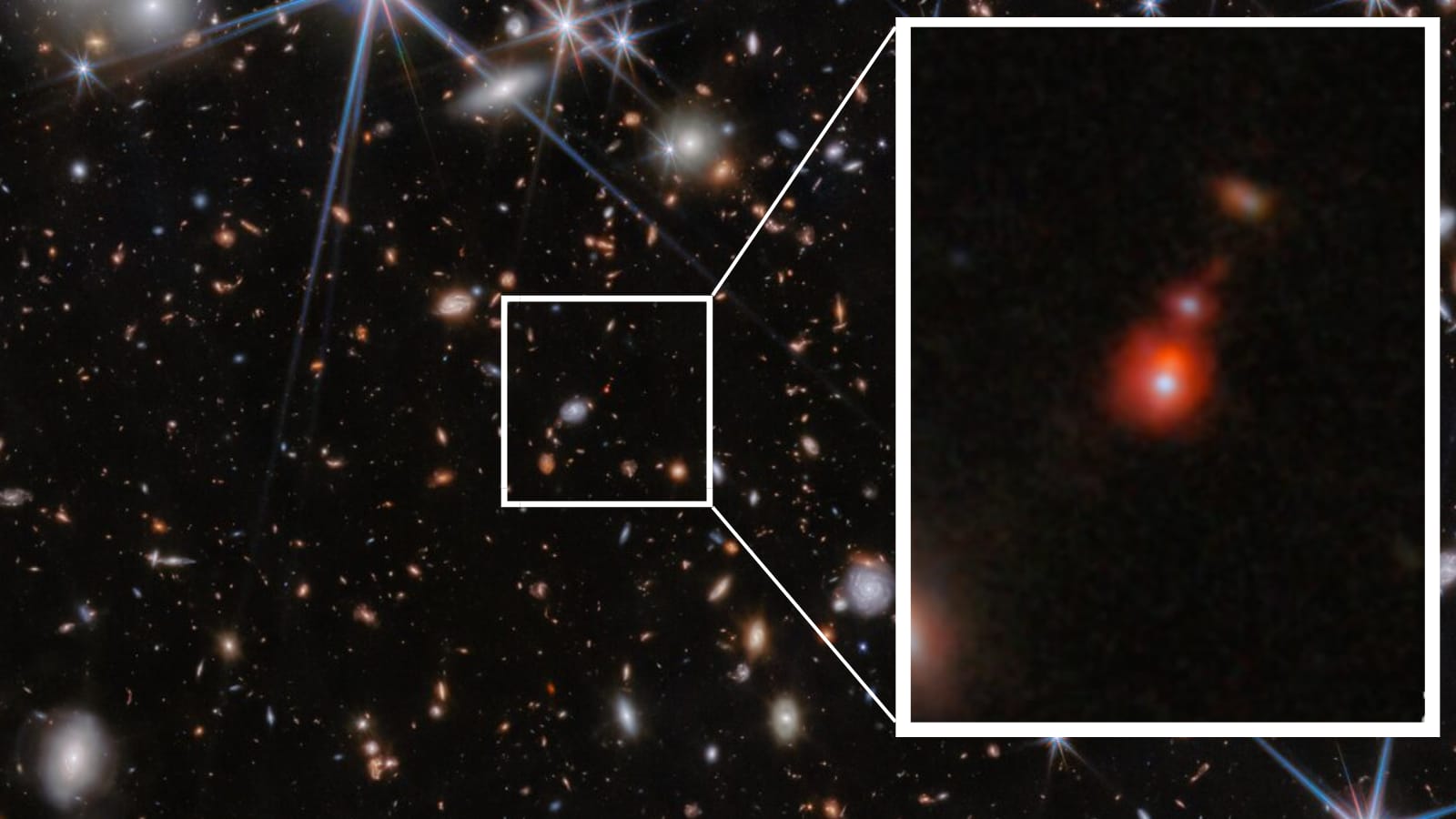

NASA’s James Webb Space Telescope has confirmed the discovery of galaxy MoM-z14, the most distant galaxy ever observed, dating back to just 280 million years after the Big Bang. This record-breaking find challenges existing theories about early cosmic evolution and offers unprecedented insights into the universe’s formative years.
Astronomers have announced a groundbreaking achievement with the James Webb Space Telescope (JWST) confirming the existence of galaxy MoM-z14 at redshift z=14.44. This galaxy, seen as it appeared only 280 million years after the Big Bang, now holds the record as the most distant and earliest galaxy ever detected. The discovery marks a significant leap in humanity’s ability to peer into the cosmic dawn, reshaping our understanding of how the first stars and galaxies formed.
Key Highlights:
-
The galaxy MoM-z14 was spectroscopically confirmed on January 28, 2026, making it the farthest galaxy ever reliably detected.
-
Its brightness and structure defy predictions, suggesting galaxies in the early universe may have formed faster and more efficiently than current models allow.
-
The find pushes the boundaries of observable space, offering astronomers a rare glimpse into the universe’s infancy and the processes that shaped its evolution.
-
Researchers emphasize that MoM-z14’s characteristics highlight a growing gap between theoretical expectations and observational data, raising new questions about star formation and cosmic timelines.
-
The discovery underscores JWST’s unmatched capabilities in infrared astronomy, enabling scientists to capture light from the earliest epochs of the universe.
-
Experts from NASA, ESA, CSA, and MIT’s Kavli Institute for Astrophysics collaborated on the study, reinforcing the telescope’s role as a cornerstone of modern astrophysics.
This milestone not only sets a new benchmark for astronomical observation but also opens avenues for further exploration into the mysteries of cosmic dawn. As JWST continues to push the limits of visibility, astronomers anticipate more revelations that could redefine our understanding of the universe’s earliest chapters.
Sources: NASA, ESA, CSA, STScI, MIT Kavli Institute for Astrophysics, Space.com