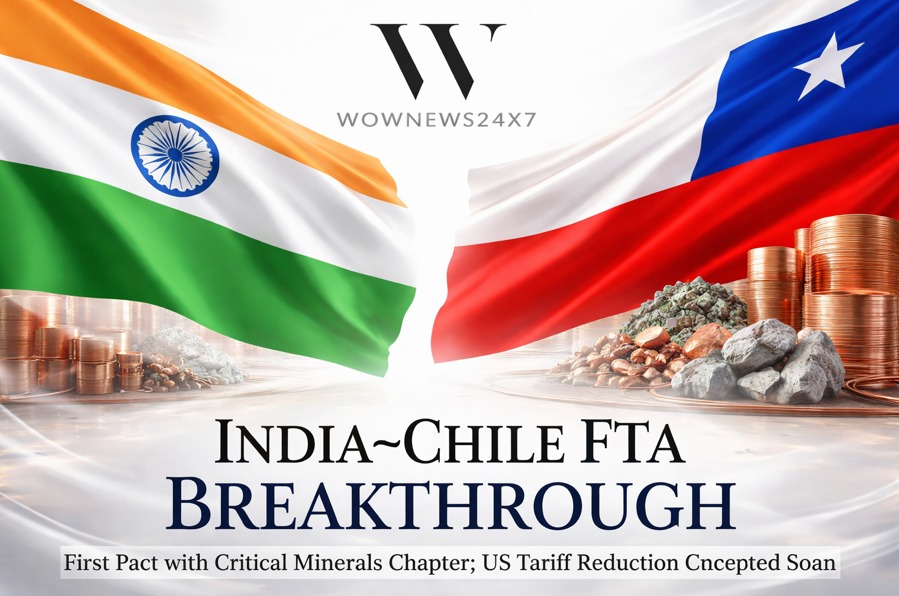





India’s trade secretary announced that the India–Chile Free Trade Agreement (FTA) is the country’s first pact to include a chapter on critical minerals, strengthening supply chain resilience. Meanwhile, trade officials expect the US to reduce tariffs on Indian goods to 18% this week, with negotiations set to conclude next week.
India has achieved a significant milestone in its trade diplomacy with the signing of the India–Chile Free Trade Agreement (FTA), which for the first time includes a dedicated chapter on critical minerals. This move is seen as crucial for India’s long-term energy security and industrial growth, given the rising global demand for rare earths and strategic minerals.
Trade officials highlighted that the agreement will enhance cooperation in sectors such as lithium, copper, and other critical resources, vital for India’s renewable energy and electric vehicle ambitions. The pact also underscores India’s intent to diversify supply chains and reduce dependency on limited sources.
In parallel, India is advancing negotiations with the United States, with expectations that Washington will reduce tariffs on Indian goods to 18% this week. India’s chief negotiator is scheduled to travel to the US next week to finalize the trade agreement, which could open new opportunities for Indian exporters in textiles, engineering goods, and pharmaceuticals.
Analysts view these developments as part of India’s broader strategy to strengthen its global trade footprint, secure critical resources, and expand market access for domestic industries.
Key Highlights
-
India–Chile FTA: First agreement with a chapter on critical minerals.
-
Strategic Focus: Cooperation on lithium, copper, and rare earths.
-
US Tariff Reduction: Expected cut to 18% this week.
-
Negotiations: India’s chief negotiator to visit US next week.
-
Economic Impact: Boost for exporters in textiles, engineering, and pharma.
-
Global Strategy: Enhances supply chain resilience and trade diversification.
Sources: Economic Times, Business Standard, Mint