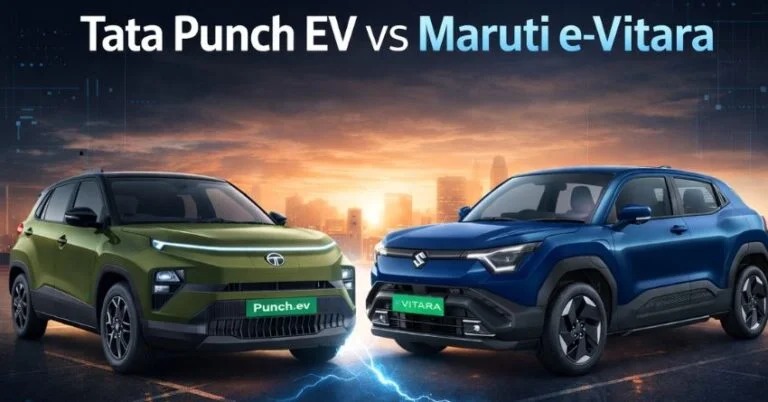



The 2026 Tata Punch EV facelift and Maruti Suzuki e Vitara mark two major entries in India’s growing EV market. While Tata positions the Punch EV as an affordable compact SUV, Maruti’s e Vitara offers longer range and premium features. The comparison highlights pricing, performance, and value-for-money factors.
India’s electric vehicle market has intensified with the launch of the Tata Punch EV facelift and Maruti Suzuki’s first electric SUV, the e Vitara. Both models target different segments but compete closely on affordability, range, and features, making them attractive options for buyers seeking sustainable mobility.
Key Highlights
-
Tata Punch EV facelift priced from Rs 9.99 lakh (ex-showroom), making it one of the most affordable EV SUVs
-
Maruti Suzuki e Vitara starts at Rs 15.99 lakh (ex-showroom), positioned as a premium electric SUV
-
Punch EV offers a range of 421 km with a 35 kWh battery pack
-
e Vitara delivers a longer range of 543 km with a 61 kWh battery pack
-
Charging times differ, with e Vitara supporting faster DC charging (10–80% in 56 minutes at 50 kW)
-
Punch EV facelift introduces refreshed design, upgraded interiors, and improved battery efficiency
-
e Vitara emphasizes premium features, larger cabin space, and advanced safety technologies
Strategic Impact
The Tata Punch EV facelift appeals to budget-conscious buyers seeking an entry-level EV with practical range and affordability. Its competitive pricing makes it a strong contender in India’s mass-market EV segment.
Maruti Suzuki’s e Vitara, on the other hand, positions itself as a premium offering with superior range and advanced features, targeting urban families and long-distance commuters. While it comes at a higher price point, the extended range and brand reliability add to its value proposition.
Value For Money Verdict
For buyers prioritizing affordability and city commutes, the Tata Punch EV facelift offers excellent value. However, for those seeking longer range, premium comfort, and advanced features, the Maruti Suzuki e Vitara justifies its higher cost. Ultimately, the choice depends on budget, usage patterns, and lifestyle needs.
Sources: Mint, CarDekho, ZigWheels