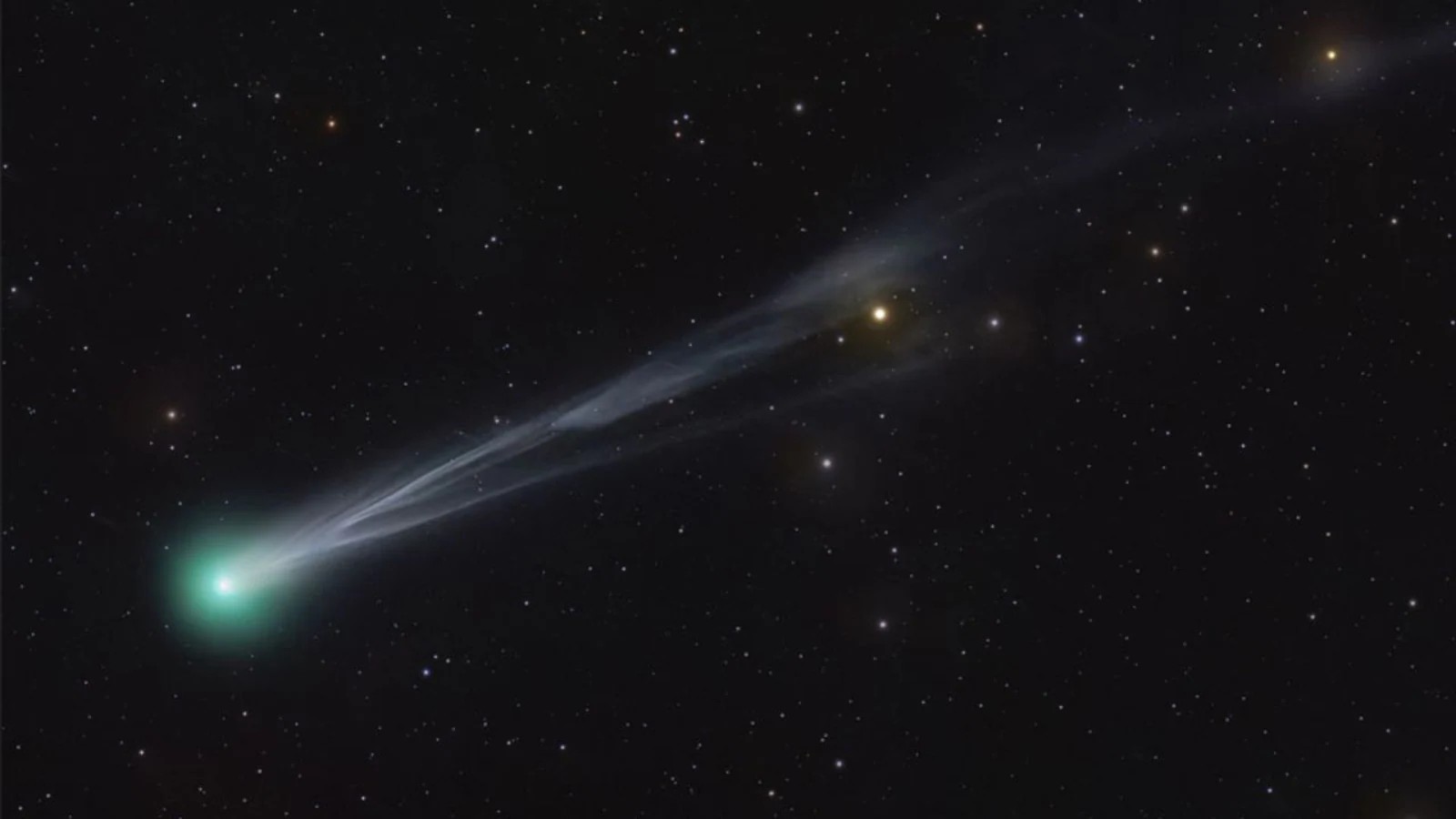






Astronomers have discovered comet 3I/ATLAS with a rare reverse tail pointing toward the Sun, challenging conventional comet science. The interstellar comet survived its closest approach to the Sun and continues to display anomalous activity, making it one of the most intriguing astronomical objects of 2025
Astronomers have captured stunning new images of comet 3I/ATLAS, revealing a rare and mysterious phenomenon: a reverse or anti-tail that points toward the Sun instead of away from it. This interstellar comet, discovered on July 1, 2025, by the ATLAS telescope in Chile, has continued to defy expectations with its unusual behavior and structure. The latest observations, including those from the Hubble Space Telescope and the Virtual Telescope Project, show that 3I/ATLAS not only has a traditional dust tail blown away from the Sun, but also a prominent anti-tail composed of larger dust grains that are pushed sunward by the comet’s own internal activity.
Key Highlights
-
3I/ATLAS is the third known interstellar object to visit our solar system and has survived its close approach to the Sun without fragmenting, a feat never before observed in comets
-
The comet’s anti-tail, seen most clearly in November and December 2025, is caused by larger dust particles that are not easily moved by solar radiation pressure, resulting in a tail that appears to point toward the Sun
-
Observations from Hubble, Gemini South, and other major observatories have revealed a structured coma and dual tails, with the anti-tail growing to tens of thousands of kilometers in length
-
The comet’s survival through perihelion and its anomalous mass loss rates have sparked intense scientific debate, with some researchers suggesting its crust may have been altered by cosmic rays over billions of years
-
3I/ATLAS made its closest approach to Earth on December 19, 2025, at a safe distance of about 270 million kilometers, and continues to be monitored as it heads out of the solar system
Sources: NASA Science , The Planetary Society, Space.com, ESA, Virtual Telescope Project