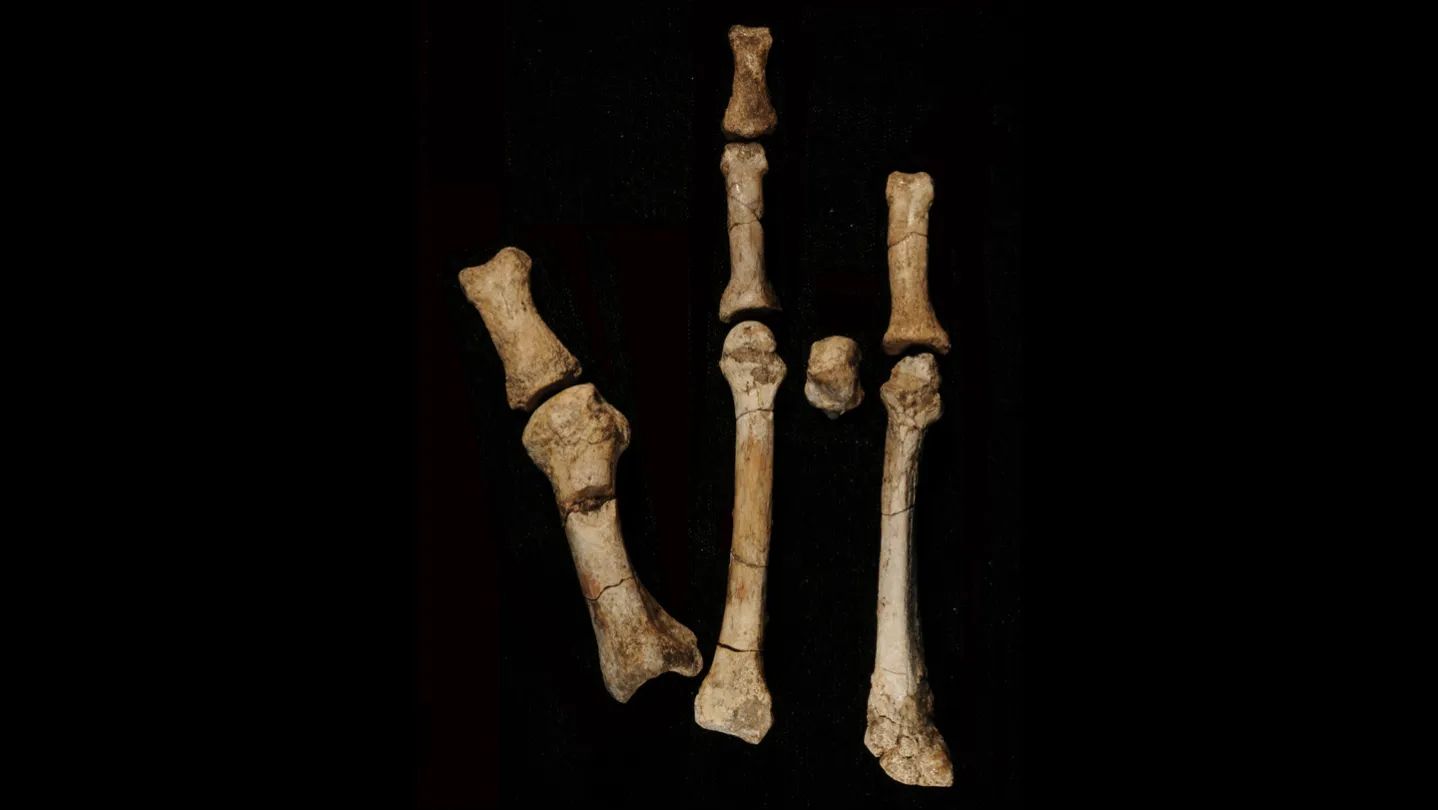






A 3.4‑million‑year‑old “Burtele foot” from Ethiopia—bearing an opposable big toe—suggests a distinct early human relative lived alongside Lucy’s species. Newly analyzed fossils indicate the foot likely belongs to Australopithecus deyiremeda, reshaping views of hominin diversity and locomotion, with mixed tree climbing and ground walking coexisting in the same landscape.
Scientists have reexamined the enigmatic “Burtele foot,” discovered in Ethiopia’s Afar Region, and concluded it belonged to a different hominin than Lucy (Australopithecus afarensis). The foot’s opposable hallux—excellent for grasping—signals a more arboreal lifestyle, supporting the presence of multiple contemporaneous hominin species experimenting with varied movement and diets around 3.4 million years ago.
Recent analyses link the fossil to Australopithecus deyiremeda, first named in 2015, strengthening evidence that East Africa hosted overlapping hominin populations with distinct adaptations. This diversity challenges linear evolutionary narratives and refines our understanding of locomotor evolution before the emergence of Homo.
Major takeaways
Distinct morphology: An opposable big toe indicates climbing adaptations unlike Lucy’s stiffer, ground‑oriented foot.
Species attribution: The Burtele assemblage is now tied to Australopithecus deyiremeda, a close but separate relative of afarensis.
Coexistence: Multiple hominin species shared landscapes and niches in the Afar region ~3.4 Ma, complicating simple ancestor‑descendant models.
Evolutionary implications: Mixed locomotion strategies suggest parallel experimentation in bipedalism and arboreality.
Notable updates
Reassessment momentum: New comparative studies and fossil finds have clarified the foot’s identity, moving beyond early uncertainties.
Broader context: The findings echo other evidence of hominin overlap, underscoring mosaic evolution across traits and habitats.
Conclusion: The “Burtele foot” nudges human origins toward a richer, branching story—where Lucy wasn’t alone, and evolution tested different ways to move, climb, and survive in ancient East Africa.
Sources: NBC News; Science NewsScience News; Phys.org; Archaeology News