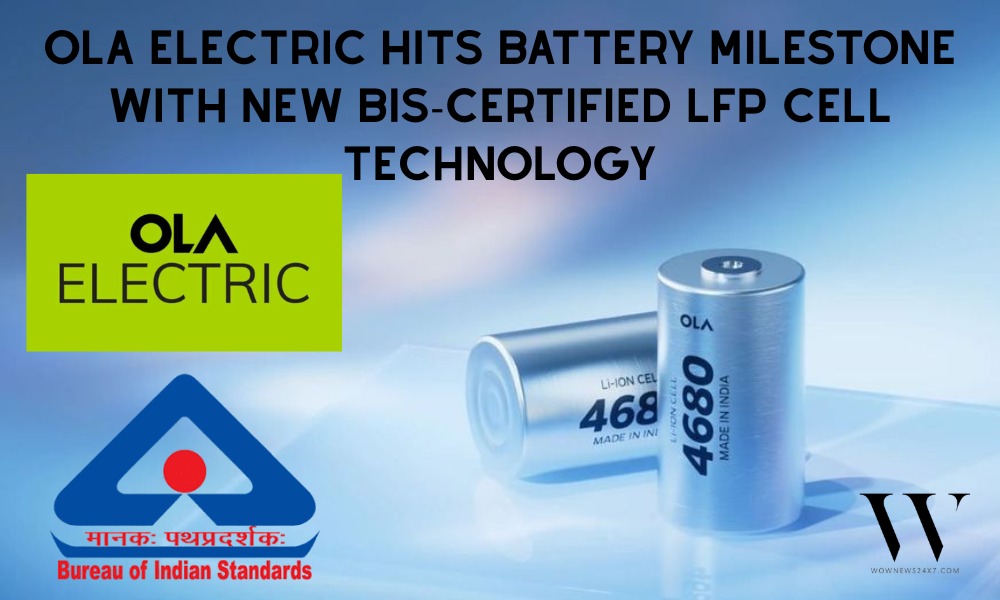
Ola Electric has become the first Indian company to receive Bureau of Indian Standards (BIS) certification for its indigenously developed 46100 LFP battery cells. Manufactured at Ola’s Gigafactory, this thermally stable, cost-effective cell technology is set to integrate into its electric vehicle lineup and energy storage systems starting next quarter.
Ola Cell Technologies (OCT), a wholly owned subsidiary of Ola Electric, has secured Bureau of Indian Standards (BIS) certification for its indigenously developed 46100 Lithium Iron Phosphate (LFP) cylindrical cell. The announcement, made on June 23, 2026, positions the company as the first in India to receive BIS certification for a cell in this specific format, reinforcing the nation's push toward self-reliance in the electric vehicle (EV) supply chain.
The certification, granted under IS 16046 (Part 2):2018 / IEC 62133-2:2017 standards, confirms that the battery technology has successfully passed stringent electrical, mechanical, and environmental safety evaluations. This achievement is a cornerstone of Ola’s "End ICE Age" vision, aimed at reducing dependency on imported battery components and driving down the cost of electric mobility across India.
Technological Leap: The 46100 LFP Platform
The 46100 LFP cell—measuring 46mm in diameter and 100mm in height—represents a strategic evolution from Ola’s existing NMC-based 4680 Bharat Cell. While the 4680 format remains a core part of its current performance lineup, the 46100 LFP platform is designed for mass-market affordability.
LFP chemistry is widely recognized for its superior thermal stability and longer cycle life compared to Nickel Manganese Cobalt (NMC) alternatives. According to Ola Electric, the move to LFP chemistry will significantly lower production costs, as it eliminates the need for expensive and supply-volatile materials like cobalt and nickel. By adopting this larger cylindrical format, the company achieves improved energy packaging efficiency, requiring fewer cells per battery pack, which simplifies assembly and reduces overall vehicle weight.
Scaling the Gigafactory
The BIS-certified cell is being manufactured at Ola’s Gigafactory, which is currently undergoing a capacity ramp-up. Initially operating at 2.5 GWh, the facility is scaling toward a targeted capacity of 6 GWh. This vertical integration—from material processing to cell manufacturing—is a key element in Ola’s strategy to qualify for the Government of India’s Production Linked Incentive (PLI) scheme for Advanced Chemistry Cells (ACC).
The company expects these indigenously produced cells to begin integrating into its vehicle lineup starting next quarter. Beyond the automotive sector, this technology is also slated to power Ola’s "Shakti" residential and commercial energy storage solutions, showcasing the versatility of the 46100 platform in India's broader energy transition.
Official Sources
Corporate Disclosure: Regulatory filing submitted to the National Stock Exchange (NSE) on June 23, 2026.
Standards Compliance: Certification confirmed under IS 16046 (Part 2):2018 and IEC 62133-2:2017, alongside UN 38.3 transport safety standards.
Company Statements: Official press releases from Ola Electric regarding the readiness and industrialization of its LFP cell technology.
Why It Matters
For the Indian EV market, the localization of 46100 LFP cells is a vital step toward price parity with internal combustion engine (ICE) vehicles. By lowering the cost of the most expensive component in an EV—the battery—Ola is removing one of the primary barriers to mass adoption. Furthermore, the ability to manufacture these cells domestically reduces exposure to global supply chain volatility and positions India as a competitive hub for advanced battery technology.
Key Facts at a Glance
Certification: First Indian company to receive BIS certification for a 46100 LFP cell.
Chemistry: Lithium Iron Phosphate (LFP), chosen for thermal safety and lifecycle longevity.
Format: 46100 cylindrical (46mm diameter, 100mm height).
Production: Manufactured at Ola’s Gigafactory, with capacity scaling toward 6 GWh.
Deployment: Integration into vehicles and energy storage systems begins in the next quarter.
Frequently Asked Questions
What is the significance of the 46100 format?
The 46100 format is physically larger than conventional cells, allowing for higher energy density per cell and a reduction in the total number of cells required for a battery pack, which decreases manufacturing complexity and cost.
How does LFP chemistry benefit the average EV owner?
LFP batteries offer better thermal stability (safer in India’s hot climate), longer life cycles (often exceeding 4,000 cycles), and a lower price point compared to NMC batteries, ultimately reducing the cost of ownership.
When will these batteries be available in vehicles?
Ola Electric has confirmed that integration of the 46100 LFP cells into its vehicle lineup is scheduled to begin in the next quarter.
Source: National Stock Exchange of India (NSE), Ola Electric Investor Relations.