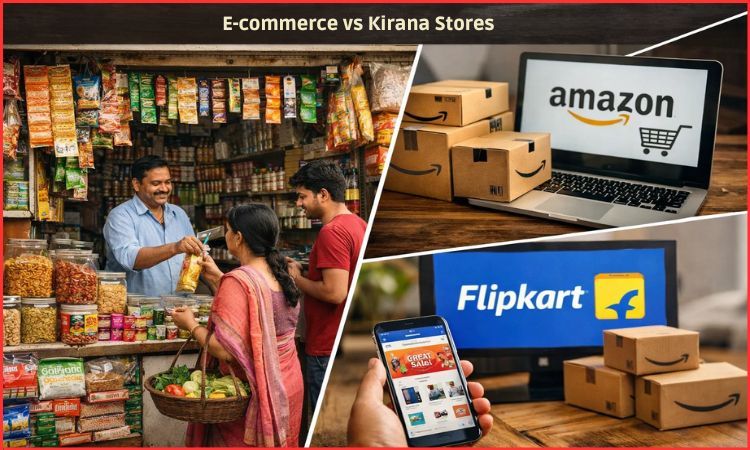
Quick commerce is rapidly transforming India’s retail landscape, with monthly GMV reaching ₹11,000 crore in early 2026. While traditional kirana stores face pressure from instant delivery convenience, they remain the dominant retail force. Survival for these local shops increasingly depends on digitizing their operations to compete in the modern era.
NEW DELHI — The landscape of Indian retail is undergoing a seismic shift as quick commerce (q-commerce) platforms rapidly expand their footprint, forcing neighborhood kirana stores—the backbone of India’s retail economy—into an unprecedented battle for survival. With platforms like Blinkit, Zepto, and Swiggy Instamart promising deliveries in under 15 minutes, consumer habits are gravitating toward instant gratification, challenging the centuries-old dominance of family-run local shops.
While kirana stores still account for approximately 91% of India’s total grocery market, the rapid growth of q-commerce, which hit a monthly Gross Merchandise Value (GMV) of roughly ₹11,000 crore in early 2026, is signaling a clear change in consumer preference. For the millions of small shop owners across India, the convenience-led model of q-commerce represents not just a competitor, but a fundamental disruption to their traditional business model.
The Collision of Two Retail Worlds
The tension between digital-first platforms and traditional outlets stems from a shifting demand landscape. According to recent industry data, q-commerce is carving out a niche in urban markets by catering to time-poor consumers who prioritize speed over the personalized, credit-based service historically offered by kiranas.
"The narrative that q-commerce will simply replace the kirana store is fundamentally flawed; rather, the market is fragmenting," explains a retail analyst. While kirana stores excel in the "mass-market" segment—relying on small, frequent ₹100–₹200 transactions—q-commerce platforms are aggressively expanding into higher-value impulse categories, including fashion, electronics, and beauty, which threaten the margins of traditional general retailers.
The Challenges Facing Traditional Retailers
Traditional shop owners are struggling to keep pace with the hyper-efficient logistics of "dark stores" and the deep-discounting strategies employed by major q-commerce players. The challenges are multifaceted:
Pricing Pressure: Platforms often utilize predatory pricing and flash sales to capture customer loyalty, a strategy small retailers with thin margins cannot replicate.
Inventory & Logistics: Lacking the real-time data analytics of digital platforms, kirana stores often struggle to manage stock efficiently, leading to either spoilage or frequent stock-outs.
Consumer Expectations: The "10-minute delivery" benchmark has reset consumer expectations, making the standard "walk-in" experience feel obsolete to an increasingly tech-savvy generation.
A Path to Hybrid Resilience
Despite these pressures, industry experts suggest that the kirana ecosystem is far from collapse. Many stores are choosing to pivot rather than perish by adopting digital payment systems like UPI, integrating online ordering facilities, and joining hyperlocal commerce networks.
By leveraging their unique strengths—such as deep-rooted community trust, local product curation, and the ability to offer flexible khata (credit) systems—traditional retailers are finding ways to coexist. "The largest untapped opportunity lies in enabling, not replacing, kiranas," note experts. Digital integration—providing inventory visibility and supply chain support to small retailers—is being framed as the next frontier for the Indian retail ecosystem.
Why It Matters
For consumers, the battle for the "grocery basket" means more convenience and competitive pricing. For the millions employed in the traditional retail sector, the rise of instant delivery is a high-stakes challenge that requires significant government and technological intervention to ensure the survival of small businesses. The outcome will ultimately redefine the social and economic fabric of Indian cities.
Key Facts at a Glance
Market Share: Kirana stores still control ~91% of India’s grocery market, with a projected 85% retention by 2030.
Q-Commerce Growth: Monthly GMV hit ~₹11,000 crore in early 2026, with order volumes nearly doubling year-over-year.
Consumer Shift: 70% of online grocery purchases now occur via quick-delivery apps in metro regions.
Strategic Adaptation: Traditional retailers are increasingly adopting UPI and inventory-digitization tools to remain competitive.
FAQ
Are kirana stores going to disappear?
Current data suggests that kiranas are not being replaced but are instead coexisting with q-commerce. They remain the dominant channel for the "mass market" (233M households) that prefers small, frequent, and credit-based shopping.
How are kiranas fighting back?
Many retailers are digitizing their operations through UPI payments, inventory management software, and joining omnichannel retail networks that allow them to compete on both convenience and service.
Why is q-commerce struggling with profitability?
The ultra-fast delivery model relies on dense urban infrastructure and faces high operational costs. Delivering low-value, small-sized baskets often makes it difficult for these platforms to maintain positive unit economics.
Source: Redseer, Financial Express Retail, International Journal of Innovative Science and Research Technology