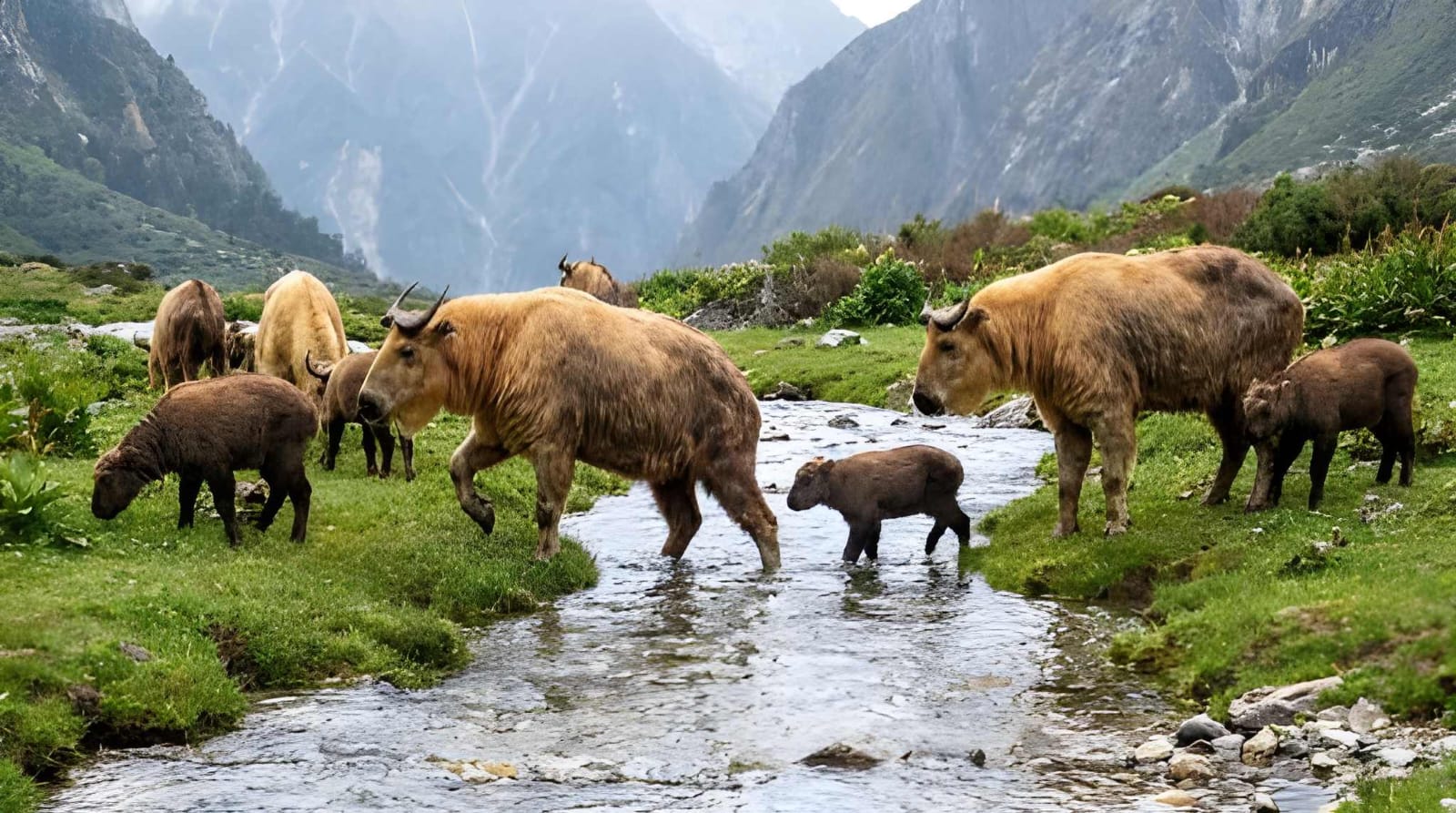
The Forest and Environment Department of Sikkim has captured the first-ever video footage of a Mishmi Takin herd in the Tingda Reserve Forest. The sighting of eight vulnerable "goat-antelopes" marks the most significant confirmed record in the state in over two decades, validating regional high-altitude habitat conservation efforts.
GANGTOK, India — In a historic development for Himalayan wildlife conservation, the first-ever video footage of a herd of the elusive Mishmi Takin has been recorded in the Tingda Reserve Forest of North Sikkim. Announced by the state’s Forest and Environment Department on June 17, 2026, the breakthrough documentation represents the most significant confirmed sighting of the vulnerable species in the state in more than two decades. The field discovery provides vital, data-driven evidence of ecological health along the high-altitude transboundary corridors of the Eastern Himalayas.
Breakthrough Sighting During Routine Patrol
The documentation occurred during a routine field patrol conducted by monitoring staff from the Forest and Environment Department in the rugged Bakuchen area of the Tingda Reserve Forest. Field officials successfully recorded a healthy herd consisting of eight individual Mishmi Takins (Budorcas taxicolor) navigating the high-altitude terrain.
Wildlife biologists emphasize that while solitary individuals have occasionally been rumored in the region, the newly captured video footage of an active social herd confirms localized population stability. State environmental authorities noted that this specific group represents the single largest cluster of Mishmi Takins ever formally recorded within this particular sector of Sikkim.
A Critical High-Altitude Indicator Species
Often structurally classified by biologists as a "goat-antelope," the Mishmi Takin is a massive, high-altitude ungulate adapted to some of the most unforgiving, rugged mountain landscapes across Asia. The species primarily populates steep, isolated environments ranging from heavily forested alpine valleys to rocky, high-elevation meadows situated up to 4,500 meters above sea level.
The mammal possesses distinct evolutionary adaptations to survive extreme sub-zero weather, including strong, muscular limbs, a thick insulating coat, and a specialized skin secretion that creates a waterproof, oily shield against rain, snow, and dense Himalayan fog. Because of their specialized biological needs, their presence serves as a primary indicator of the overall ecological balance and health of fragile alpine ecosystems.
Conservation Importance and Regional Impact
The state of Sikkim marks the absolute westernmost boundary of the Mishmi Takin’s known global distribution range, which normally centers further east within Arunachal Pradesh, northern Myanmar, southern Tibet, and southwestern China. Consequently, verified documentation at this geographical edge is highly valuable for wildlife researchers and regional policymakers tracking species migration patterns.
Regional wildlife experts stated that the documented presence of a multi-individual herd confirms the success of transboundary ecological corridors. Preserving unbroken habitat connectivity across the Eastern Himalayas is vital to maintaining genetic diversity and preventing localized population bottlenecks among wide-ranging high-altitude species.
State officials have attributed this rare visual documentation to the long-term success of integrated habitat management, strict anti-poaching protocols, and sustained landscape protection strategies implemented over the past two decades.
Official Sources Section
The formal details, location metrics, and species data regarding this wildlife milestone were distributed via official press statements from the Forest and Environment Department of the Government of Sikkim. Comprehensive baseline data regarding the global conservation status and range maps of Budorcas taxicolor are maintained under the statutory frameworks of the International Union for Conservation of Nature (IUCN) Red List.
Quote Section
"The footage documents a herd of eight individuals, representing the largest group of Takins ever recorded from this locality," the Forest and Environment Department of Sikkim specified in its official regulatory statement. "Historical records of the species in Sikkim are extremely limited. The present documentation therefore represents one of the most significant confirmed records of the Mishmi Takin in Sikkim in over two decades."
Why It Matters
For global environmental researchers, environmental policymakers, and regional conservationists, this visual evidence validates the protective integrity of Sikkim’s protected forests. The tracking data compiled from the footage will help shape future land-use maps, expand environmental protections within high-altitude development plans, and optimize specialized climate adaptation models designed to shield vulnerable mountain mammals from rising global temperatures.
Key Facts at a Glance
Herd Composition: A documented social group of eight individual Mishmi Takins, the largest ever recorded in the locality.
Exact Sighting Location: The Bakuchen pocket inside the protected boundaries of the Tingda Reserve Forest, North Sikkim.
Historical Gap: Marks the first confirmed multi-decade video recording of a healthy herd within the state.
Conservation Status: Listed globally as 'Vulnerable' on the formal IUCN Red List of Threatened Species.
Altitude Range: The species is native to steep, rugged mountainous terrain stretching up to 4,500 meters high.
FAQ Section
What is a Mishmi Takin?
The Mishmi Takin (Budorcas taxicolor) is a large, stout-bodied high-altitude mammal frequently described as a "goat-antelope." It belongs to the family Bovidae and is specially adapted to live in harsh, steep mountain environments.
Why is this specific sighting in Sikkim considered historic?
Sikkim represents the absolute westernmost edge of the species' global habitat distribution, where historical records are extremely limited. This footage captures a herd of eight individuals, marking the first confirmed video documentation of a group in the state in more than 20 years.
What is the current global conservation status of the Mishmi Takin?
The species is officially classified as "Vulnerable" on the International Union for Conservation of Nature (IUCN) Red List due to habitat fragmentation and changing climate patterns in the Eastern Himalayas.
Source: Government of Sikkim Forest and Environment Department, International Union for Conservation of Nature (IUCN), Press Trust of India (PTI).