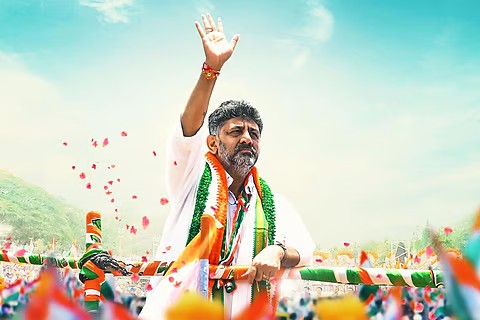
The ruling Congress party secured five out of seven seats in the Karnataka Legislative Council elections, dealing a blow to the BJP-JD(S) alliance. Backed by strategic floor management from Chief Minister DK Shivakumar, the victory was bolstered by opposition cross-voting, expanding the government's legislative footprint in the state's Upper House.
BENGALURU — Under the strategic leadership of Chief Minister DK Shivakumar, the ruling Indian National Congress secured a significant political victory in the Karnataka Legislative Council biennial elections held on June 18, 2026. Securing five out of the seven vacant seats up for election, the Congress successfully leveraged cross-voting and strategic floor management to outmaneuver the Bharatiya Janata Party (BJP) and Janata Dal (Secular) alliance. This major electoral test consolidated Chief Minister Shivakumar's authority in the state legislature just weeks after his ascension to the Chief Minister's office on June 3, 2026.
Congress Expands Upper House Footprint
The high-stakes biennial election was held to fill seven vacancies in the 75-member Upper House created by retiring members whose terms conclude on June 30, 2026. Entering the poll, the ruling Congress party held 37 seats and required a disciplined preferential voting process to maximize its candidates' outcomes. With each candidate needing a minimum of 28 first-preference votes from members of the Legislative Assembly (MLAs) to win, the party targeted all five seats it contested.
Official tallies from the Karnataka Legislative Assembly Secretariat confirmed that Congress successfully cleared its slate, winning five seats, while the BJP secured the remaining two seats. The outcome marks a net gain for the ruling party, which previously held four of the retiring seats, and pushes its total presence closer to an absolute majority in the Legislative Council.
Alliance Discontent Fuels Cross-Voting
The political headline of the election centered on the intense battle for the seventh contested seat, where Congress nominee Vinay Karthik faced off against the JD(S) alliance candidate, Govindaraj. Going into the secret ballot, the JD(S) had relied on receiving surplus votes transferred from its coalition partner, the BJP, to secure victory.
However, discontent within the opposition ranks led to critical shifts. Speculation regarding cross-voting materialized when several disgruntled opposition legislators and independent members backed the Congress slate. All India Congress Committee (AICC) leader Randeep Surjewala announced that the Congress candidates ultimately commanded the support of 151 legislators in the 222-member lower house, revealing a substantial breach in opposition unity.
Strategic Implications for State Governance
The successful election cycle represents a significant legislative boost for the newly minted Shivakumar administration. Expanding the party's numbers in the Legislative Council reduces the opposition's capacity to stall or reject key executive bills and financial policy reforms passed by the lower house.
For the citizens and business sectors of Karnataka, a more uniform legislative structure indicates a period of sustained policy stability and smoother governance transitions in infrastructure development, local commerce, and public welfare programs. Conversely, for the BJP-JD(S) alliance, the loss highlights the immediate need to address coordination gaps and internal fractures before upcoming municipal and local body polls.
Official Sources Section
The final election outcomes and complete voter turnout data were formally distributed via the Karnataka Legislative Assembly Secretariat, under the authority of Returning Officer MK Vishalakshi. Further confirmation of legislative benchmarks and candidate declarations were synchronized through the official channels of the Election Commission of India.
Quote Section
"Thank all legislators, especially those from other parties, for trusting and voting for Congress," stated Karnataka Chief Minister DK Shivakumar during an evening press briefing following the declaration of the poll results.
Why It Matters
The outcome changes the balance of legislative influence within Karnataka's bicameral system. By weakening the combined opposition's absolute leverage in the Upper House, the ruling government gains substantial freedom to execute its legislative agenda without structural gridlock, altering the political landscape for corporate investments, public spending, and long-term regional policies.
Key Facts at a Glance
Final Result: Congress wins 5 seats; BJP wins 2 seats; JD(S) fails to secure its contested seat.
Turnout: 100 percent participation recorded, with all 222 eligible MLAs casting their ballots at Vidhana Soudha.
Threshold: A strict mathematical minimum of 28 preferential votes was required per candidate to achieve victory.
Context: The election was triggered by the scheduled retirement of seven sitting MLCs on June 30, 2026.
FAQ Section
How many seats did the Congress party win in the 2026 Council elections?
The ruling Congress party successfully won five out of the seven seats up for election in the Legislative Council.
Who was the primary driving force behind the Congress victory?
Karnataka Chief Minister DK Shivakumar, who took office on June 3, 2026, oversaw the strategic floor management and mock polling sessions that secured the party’s sweep.
What is the legislative significance of this election for Karnataka?
By expanding its seats in the 75-member Upper House, the Congress party moves closer to an absolute legislative majority, smoothing the pathway for state policy and budget approvals.
Source: Karnataka Legislative Assembly Secretariat, Election Commission of India.