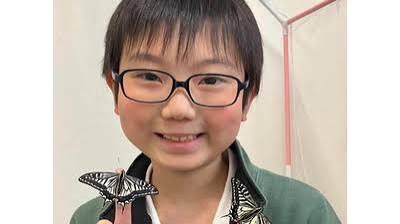
Ten-year-old Japanese student Jo Nagai has drawn international attention after his study on Asian swallowtail butterflies suggested that memories formed during the caterpillar stage can survive metamorphosis. The project, conducted in collaboration with a Georgetown University entomologist, has sparked renewed scientific interest in insect cognition.
KOBE — A 10-year-old student from Japan has captured worldwide attention after his home-based study on Asian swallowtail butterflies challenged long-held scientific assumptions regarding insect memory and complete metamorphosis. Jo Nagai, an elementary school student in Kobe and a scholar supported by the Son Masayoshi Philanthropic Foundation, spent years documenting insect behavior before executing a structured research project that caught the notice of international entomologists.
The investigation began when Nagai noticed that butterflies he raised from caterpillars routinely flew back to his hand upon release, unlike wild butterflies. Seeking to understand if memories formed during the caterpillar stage can survive the pupal restructuring process, Nagai initiated a cross-continental collaboration with Dr. Martha Weiss, an entomologist at Georgetown University.
Experimental Design and Transgenerational Findings
To test whether learned behavior persists through metamorphosis, Nagai exposed swallowtail caterpillars to the scent of lavender while simultaneously applying a mild physical stimulus using a muscle-therapy device. Once the subjects matured into adult butterflies, they were tested in a Y-shaped tube maze.
According to documentation compiled in his 33-page research report:
Aversion Retention: Approximately 70% of the adult butterflies trained as caterpillars avoided the lavender scent, indicating retained memory.
Generational Tracking: Subsequent breeding trials indicated that offspring and grandchildren of the conditioned insects also exhibited an aversion to lavender, pointing toward potential transgenerational epigenetic inheritance.
Academic Collaboration: Initiated by a detailed four-page letter sent as a second-grader to Dr. Weiss, the project bridges amateur observation with professional entomological frameworks.
Official Sources Section
Georgetown University Department of Biology Disclosures: Research notes and academic commentary regarding the collaboration with student researcher Jo Nagai.
Son Masayoshi Philanthropic Foundation Official Portal: Scholar profile listings, youth talent development records, and program disclosures.
Quote Section
According to academic researchers and entomology sources familiar with the study:
"While preliminary findings from independent student-led projects require rigorous replication by formal laboratories, the meticulous behavioral documentation provides an intriguing basis for further exploration into insect neurobiology and memory retention."
Why It Matters
For the broader scientific community, the study reinvigorates debate over how insect nervous systems process and retain information during the radical breakdown and reorganization of tissue that occurs inside a chrysalis. While professional validation and peer-reviewed replication remain pending, the endeavor highlights the value of citizen science and early-age empirical inquiry.
Key Facts at a Glance
Researcher: Jo Nagai, 10-year-old fifth-grade student at Ibuki East Elementary School in Kobe.
Subject: Asian swallowtail butterfly memory retention across metamorphosis.
Core Observation: ~70% of trained subjects avoided conditioned aversive stimuli as adults.
Collaborator: Dr. Martha Weiss, Georgetown University entomologist.
FAQ Section
What did Jo Nagai's butterfly experiment discover?
His observations suggested that butterflies can retain behavioral memories formed during their caterpillar stage, challenging the traditional view that metamorphosis completely erases prior insect memory.
Are the findings scientifically verified?
While the research has garnered global attention and praise from scientists, experts emphasize that independent peer-reviewed replication is still required to confirm the results.
How did the collaboration with Georgetown University begin?
As a young student, Nagai wrote a detailed letter to Georgetown entomologist Dr. Martha Weiss, who had studied similar memory traits in moths, leading to a coordinated mentoring relationship.
What are Jo Nagai's future career plans?
Despite his success in entomological research, Nagai has stated that his long-term ambition is to become a veterinarian.
Source: Georgetown University, Son Masayoshi Foundation, Times of India