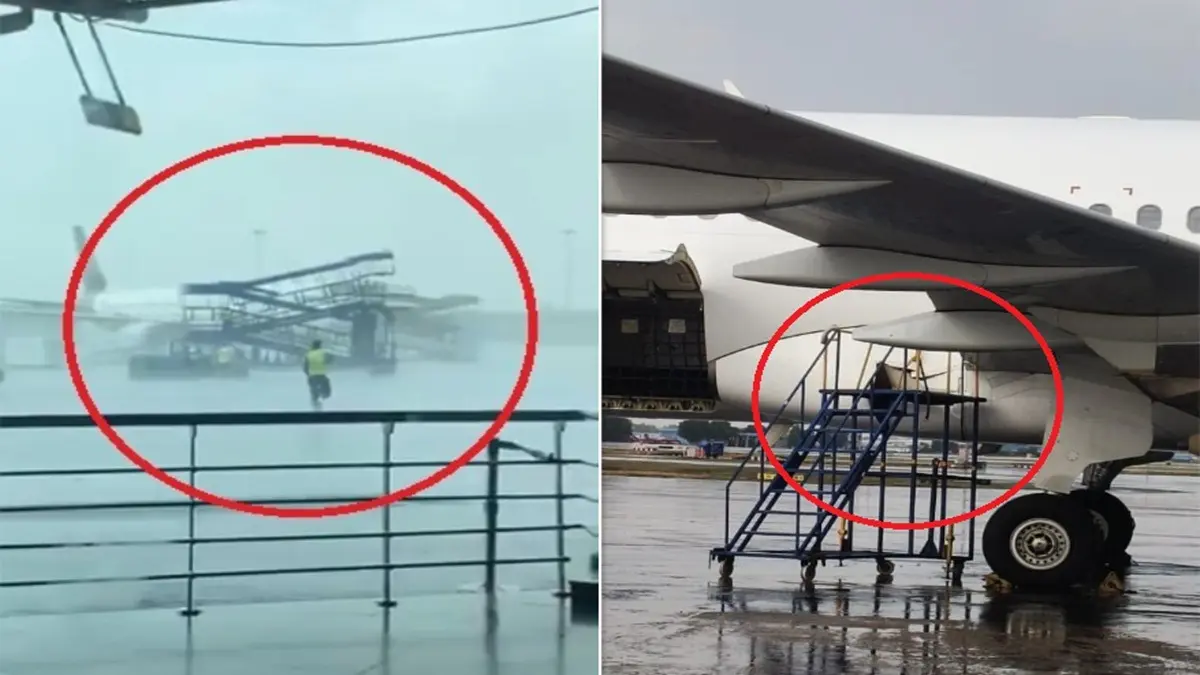
Three Air India narrowbody aircraft parked at Terminal 2 of Delhi’s Indira Gandhi International Airport were taken out of service on Sunday, June 7, 2026. Sudden heavy rain and gusty winds displaced heavy ground support equipment, hurling a stairwell and a trestle directly into the stationary planes.
NEW DELHI — A sudden spell of severe inclement weather caused notable operational disruptions at Delhi’s Indira Gandhi International Airport (IGIA) on Sunday, June 7, 2026. Sudden strong winds and heavy rain physically displaced heavy ground support equipment, blowing them across the tarmac into three stationary aircraft. The consecutive collisions occurred at approximately 4:40 PM in the primary parking bays located near Terminal 2. The airport operator confirmed that all three affected aircraft sustained surface structural damage and were immediately taken out of operation for safety inspections, prompting localized flight delays and aircraft reassignment.
Unwarned Squall Displaces Ground Support Equipment
The weather incident developed rapidly, catching tarmac operators and airlines without advanced tactical alerts. According to preliminary incident filings, a sharp local localized squall line brought severe wind gusts and blinding rain across the airfield.
The wind velocity proved strong enough to break the stationary friction holds of multiple heavy items of ground support equipment parked on the apron. These included a heavy maintenance trestle and a mobile step-ladder stairwell asset.
Airport authorities noted that because the localized storm cell materialized so abruptly, air traffic controllers had not issued an active severe weather warning to either the airport operator or the stationed airlines ahead of the sudden deterioration in airfield visibility and wind spikes.
Impact on Fleet Operations and Flight Schedules
The three impacted aircraft have been identified as Airbus A320 narrowbody passenger jets. At the time of the storm, all three planes were fully vacant of passengers and cabin crew, and no ground handling personnel were standing within the immediate strike zone, preventing any physical injuries.
However, the physical toll on the fleet varied:
One Air India aircraft suffered substantial structural damage after being hit directly by a rolling metal boarding stairwell, severely crushing sections of its fuselage exterior.
The remaining two narrowbody aircraft incurred minor skin dents and impact abrasions from secondary equipment tethers.
Aviation mechanics instantly grounded all three units to conduct mandatory safety evaluations. While two of the planes are projected to return to standard flight rotations within 48 hours, the heavily damaged third jet will remain out of service for an extended period to undergo structural reinforcement and regulatory recertification.
Official Sources Section
The operational data and sequence of events have been validated through statements from terminal managers and carrier representatives:
Delhi International Airport Limited (DIAL): Confirmed the specific timeline of the ground equipment breakaway and noted the lack of a preceding Air Traffic Control weather warning.
Air India Engineering & Operations Desk: Acknowledged the withdrawal of the three narrowbody units from active commercial service, indicating that alternative aircraft are being routed to preserve scheduled network flights.
Quote Section
"According to airport officials, the ground equipment moved violently from its staging position due to the sheer velocity of the sudden strong wind and rain, directly striking the fuselages of the aircraft parked at Terminal 2."
Why It Matters
The structural damage to multiple commercial aircraft at a primary hub highlights key issues within civil aviation operations:
For Air Travelers: The sudden withdrawal of three high-capacity narrowbody aircraft creates immediate scheduling bottlenecks, causing short-term flight delays, cancellations, and gate reassignments during peak transit hours.
For Airline Investors: Grounding primary short-haul assets cuts into daily seat-kilometer revenue while creating unbudgeted repair liabilities and complex insurance reconciliation processes.
For Ground Handling Agencies: The incident underscores the critical necessity of stringent all-weather anchoring protocols for heavy equipment, even in the absence of active meteorological warnings.
Key Facts at a Glance
Fleet Impact: Three Air India Airbus A320 narrowbody aircraft were struck and taken out of active operations due to sudden airfield collisions.
Weather Trigger: The incident occurred amid high-velocity winds and blinding rainfall at Delhi Airport's Terminal 2 apron.
Equipment Failure: The damage was inflicted by mobile ground support equipment, including a boarding step-ladder and a heavy maintenance trestle.
Zero Warning: Air Traffic Control had not broadcast an advance severe weather alert to terminal operations before the storm hit.
No Casualties: Because the aircraft and parking bays were completely clear of passengers and workers, no injuries were reported.
FAQ Section
Exactly how were the airplanes damaged if they were just parked?
The airplanes were not damaged by the rain itself, but by unanchored ground support equipment. The intense wind gusts pushed heavy rolling metal step-ladders and maintenance trestles across the concrete tarmac, slamming them directly into the stationary planes.
Will this ground equipment incident cause widespread flight cancellations?
While the sudden removal of three narrowbody aircraft strains local capacity, major airlines traditionally utilize standby aircraft to cover emergency maintenance needs. Passengers may experience minor delays or gate changes, but widespread cancellations are unlikely.
What safety protocols are used to prevent ground equipment from rolling?
Standard operating procedures dictate that all mobile ground equipment must have active mechanical parking brakes engaged or wheels safely chocked. However, extreme wind speeds can sometimes overcome basic wheel chocks if the equipment presents a high surface area to wind profiles.
Source: Official operational incident logs compiled by Delhi International Airport Limited, emergency maintenance schedules tracked by Air India, and aviation safety updates syndicated via the Press Trust of India.