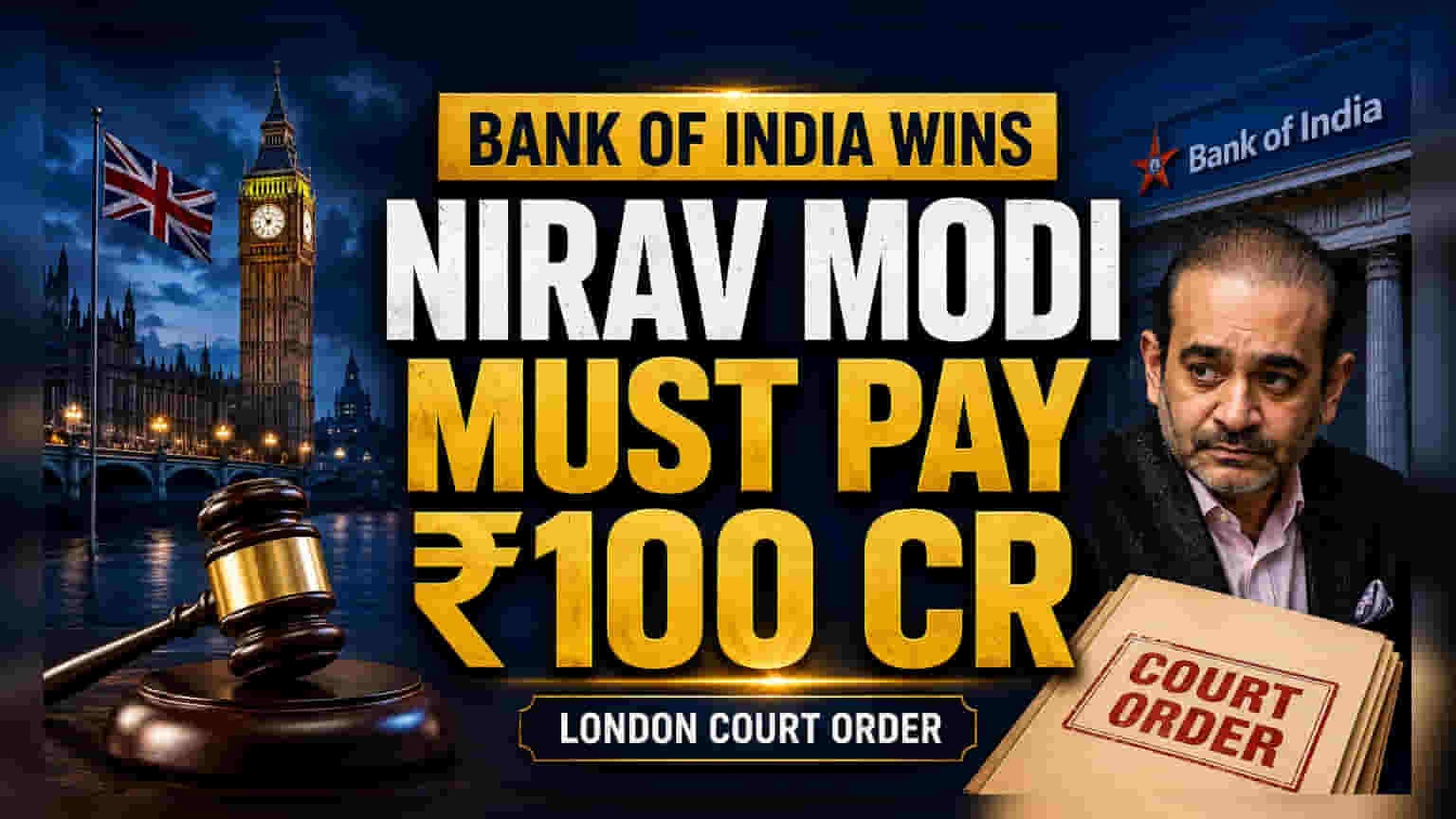
The London High Court has ordered fugitive diamantaire Nirav Modi to pay over $10.7 million (₹100 crore) to the Bank of India. Rejecting all defense arguments, the court upheld his personal guarantee on a 2012 Dubai corporate loan, marking a vital recovery win for India's public banking sector.
LONDON — In a major financial breakthrough for India's public sector banking system, a commercial branch of the High Court of Justice in London has ruled that fugitive diamond merchant Nirav Modi must return millions in defaulted corporate credit. The definitive UK court orders Nirav Modi to pay ₹100 crore to Bank of India after validating a long-contested personal guarantee agreement tied to his former jewelry empire.
The judgment, issued on Tuesday, June 23, 2026, by Judge Simon Tinkler at the London Circuit Commercial Court, rejects a series of technical defenses put forward by Modi’s legal representation. This legal decision is globally significant today as it provides Indian state banks with a clear, enforceable precedent to seize overseas assets belonging to economic fugitives who have sought sanctuary from the Indian judicial system.
The Roots of the Personal Guarantee Dispute
The international litigation dates back to July 2012, when the Bank of India extended a commercial loan facility to Firestar Diamond FZE, a Dubai-based subsidiary controlled by Modi's business network. To secure the funding lines, Modi executed a binding personal guarantee on August 3, 2013. The credit facility functioned smoothly until early 2018, when Indian federal investigators exposed a separate, massive systemic fraud totaling over ₹13,000 crore at Punjab National Bank (PNB).
Following the exposure of the PNB anomalies, the Bank of India moved swiftly to safeguard its capital by terminating the Firestar loan and calling in its security. Formal demands sent to the company's offices and Modi's personal residences in March and April 2018 went entirely unanswered, sparking a multi-year cross-border legal battle.
Defense Arguments Overruled by Commercial Court
During the full trial in London, where Modi appeared via legal counsel from his current residence at His Majesty's Prison (HMP) Thameside, his legal defense team sought to have the debt collection dismissed. The defense argued that the structural guarantees were legally defective, that formal acceleration notices were never properly served, and that external media reports regarding Indian banking fraud were insufficient grounds to terminate the Dubai credit lines.
Judge Tinkler completely dismissed these claims, ruling the original agreements fully enforceable. The court noted that internal emails sent by Modi himself in February 2018 admitted that media scrutiny and Indian asset seizures had caused his business network to effectively cease operating as a going concern. Consequently, the ruling confirms that the value of his backing was substantially impaired, justifying the lender's protective intervention.
Impact on Investors and Public Taxpayers
The judicial outcome directly impacts Indian taxpayers and institutional investors by demonstrating that state lenders can recover public funds from overseas jurisdictions. Because the UK court orders Nirav Modi to pay ₹100 crore to Bank of India, the state-run financial institution can now initiate asset tracing and liquidation orders against any global property, luxury assets, or liquid capital accounts held under Modi’s name within British territories.
This ruling also adds immense pressure on the fugitive's broader legal battles. Modi has been held in UK custody since March 2019 under an international extradition warrant filed by the Central Bureau of Investigation (CBI) and the Enforcement Directorate (ED) of India.
Official Sources Section
The final verdict is supported by documentation from international judicial platforms and sovereign institutions:
High Court of Justice (King's Bench Division): Delivered the final commercial order under the Circuit Commercial Court registry.
Bank of India (BOI): Initiated the global summary judgment application to recover the principal sum of $4.1 million plus accrued interest.
Ministry of External Affairs (MEA), India: Continues to monitor the parallel diplomatic and legal processes regarding the fugitive's pending repatriation.
Executive Quotes
"Mr Modi is liable under the personal guarantee to the bank for the principal amount due of $4.1 million (approximately Rs 38.9 crore). The interest calculated on the basis set out by the bank is to be added. Mr Modi has not provided any defence to explain why the bank was not entitled to that sum." Simon Tinkler, High Court Judge, London Circuit Commercial Court
"According to officials representing the state-run lender, the UK court orders Nirav Modi to pay ₹100 crore to Bank of India, which represents a critical financial validation. It proves that moving funds across international borders does not shield defaulting borrowers from final accountability." Bank of India Legal Secretariat Briefing
Why It Matters
For global financial institutions, the fact that a UK court orders Nirav Modi to pay ₹100 crore to Bank of India establishes a potent precedent for public sector asset recovery. It strongly discourages high-profile borrowers from utilizing sovereign borders to insulate themselves from domestic financial liabilities. The decision also reinforces the validity of corporate personal guarantees in international trade hubs like Dubai and London.
Key Facts at a Glance
Judicial Order: The London Commercial Court mandates the immediate repayment of over $10.7 million (exceeding ₹100 crore) encompassing original loan principals and accumulated interest.
Underlying Asset: The disputed funds originate from a 2012 corporate credit line extended to Firestar Diamond FZE in Dubai.
Defense Rejected: The judge dismissed assertions that the debt demands were time-barred or unreceived, confirming delivery to Modi's prison facility.
Custodial Status: Nirav Modi remains incarcerated at London's HMP Thameside while exhausting his remaining appeals against deportation to India.
FAQ Section
Q: What is the exact amount the UK court orders Nirav Modi to pay Bank of India?
A: The London High Court ordered the repayment of a principal sum of $4.1 million (around ₹38.9 crore), plus contractual interest, bringing the total financial obligation to over $10.7 million, which is equivalent to more than ₹100 crore.
Q: How does this ruling affect his separate criminal trial in India?
A: This is a civil debt recovery judgment. It does not directly alter the criminal fraud and money laundering cases filed by the CBI, but it strips away overseas corporate assets to reimburse public sector banks.
Q: Can Nirav Modi appeal this debt recovery order?
A: While procedural options exist, the summary nature of Judge Tinkler’s ruling indicates that Modi failed to present a viable, legally sustainable defense during the trial, significantly narrowing his grounds for a successful appeal.
Sources: