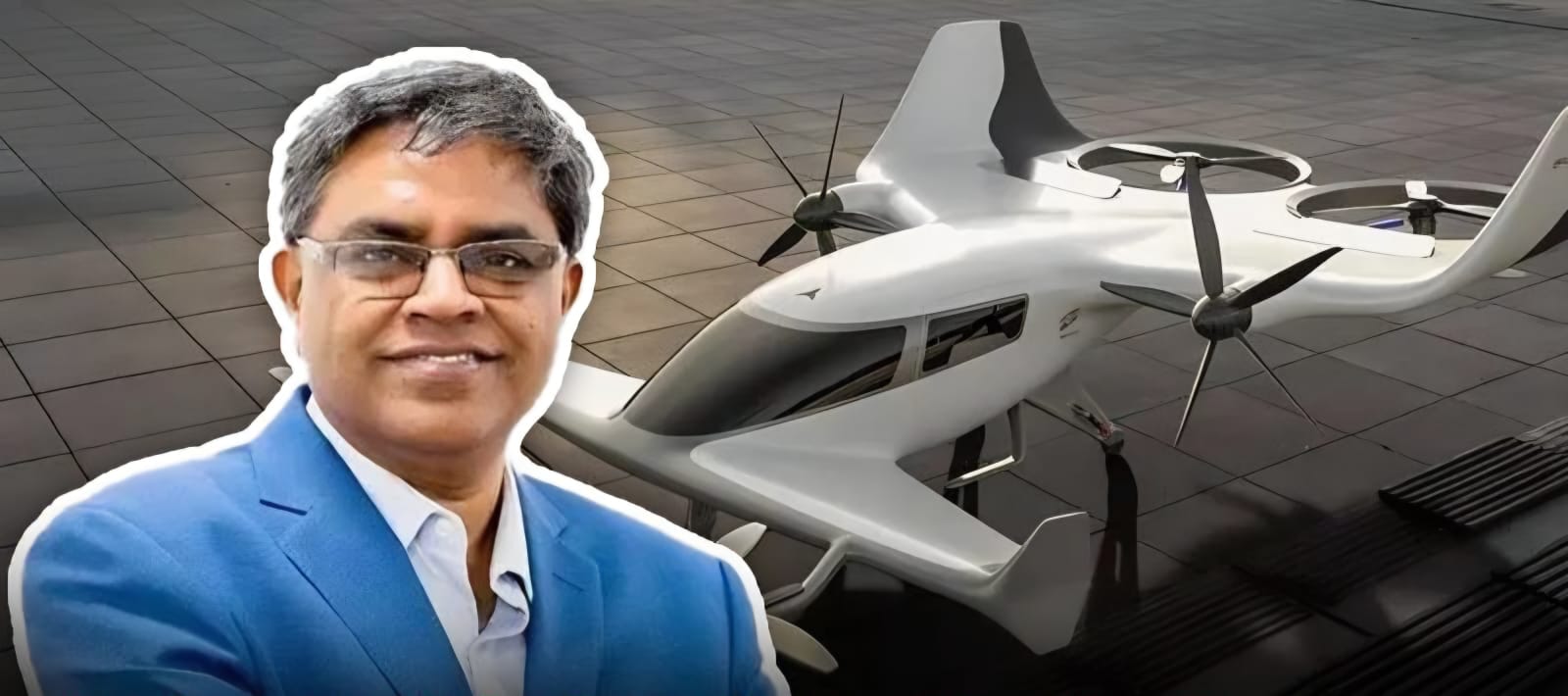
The ePlane Company has successfully completed the full-scale assembly of its e200X eVTOL prototype, designated PT-01. Developed with a capital-efficient budget of $21 million, the compact, vertically integrated electric airframe is designed for passenger, cargo, and medical transit, and is now advancing into structural ground testing and flight certification.
CHENNAI, India — The ePlane Company, an aviation startup incubated at the Indian Institute of Technology (IIT) Madras, officially announced on June 24, 2026, the structural completion and full-scale assembly of its electric vertical takeoff and landing (eVTOL) aircraft, the e200X. The completed prototype, designated as PT-01, integrates all proprietary core subsystems into a single physical airframe. This milestone shifts the aerospace program from software simulation into rigorous structural testing, paving the way for manned flight trials and formal regulatory evaluation.
Technical Validation and Vertical Integration
The completion of the full-scale airframe serves as a critical validation phase for the e200X program, confirming that the manufacturing tooling, internal supply chains, and component tolerances align with engineering specifications. Unlike many global advanced air mobility (AAM) developers that source components from an international network, the Chennai-based developer has pursued a vertically integrated production strategy.
According to company engineering logs, the major sub-assemblies of the PT-01 prototype—including the multi-rotor carbon-fiber propellers, primary airframe structure, high-density battery pack, and specialized landing gear—were designed and manufactured entirely in-house at the company's dedicated production facility in Tamil Nadu. This localized manufacturing strategy gives the engineering team direct oversight over structural performance parameters and significantly accelerates iteration intervals during physical validation.
Market Positioning and Capital Efficiency
The global eVTOL sector was valued at approximately $1.3 billion in 2023 and is projected by industrial analysts to scale between $20 billion and $30 billion by 2030. Within this expanding ecosystem, the e200X has been specifically engineered to operate within dense, pre-existing municipal infrastructures without necessitating the development of massive, specialized vertiports.
The aircraft utilizes a highly compact 8x10 meter footprint, optimized specifically to navigate tightly congested urban environments. Financially, the program has achieved its full-scale assembly phase on an estimated budget of $21 million raised to date. Corporate filings indicate this is a fraction of the capital expended by Western or East Asian competitors progressing through similar aerospace milestones, underscoring a highly capital-efficient development approach.
Impact on Urban Mobility and Civil Safety
The deployment of the e200X targets critical challenges in regional logistics and emergency healthcare. Road safety statistics highlight a severe vulnerability in ground transit, with India alone recording 172,890 road-accident fatalities in 2023 alongside a systemic shortage of rapid emergency medical transport.
By taking medical logistics and patient transfers into the air, the multi-role airframe is projected to bypass gridlock and reduce point-to-point travel times by up to seven times compared to standard road transit. Beyond medical services, the compact multi-copter design will serve cargo distributors handling time-sensitive freight and commercial commuters seeking short-range air taxi routes.
Official Sources Section
Regulatory filings confirm that the startup is pursuing a Type Certification with India’s Directorate General of Civil Aviation (DGCA). The DGCA represents the first civil aviation authority in the region to formally integrate an indigenous eVTOL design directly into its national airworthiness certification framework. Following the acquisition of domestic type approval, the manufacturer plans to submit validation applications to international aviation authorities to facilitate export sales in Southeast Asia and the Middle East.
Quote Section
"We set out to build an electric aircraft to a world-class benchmark, engineered and manufactured in depth in India for the world," stated Prof. Satya Chakravarthy, Founder and Chief Technology Officer of The ePlane Company. "We deliberately designed the e200X to be compact, because an aircraft that asks a city to rebuild itself around it will not solve the problem it was built to solve. The same airframe can move people as an air taxi, carry goods as a cargo aircraft, and save lives as an air ambulance, and it can do all three using the infrastructure cities already have."
Why It Matters
The transition of the e200X to a physical prototype represents a tangible shift toward operational zero-emission urban aviation. For city planners and logistics networks, it offers a functional alternative to high-emission ground transport without requiring multi-million-dollar investments in new physical roadways. For the broader aerospace market, it establishes an alternative model showing that competitive, multi-role electric aircraft can be successfully designed, manufactured, and prepared for flight validation under highly constrained capital budgets.
Key Facts at a Glance
Prototype Designation: The PT-01 prototype represents the successful integration of all in-house subsystems into a single full-scale structural airframe.
Capital Efficiency: The milestone was reached utilizing approximately $21 million in total funding, significantly lower than the average global expenditure for full-scale eVTOL assembly.
Versatile Framework: The e200X airframe supports a unified, three-market configurations matrix: air ambulance, urban cargo, and passenger taxi.
In-House Engineering: Critical assemblies, including the composite propellers, specialized landing gear, and high-capacity battery modules, were produced entirely via vertical integration.
Regulatory Track: The program is actively progressing through the Type Certification pipeline with the DGCA, paving the way for near-term commercial approvals.
Frequently Asked Questions
What is the primary difference between the e200X and standard helicopters?
The e200X is an all-electric vertical takeoff and landing (eVTOL) aircraft. It utilizes multi-rotor electric propulsion, which delivers zero direct emissions, vastly reduced acoustic footprints compared to combustion engines, and significantly lower operating costs due to fewer moving parts.
What are the immediate next steps for the PT-01 prototype?
The aircraft is entering an immediate ground-testing phase at the company’s dedicated facilities. Specialized machinery will subject the structure, composite materials, and electrical subsystems to simulated aerodynamic and mechanical loads before the aircraft advances to physical flight trials.
How fast and how far can the e200X fly?
The production-spec aircraft is designed to achieve a maximum cruising speed of 160 kmph (99 mph) with a maximum non-recharged range of 110 kilometers (68 miles), targeting mid-mile urban commutes and rapid logistics transfers.
When will the public see the completed aircraft?
The company has confirmed plans to host an official public unveiling of the fully assembled e200X prototype within the coming weeks, concurrent with the commencement of its physical ground testing campaign.