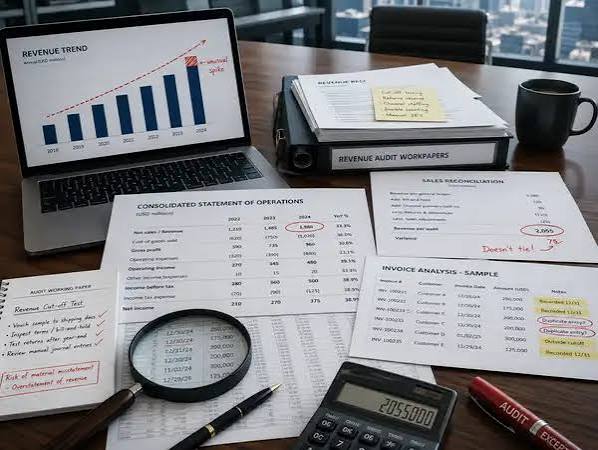
Amid tighter regulatory oversight, distinguishing between shipped products and true sales has become essential for market participants. Practices like channel stuffing artificially inflate short-term revenues by flooding distribution channels with excess inventory. Investors can spot these manipulations by tracking structural anomalies like rising accounts receivable alongside stagnant operating cash flows.
Understanding Revenue Recognition: How Sales Figures Can Be Manipulated
Global market regulators enforce stricter transparency standards as corporate entities face pressure to balance shipped inventory against actual customer control.
WASHINGTON — The U.S. Securities and Exchange Commission (SEC) and international accounting boards have intensified their scrutiny of corporate financial reporting as companies face mounting pressure to hit short-term performance benchmarks. According to enforcement updates and regulatory case reviews published on June 27, 2026, compliance tracking divisions are observing a structural rise in high-risk revenue recognition tactics. The most prominent among these is "channel stuffing"—an aggressive practice where public companies artificially inflate immediate sales metrics by shipping surplus inventory to distributors well ahead of authentic consumer demand.
Distinguishing whether a product has been legitimately sold or simply shipped has transformed into a critical analytical requirement for retail investors, auditors, and market analysts. Under current global accounting standards, recognizing revenue prematurely can distort a corporation's true financial trajectory. When companies use loose shipping definitions to book immediate profits, they frequently compromise their future earnings potential, setting the stage for abrupt stock market corrections and regulatory enforcement actions.
The Legal Threshold of Revenue Recognition
The core principle governing modern financial accounting is that revenue must depict the actual transfer of promised goods or services to customers. According to the foundational Financial Accounting Standards Board (FASB) and the International Accounting Standards Board (IASB), all public and private entities must adhere to a strict five-step framework laid out under converged standards ASC 606 (U.S. GAAP) and IFRS 15 (Global Markets).
Under these modern principles, the historical benchmark of simple "delivery or shipment" no longer serves as an automatic trigger to book a sale. Instead, the rules focus explicitly on the concept of control. A corporate entity is legally permitted to record revenue only when the end customer gains full possession, ownership rights, and the practical utility of the purchased asset.
If an enterprise ships products to a third-party distributor but retains the underlying inventory risks—such as offering unrestricted return privileges or guaranteeing buy-backs—the transaction cannot legally be recorded as a completed sale.
Common Methods of Sales Manipulation
When corporate management teams face economic slowdowns or aggressive quarterly targets, they may turn to high-risk distribution practices to align their reported metrics with market expectations. Financial compliance reports identify three primary mechanisms used to accelerate top-line numbers:
Channel Stuffing: This involves offering deeply discounted wholesale pricing, extended payment windows, or lucrative credit terms to wholesale distributors at the close of a financial quarter. This induces distributors to accept excess product shipments that they cannot realistically sell to retail consumers within a standard operational window.
Bill-and-Hold Transactions: Under this method, a company bills a customer for a purchase but holds the physical inventory in its own warehouse facilities. While valid under restricted contractual conditions, bad actors frequently use this structure to record revenue for products that have neither left the warehouse nor been requested for immediate deployment by the client.
Side Agreements: These are hidden contractual annexes that alter the standard terms of a recorded transaction. A company might execute a standard sales invoice to satisfy its auditors while concurrently signing a private side agreement that grants the buyer the absolute right to return the shipped goods without financial penalty if retail demand stalls.
How Investors Can Spot Artificial Sales Figures
While aggressive revenue booking takes place behind closed corporate doors, individual investors and forensic analysts can identify early warning signs by cross-referencing specific metrics within standard public financial statements
A primary metric to track is Days Sales Outstanding (DSO), which measures the average number of days it takes a company to collect payment after a sale is executed. If a firm’s DSO spikes sharply at the end of a fiscal year, it indicates that the business is extending overly loose credit terms to force inventory out the door, leaving substantial uncollected revenue sitting vulnerable on its balance sheet.
Similarly, if Accounts Receivable expands at a rate that significantly outpaces general revenue growth, it suggests the business is aggressively booking paper sales without pulling in actual cash inflows.
Impact on Mainstream Investors and Market Credibility
The practical implications of sales manipulation extend directly to everyday retail investors and retirement asset managers. When a company uses channel stuffing to mask a structural decline in organic product demand, it essentially borrows revenues from future quarters to artificially boost its current stock price.
According to historical enforcement reviews published by the Securities and Exchange Commission (SEC), once the distribution channel becomes oversaturated, shipments must inevitably stop. This triggers a sudden collapse in subsequent quarterly earnings, often accompanied by material restatements of past financial reports, class-action shareholder lawsuits, and severe drops in equity valuation that harm ordinary market participants.
Official Sources Section
The regulatory frameworks, disclosure protocols, and legal definitions used within this report are drawn from official policy guidelines issued by the U.S. Securities and Exchange Commission (SEC) and the codified accounting standards maintained by the Financial Accounting Standards Board (FASB).
Quote Section
"Where workforces are under pressure to meet financial targets in the face of economic winds, they are more likely to turn to high-risk tactics such as 'channel stuffing,' managing earnings by adjusting accounting entries near the end of a quarter."
— According to corporate compliance analytics compiled within the 2026 Legal Enforcement Review.
Why It Matters
For everyday market participants and investment managers, understanding the mechanics of revenue recognition is essential for accurate risk management. Relying purely on top-line revenue headers can lead to mispricing corporate value. Learning to identify structural mismatches between shipped inventory and actual cash collection allows individuals to safeguard capital from devastating corporate accounting failures.
Key Facts at a Glance
Core Rule: Revenue recognition under ASC 606 and IFRS 15 requires the absolute transfer of operational control to the buyer, not merely shipping an item.
The Red Flag: A sharp divergence where reported net income rises while real operating cash flows contract or turn negative.
Analytical Tools: Tracking sudden spikes in Days Sales Outstanding (DSO) helps expose artificial end-of-quarter dealer shipments.
Long-Term Damage: Overloading distribution networks inevitably causes an earnings cliff in later periods as distributors stop taking product.
Regulator Stance: Global enforcement agencies are prioritizing the prosecution of disclosure violations linked to hidden buy-back terms and side letters.
FAQ Section
Q: What is the exact difference between a product being shipped and a product being sold? A: Shipping refers strictly to the physical movement of inventory from a warehouse. A product is legally sold only when operational control, risk of loss, and right of use have successfully transferred to the buyer under ASC 606 criteria.
Q: Why do companies engage in channel stuffing if it harms future quarters? A: Corporate leadership teams sometimes resort to these practices under intense short-term pressure to hit specific quarterly revenue estimates, choosing to mask current demand drops in the hope that consumer purchasing will recover before the next reporting cycle.
Q: Where can an individual investor find signs of sales manipulation? A: Investors should review the Balance Sheet and Cash Flow Statement in regular quarterly filings, paying close attention to whether accounts receivable are expanding faster than total sales, or if cash from operations is lagging behind net income.
Source: U.S. Securities and Exchange Commission, Financial Accounting Standards Board.