In a quiet corner of Pune, Maharashtra, a school named Gokul is rewriting the rules of education. No bells ring to start the day. No benches line the classrooms. No textbooks weigh down backpacks. Yet, students here are learning everything from mathematics to international relations—through...
In a quiet corner of Pune, Maharashtra, a school named Gokul is rewriting the rules of education. No bells ring to start the day. No benches line the classrooms. No textbooks weigh down backpacks. Yet, students here are learning everything from mathematics to international relations—through observation, discussion, and experience. Founded by Dr Jyotsna Pethkar, a medical practitioner with a dream of open, exploratory learning, Gokul is a living experiment in what education can be when freed from convention.
Key features of the Gokul learning model:
1. The day begins with traditional Indian music, not a school bell
2. Students engage in current affairs discussions for the first 90 minutes
3. No rigid subject divisions—topics flow organically across disciplines
4. Learning is rooted in observation, dialogue, and real-world relevance
5. Students are between ages 6 and 14, and later transition to NIOS for board exams
Learning through observation: A classroom without walls
At Gokul, the classroom is not defined by four walls or a blackboard. Instead, it’s shaped by curiosity. When a news story like the Iran-Israel conflict is discussed, it becomes a gateway to history, geography, economics, and culture. Students explore how global events affect India, what people in those regions eat, how their economies function, and more. This method transforms passive reading into active exploration.
Teachers like Indrayani Chavan, an Indology expert, note that students retain more because they’re emotionally and intellectually engaged. There’s no rote memorization. Concepts are understood through conversation, not crammed for exams.
A day at Gokul: Life skills meet academics
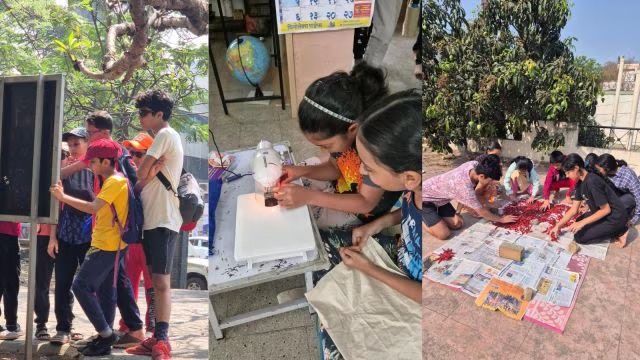
The school runs from 9 am to 2:30 pm, with a brief recess. In that time, students participate in:
- Cooking and first-aid training
- Astronomy sessions and field visits
- Debates, painting, sports, and dance
- Communication workshops and storytelling
- Academic discussions on science, math, languages, and social studies
This blend of life skills and academics ensures that children are not just exam-ready but life-ready. The school’s limited intake allows for personalized attention, with periodic evaluations helping parents understand their child’s strengths and interests.
No pressure, no stress: A child-first philosophy
One of the most striking outcomes of Gokul’s approach is the reduction in student stress. Children who previously struggled in conventional schools find joy in learning again. A student who once dreaded science and math discovered a love for painting and was guided accordingly. The absence of grades and rigid assessments allows children to grow at their own pace.
After completing their time at Gokul, students enroll with the National Institute of Open Schooling (NIOS) for their tenth standard exams. Many go on to pursue higher education in fields aligned with their passions.
Why this matters: Rethinking education in India
Gokul’s model challenges the deeply entrenched norms of Indian schooling. It asks:
- What if learning wasn’t about marks, but meaning?
- What if classrooms were places of discovery, not discipline?
- What if students were taught to think, not just remember?
In an era where mental health concerns and academic burnout are rising, Gokul offers a refreshing alternative. It proves that education can be rigorous without being rigid, and that children learn best when they’re inspired—not intimidated.
Sources: Indian Express, Scrap.com