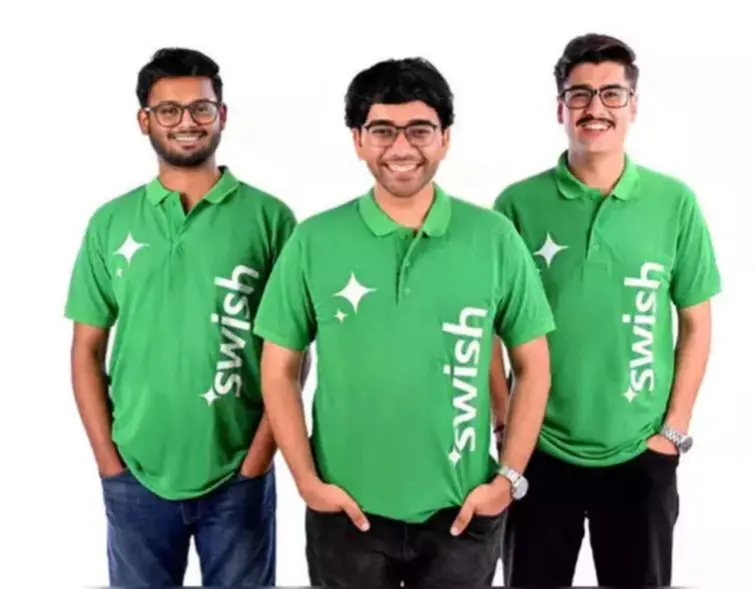
Founded in 2024 by Aniket Shah, Ujjwal Sukheja, and Saran S., Swish is Bengaluru's full-stack 10-minute fresh food delivery startup. Owning its kitchens, technology, and last-mile delivery, it grew from 5,000 to 20,000 daily orders in four months, raised $54 million across three rounds, and is now valued at $139 million.
Three of India's largest food and quick-commerce platforms tried 10-minute food delivery. Swiggy shut down Snacc within a year. Zomato paused Quick four months after launching it. Zepto closed nearly 200 of the 600 Zepto Café locations it had opened.
Into that retreat, a startup founded just 18 months ago walked forward. Swish raised $38 million, doubled its valuation, and pressed ahead — because three young founders from Bengaluru believed the giants had the right idea but the wrong architecture.
The Origin — Coffee, Late-Night Snacks, and a Model Built From the Ground Up
- Swish was founded in 2024 by Aniket Shah, Ujjwal Sukheja, and Saran S. Kumar, and is headquartered at HSR Layout, Bengaluru, registered as Munchmart Technologies Private Limited.
- Swish began with simple offerings like coffee and late-night snacks. As customer traction grew, users requested more, leading the team to expand the menu to include breakfast, healthy bowls, protein options, festive specials, and desserts. Today, more than 20,000 people order from Swish daily.
- The founding insight was structural. Every platform that had tried and stepped back from 10-minute food delivery was an aggregator — dependent on third-party restaurant kitchens, commission-based economics, and delivery infrastructure they did not fully control. The result was a system optimised for speed at the expense of quality, or quality at the expense of speed. Swish decided to own every part of the chain.
The Strategic Genius — Own the Kitchen, Own the Last Mile, Win the Customer
- Swish is an end-to-end foodtech company that owns the kitchen, cooks the food, operates the consumer ordering application, and delivers within an average radius of one kilometre. The company has built neighbourhood kitchens with dedicated prep, cooking, and assembly stations designed for speed and precision.
- This gives Swish better economics compared to marketplace platforms that rely on third-party restaurant commissions. The startup focuses on dense, hyperlocal clusters with delivery radii of around one kilometre, operating across 10 micro-markets in Bengaluru.
- The company's more mature kitchen clusters have reached profitability, suggesting the model can achieve positive unit economics under the right conditions. That is the critical data point that every investor needed to see. The architecture works. The question now is whether it scales.
- "We are very dense, very close to the customer, ensuring that we are able to almost act like a restaurant kitchen, bringing food to your table," CEO Aniket Shah told TechCrunch. That density is the moat. A one-kilometre delivery radius, combined with automated kitchen stations optimised for speed, is what allows Swish to deliver a freshly cooked meal in the same time it takes most apps to confirm an order.
The Series B — A $139 Million Bet on Full-Stack Food Infrastructure
- Swish's $38 million Series B was led by Hara Global and Bain Capital Ventures, with continued backing from Accel, which was among Swish's earliest institutional investors. The round also included Alteria Capital and Stride Ventures, and values Swish at $139 million post-money, more than double its $60 million Series A valuation from March 2025.
- Swish raised $2 million in a seed round from Accel in November 2024, followed by $14 million in its Series A led by Hara Global, with support from Accel and angel investors including Unacademy founder Gaurav Munjal. The Series B of $38 million brings total funding to $54 million across three rounds in 18 months.
- Saanya Ojha, Partner at Bain Capital Ventures, captured the investment thesis precisely: "India's quick-commerce adoption has reset consumer expectations around speed, reliability, and convenience, but food delivery has largely been optimised for planned, higher-value meals. Swish is targeting a much larger, more frequent surface area. The opportunity is to expand the market by bringing more daily consumption online."
Scale, Numbers and Real-World Impact
- Swish has scaled from 5,000 to over 20,000 daily orders in just four months, operating across 10 micro-markets in Bengaluru. The platform offers more than 200 items across meals, snacks, and beverages, with an average order value of ₹200 to ₹250. Usage is highly repeat-driven, with top users ordering more than 10 times a month, largely among young urban consumers aged 20 to 35.
- Revenue between July 2024 and March 2025 was ₹4 crore, against a net loss of ₹19 crore — reflecting heavy investment in kitchen infrastructure and team building rather than a mature business generating near-term profit. The new capital is earmarked for team expansion, multi-city growth into Delhi-NCR and Mumbai, and investment in kitchen automation and supply chain infrastructure.
- Swish ranks fifth among 430 active competitors globally in ultra-fast food delivery, with founders holding 49.12% equity — a sign of disciplined cap table management for a company that has raised $54 million in 18 months.
The Business Lesson — When the Giants Retreat, the Disciplined Founder Advances
- The sharpest lesson from Swish's journey is one that applies across every industry where large incumbents have tried and stepped back from a difficult problem: retreat by the big players is not a signal that the problem is unsolvable. It is a signal that the current architecture is wrong.
- Swiggy, Zomato, and Zepto approached 10-minute food delivery as an addition to an existing marketplace model. Swish approached it as the founding architecture of an entirely different kind of food company. That structural difference, owning the kitchen, the app, and the last mile, is what allowed Swish to achieve unit economics that the marketplace model structurally prevents.
- "Owning every part of the decision in the food supply chain is the only way to serve high-quality, fresh food in 10 minutes to consumers at scale," Aniket Shah says. That sentence is not a founder's bravado. It is a technical conclusion drawn from watching every major competitor fail at the same problem with a different infrastructure.
- Three founders in Bengaluru drew that conclusion. Then they built the infrastructure to prove it. Eighteen months and $54 million later, the market is beginning to agree.
Sources: TechCrunch, The Next Web, Swish Official Press Release, Tracxn, Inc42, StartupArticle