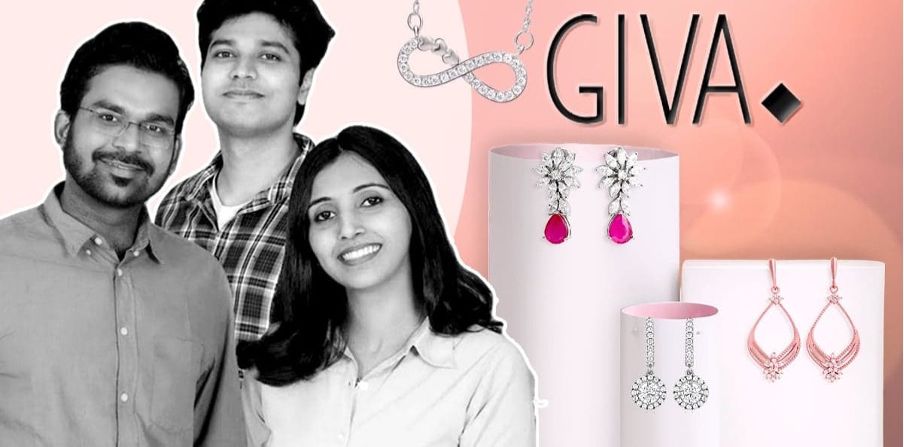
In 2019, IIT Kanpur alumnus Ishendra Agarwal, NIFT graduate Nikita Prasad, and COO Aditya Labroo co-founded GIVA in Bengaluru to build India's first trusted silver jewellery brand. Six years later, GIVA operates 280 stores, clocked ₹523 crore in FY25 revenue, raised $133 million in total funding, and commands a valuation of ₹2,020 crore.
India has a jewellery market worth $100 billion. Gold had Tanishq and Kalyan. Diamonds had CaratLane and BlueStone.
Silver had nothing. No trusted brand. No quality certification. No national scale. Just thousands of small unorganised shops selling at whatever purity they claimed, with zero accountability.
Three people looked at that gap and decided to fill it. And in doing so, they built one of India's fastest-growing D2C brands of the last decade.
The Origin — Three Founders, One Insight, and ₹10 Lakh to Start
• IIT Kanpur alumnus Ishendra Agarwal was born into a middle-class family with ties to the jewellery business. Despite being an electrical engineer by profession, he always had his mind set on building a business of his own.
• Before GIVA took shape, Ishendra Agarwal, Nikita Prasad, and Aditya Labroo conducted extensive market research to decode how modern Indian consumers were evolving. The findings revealed that while consumers in the United States spend around ₹9,000 to ₹10,000 per jewellery purchase on average, Indian consumers spend nearly three times that amount. This research became the foundation of GIVA's marketing and digital strategy.
• Nikita Prasad, Co-founder and Creative Head, brings a background in fashion from the National Institute of Fashion Technology and a solid foundation in the jewellery industry. She launched her career as an intern in a jewellery design department and through the years honed a meticulous attention to detail, a quality that has been a driving force behind GIVA. Aditya Labroo, who joined as COO, was elevated to co-founder at the time of the Series C round in June 2025, reflecting his central role in building GIVA's retail and operational infrastructure.
• When the founders began researching the jewellery market in 2019, they noticed something peculiar. Small unbranded shops were "doing their manmani" — acting arbitrarily, selling whatever purity they claimed without accountability. Consumers had no choice but to trust local jewellers, and that trust was eroding. So they decided to create a reliable, contemporary silver brand that young Indians could depend on.
The Strategic Genius — Silver as Fashion, Trust as the Product
• The boldest move GIVA made was a positioning decision: they chose to market silver as a fashion category rather than a commodity or investment.
• They bet on silver — fashionable, affordable, everyday silver that millennials and Gen Z would wear to work, dates, and brunches. Every piece came with an authenticity certificate validating 925 sterling silver purity. GIVA also offered free lifetime plating service for gold-plated and silver products, reducing post-purchase anxiety about tarnishing.
• The product-market fit was immediate. GIVA adopted a direct-to-consumer approach, allowing the company to control customer experience, pricing, and branding while cutting out middlemen. From starting as an online platform for fine silver jewellery in 2019, GIVA expanded its portfolio into gold and lab-grown diamonds, collaborating with Shoppers Stop to augment its offline presence, and offering free lifetime plating service across all products.
• The Bengaluru-based startup currently operates more than 240 stores across the country, with plans to open 145 to 150 more stores especially targeting tier II cities. The omnichannel strategy was not reactive. It was structural, built on the insight that jewellery requires touch and feel at the point of purchase, and that trust is built in person as much as online.
Scale, Numbers and Real-World Impact
• Annual revenue of GIVA stands at ₹523 crore as of March 31, 2025. The company has raised a total of $133 million across 16 rounds from 80 investors, with investors including IQ Capital, Premji Invest, and A91 Partners. GIVA has 2,344 employees as of August 2025, representing 58% growth year-on-year.
• GIVA secured ₹530 crore in its Series C round led by Creaegis, with participation from Premji Invest, Epiq Capital, and Edelweiss Discovery Fund. The round valued GIVA at $374 million, up approximately 47% from its previous valuation of $254 million in October 2024. The fresh proceeds will be deployed to boost retail and digital footprint, enhance tech-enabled supply chain capabilities, deepen lab-grown diamond offerings, and expand into new categories.
• GIVA projects ₹850 crore in revenue by FY26 while achieving positive EBITDA. The company also plans to expand into new product categories such as men's jewellery and children's jewellery while pursuing global expansion opportunities.
The Business Lesson — The Biggest Opportunity Is the Category Nobody Has Organised Yet
• The sharpest lesson from GIVA's journey is one that cuts across every industry: the most defensible market position is always the one you build before anyone else arrives.
• Silver jewellery had been sold in India for centuries. What was new was a brand that brought quality certification, consistent design, transparent pricing, and national distribution to a category that had never had any of those things. GIVA did not compete for market share. It created the market.
• Category creation beats market share wars when you are solving for an unmet need rather than competing for existing customers. That philosophy, lived consistently across six years of product decisions, distribution choices, and brand-building moves, is what separates GIVA from every competitor that arrived after.
• Three founders. One category nobody had built. And six years later, ₹523 crore in revenue, 280 stores across India, and a generation of young Indian women who wear silver to work, to brunch, and to every occasion in between. GIVA did not enter the jewellery market. It rewrote one of its most overlooked corners, entirely on its own terms.
Sources: GIVA Official Website, Tracxn, Business Today, The Hot Startups, YourStory, Grocurv, Entrepreneur India