Amazon India country chief Samir Kumar declared the e-commerce giant will secure market leadership in the quick commerce sector. The firm is launching three to four dark stores daily, targeting 1,000 micro-fulfillment hubs across 100 cities. Amazon aims to use its extensive catalog size to eclipse entrenched local competitors.
BENGALURU - Amazon India Country Manager Samir Kumar announced that the e-commerce giant intends to emerge as the market leader in the rapidly consolidating quick commerce sector in the near future. Speaking at an industrial update briefing on June 8, 2026, Kumar stated that the company is actively deploying substantial capital to scale its rapid-delivery vertical, Amazon Now. Dismissing assertions that the organization missed its window of opportunity by entering the ultra-fast retail ecosystem after localized incumbents, Kumar emphasized that Amazon’s extensive supply chain background and data architectures will position it to secure long-term segment dominance across more than 100 Indian cities.
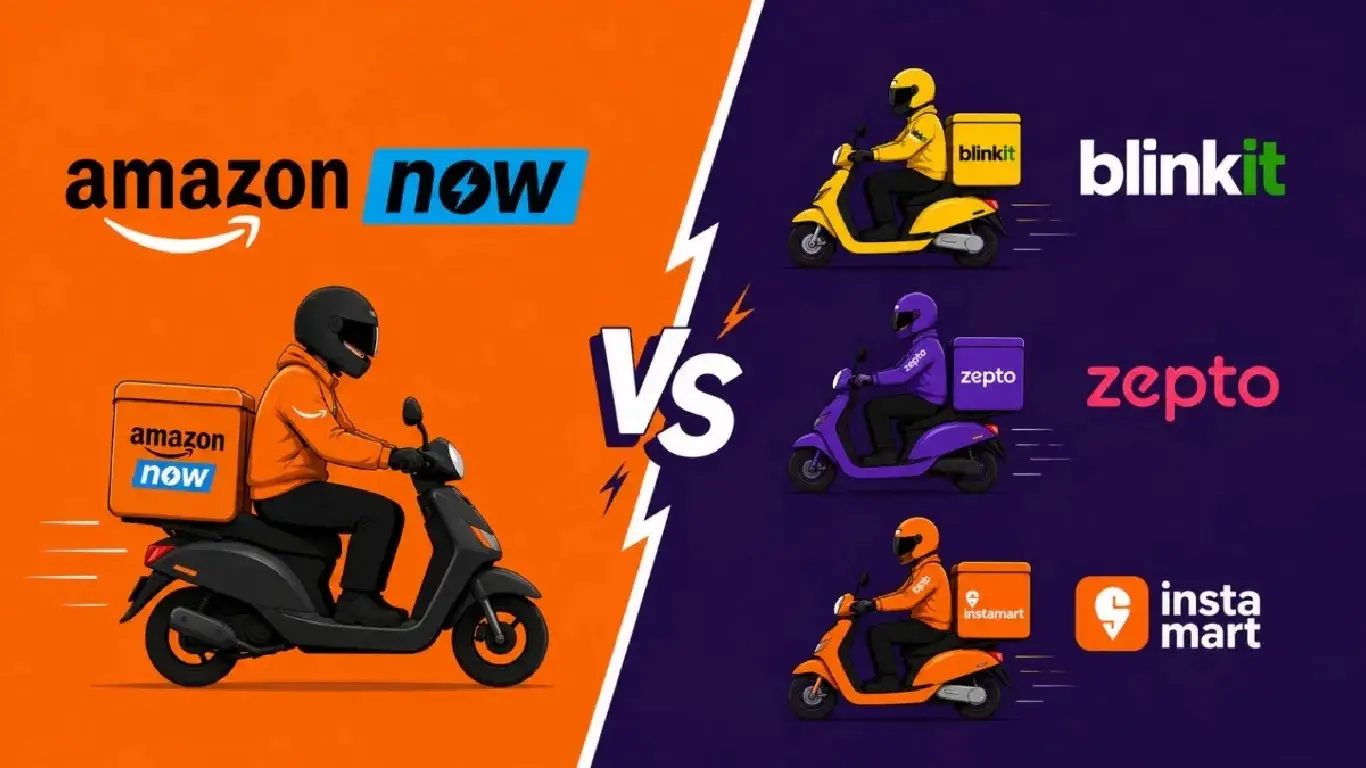
Strategic Dark Store Scaling Plan Set to Rival Blinkit and Zepto
The strategic push signals a major pivot for Amazon India as consumer spending trends inside major urban territories rapidly shift away from standard, next-day e-commerce fulfillments toward sub-15-minute deliveries. According to operational roll-out schedules provided by the company, Amazon is establishing three to four new dark stores—technically classified as micro-fulfillment centers—every single day.
While independent market tracking reports compiled by international financial institutions like UBS place Amazon Now’s current daily traction at roughly 450,000 to 500,000 orders, it still trails the 3 million daily orders processed by current category frontrunner Blinkit. However, Kumar dismissed storefront metrics as a pure vanity index, indicating that Amazon's focus centers strictly on hyper-local order fill rates and fulfillment precision rather than simply stacking unviable warehouses.
"We are in this to win it and are going to be a market leader in the near future," Kumar stated, validating that mature fulfillment pockets are already meeting internal yield benchmarks.
Expanding Product Assortment Beyond Grocery to Boost Order Value
To distinguish its platform from pure-play grocery instant delivery apps, Amazon is leveraging its 13-year historical supply chain infrastructure to bring deep inventory catalogs into the quick commerce grid. Beyond the traditional selection of fruits, vegetables, and everyday dairy items, the enterprise is introducing electronics, home goods, apparel, and small kitchen appliances into localized dark stores.
According to institutional metrics shared by the company, this catalog expansion is driving a measurable upward shift in average order values (AOV) as urban shoppers increasingly buy high-margin non-grocery goods. The roll-out is also finding unexpected momentum outside metropolitan areas; internal subscriber records reveal that roughly 70% of newly registered Prime users are originating from tier-2 and tier-3 geographic clusters, illustrating that rapid-delivery expectations are decentralizing into smaller regional economies.
Operational insights developed by the specialized 100-member core team handling Amazon Now have yielded localized logistical software changes. Senior corporate representatives stated that tech solutions conceptualized by the Indian engineering wing have already begun migrating into international fast-delivery frameworks operated by Amazon across the United States, the United Kingdom, Japan, and Brazil.
Official Sources Section
Amazon India Corporate Communications: Direct executive statements, expansion blueprints, and investment declarations published during country briefs.
The Reserve Bank of India & Ministry of Commerce: Consolidated macro-retail performance indicators tracking organized e-commerce logistics.
UBS Global Research: Channel checks and order density evaluation sheets covering Indian internet business trends for 2026.
Quote Section
"We were slow out of the gate, but we were not sitting idle. We were figuring out what we should do and how we should serve our customers in this format. I don't believe we were late to the game because we still believe this is day one for this story."
— Samir Kumar, Country Manager, Amazon India
Why It Matters
Amazon’s entry into rapid fulfillment changes the economics of retail for Indian consumers and physical storefronts alike. As the world's largest digital retailer transitions its massive delivery framework to complete transactions in minutes, localized mom-and-pop retail operations (Kirana stores) will face intensified structural competition. Conversely, consumers stand to benefit from a prolonged pricing war driven by aggressive corporate discounting, which forces competing platforms to maintain competitive rates on common household staples.
Key Facts at a Glance
1,000 Store Target: Amazon India is actively scaling its micro-fulfillment center footprint toward a target of 1,000 dark stores across 100 cities.
Aggressive Roll-out: The retail platform is establishing an average of three to four functional micro-warehouses every 24 hours.
Order Densities: Amazon Now currently averages 450,000 to 500,000 daily orders, backed by a current network of 500 operational dark stores.
Non-Grocery Diversification: The business is prioritizing heavy selection depth, integrating electronics and home goods to drive larger shopping cart sizes.
Global Architecture: Supply chain mechanisms created by the Indian startup unit are now being integrated into Amazon's quick delivery grids in the US, UK, and Japan.
FAQ Section
How does Amazon Now differ from traditional Amazon Prime deliveries?
While Amazon Prime typically provides same-day or next-day shipping from massive regional sorting centers, Amazon Now routes high-demand daily essentials and retail products out of localized, neighborhood micro-fulfillment facilities to drop orders at customer doorsteps in 10 to 15 minutes.
Is Amazon quick commerce expanding into smaller Indian towns?
Yes. Company leadership noted that 70% of its incoming Prime user base is appearing from tier-2 and tier-3 towns. The network intends to scale its ultra-fast logistics beyond primary metro regions wherever localized purchasing densities justify the dark store overheads.
Are these 10-minute delivery services profitable for Amazon?
Corporate leadership acknowledged that sector-wide quick commerce profitability remains a major operational challenge across the industry in 2026. However, Amazon is focusing on long-term unit economics, leveraging existing logistical assets to lower overall delivery costs rather than pursuing raw growth at any cost.
Source: Official business review data published by Amazon India Pressroom, sector research sheets archived by the Ministry of Commerce and Industry, and industrial performance trackers maintained by the Retailers Association of India.