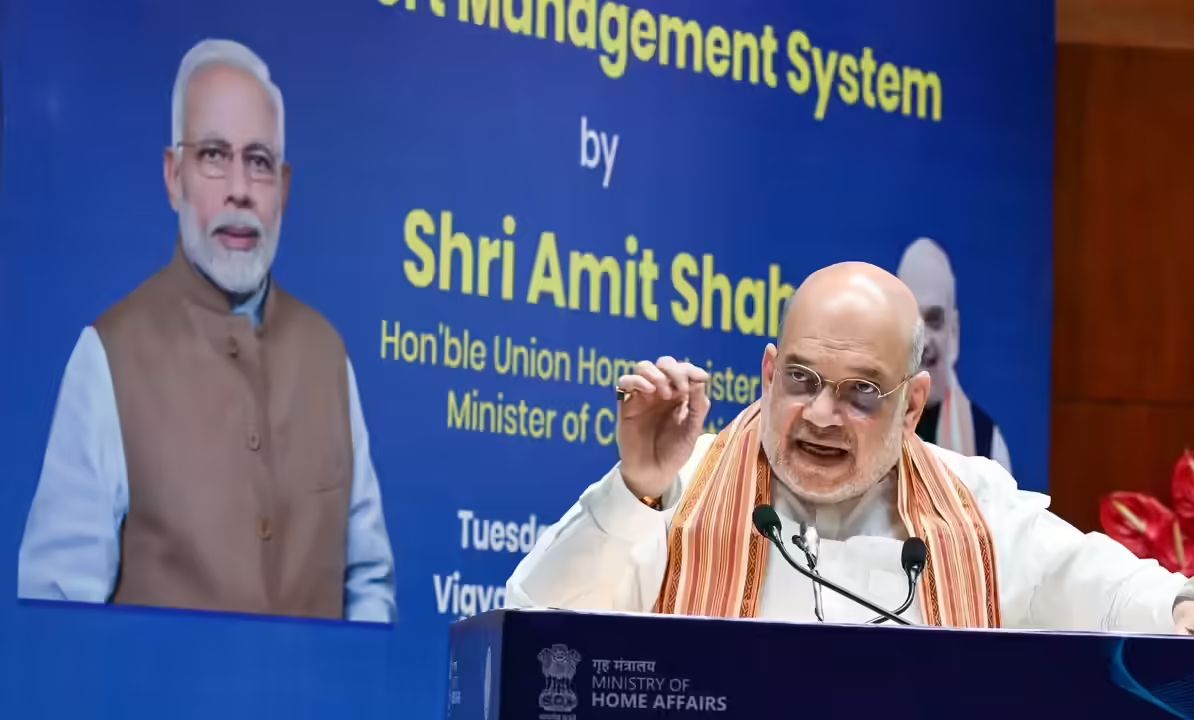
Union Home Minister Amit Shah has launched the 'Vinimay' Land Port Management System to digitize cargo and passenger tracking across India's land borders. Eliminating 90% of paperwork through automated gates, the portal strengthens the 'Smart Border' security plan while supporting a trade network that has grown to ₹83,000 crore.
NEW DELHI — In a major initiative to modernize cross-border infrastructure, the government has launched a unified digital management network to scale international commerce across its perimeter check posts. Union Home Minister Amit Shah officially inaugurated the Land Port Management System (LPMS) – Vinimay in New Delhi, introducing an integrated digital platform designed to overhaul cargo processing and streamline passenger transit across India’s land borders.
The launch of the Vinimay framework marks a structural transformation in national border administration. Developed as a real-time, digital, and fully integrated ecosystem, the platform brings all logistics operators, custom houses, and security entities onto a single electronic interface. According to official ministry declarations, the initiative directly supports the country's long-term economic ambitions under the Viksit Bharat 2047 roadmap, driving trade facilitation and boosting external connectivity while reinforcing national security protocols.
Technical Overhaul to Trim Customs Gaps
The deployment of the Vinimay ecosystem targets a major reduction in manual clearances through advanced data-driven automation.
According to statutory declarations released during the launch event, the Land Port Management System resolves long-standing administrative frictions by eliminating nearly 90 per cent of all physical paperwork. The core infrastructure relies on a Single Electronic Window alongside Automatic Number Plate Recognition (ANPR)-based gate protocols. These tech-driven features are engineered to sharply minimize total vehicle processing times, preventing cargo trucks from encountering prolonged chokepoints during cross-border terminal entries.
Expanding Cross-Border Trade Volumes and Local Fortifications
The upgrade comes amid an unprecedented multi-year surge in total commerce moving across the country's dedicated border facilities.
Shifting Economic Metrics at Overland Checkpoints
Data presented at the inauguration highlights a sharp rise in physical trade values passing through international border stations over the last twelve years. Financial registers confirm that land-based trade has risen 16-fold, jumping from ₹5,000 crore in 2014 to a massive ₹83,000 crore at present.
The Home Ministry's infrastructural footprint incorporates specific growth milestones:
Active Terminals: There are currently 15 operational land ports facilitating international trade and transit across regional borders.
Pipeline Expansion: An additional 11 land ports are scheduled to become fully operational over the next two to three years.
Socio-Economic Stabilization: The continuous expansion of border ports plays an important role in curbing migration from remote frontier districts by strengthening local township economies.
Cultural Exchange: Modern terminals serve as vital anchors for enhancing local people-to-people ties and cross-border cultural connectivity.
Implementing Smart Deterrence and National Security Blueprints
Beyond pure logistical improvements, the introduction of the Vinimay platform functions as a key component of India’s updated national defense and border security frameworks.
"According to officials from the Ministry of Home Affairs, authorities are working on a multi-pronged strategy to protect international perimeters under the unified Smart Border concept. The Land Ports Authority of India will play a central role in realizing this strategic vision."
Home Minister Amit Shah emphasized that the combination of the Land Port Management System and Smart Border technologies will build a more secure, modern border management architecture. The integrated data channels give security regulators the necessary oversight to actively curb illegal cross-border movements while ensuring smooth passage for authorized traders and travelers.
Why It Matters
For cross-border logistics businesses, cargo operators, and transport drivers, the Vinimay platform replaces sluggish, manual clearance steps with rapid digital verification. The system brings India's land checkpoints to the same high technical standard seen at top airports and seaports, offering predictable scheduling and helping commercial shipments cross international lines with minimal delay.
For border communities and regional companies, the continuous rollout of new ports provides reliable local jobs and strengthens frontier economies. By building modern trade hubs, the government is making it easier for local firms to tap into international markets, which helps lower migration rates from border districts and builds resilient economic zones.
Key Facts at a Glance
Digital Integration: Union Home Minister Amit Shah launched the 'Vinimay' Land Port Management System in New Delhi to create a unified digital ecosystem.
Paperless Operations: The advanced software interface cuts down processing times by eliminating nearly 90% of traditional manual paperwork.
Advanced Tracking: Gate operations will now use Automatic Number Plate Recognition (ANPR) systems to speed up vehicle checks.
Exponential Trade Growth: Overland trade has achieved a 16-fold increase over the past 12 years, growing from ₹5,000 crore in 2014 to ₹83,000 crore today.
Network Scaling: There are 15 land ports operating across the country, with 11 more installations scheduled to go live over the next two to three years.
Frequently Asked Questions
What is the primary objective of the Vinimay platform?
It is an integrated digital platform designed to speed up cross-border movement, eliminate extensive paperwork, and connect all trade stakeholders onto a single real-time dashboard.
How does the system help improve national security?
By pairing the LPMS with the government's broader 'Smart Border' concept, the platform enables real-time data monitoring to curb illegal activities while keeping border crossings secure.
What impact do modern land ports have on local border populations?
The development of these ports helps curb migration out of frontier districts by driving local commerce, creating nearby jobs, and strengthening cultural ties.
Sources: