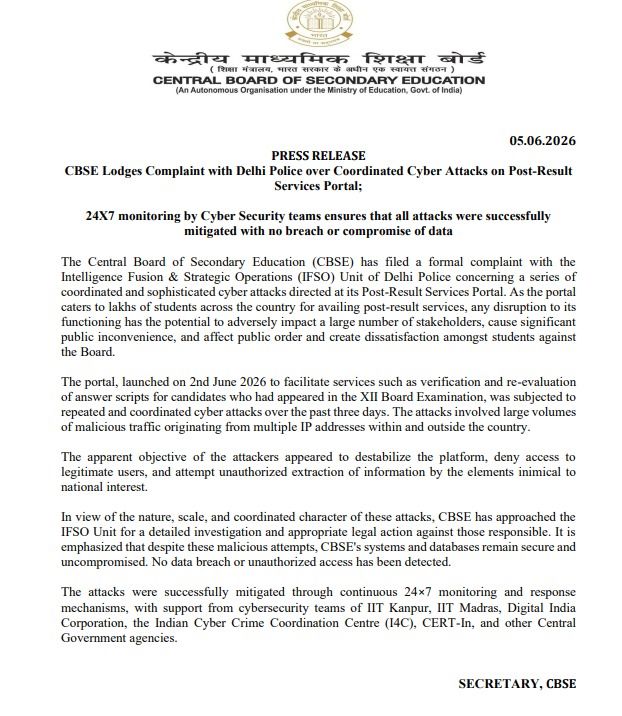
The Central Board of Secondary Education has filed a formal complaint with the Delhi Police IFSO unit following a series of coordinated cyber attacks targeting its Class 12 post-result services portal. Supported by elite agencies like CERT-In and teams from IITs, the board successfully neutralized the traffic surges without any data compromise.
NEW DELHI — In a major enforcement development following national board examinations, the Central Board of Secondary Education (CBSE) has formally approached law enforcement following a barrage of highly sophisticated, malicious digital interventions. Confirming the statutory action on Friday, June 5, 2026, the national education board announced it has lodged an official cybercrime complaint with the Intelligence Fusion and Strategic Operations (IFSO) specialized unit of the Delhi Police. The criminal filing targets a series of aggressive, coordinated cyber attacks directed against the board’s newly activated Post-Result Services Portal over a consecutive three-day window. Prompted by an influx of volatile web traffic routed from networks located both within India and across global borders, the joint enforcement response aims to identify state or non-state actors trying to disrupt essential administrative services utilized by hundreds of thousands of undergraduate applicants nationwide.
Multi-Day Traffic Barrage Targets Post-Result Infrastructure
According to a comprehensive press release issued by the board's central secretariat, the cyber attacks targeted the dedicated Post-Result Activities (PRA) portal, which went live in the early hours of June 2, 2026. The localized platform is designed to process high volumes of student requests for the verification of marks, digital delivery of evaluated answer booklets, and formal script re-evaluations for Class 12 candidates.
Security telemetry logs detailed in the official complaint show that the infrastructure was hit by sustained distributed denial-of-service (DDoS) tactics. The malicious activity weaponized thousands of compromised IP addresses to generate immense traffic spikes, attempting to overwhelm the system's hosting hardware.
Administrative dockets reveal that the primary objectives behind the digital offensive were to completely lock out legitimate student traffic, destabilize the portal's core database frameworks, and carry out unauthorized data extraction. Because the portal had already accepted over 56,000 applications for verification within its initial 36 hours of operation, the timing of the disruption appeared calculated to trigger widespread public panic during critical university admission windows.
Joint Security Taskforce Prevents Serious Data Breach
Following the initial discovery of the unauthorized digital tracking, the central government activated an elite cybersecurity collaborative taskforce to defend the national education infrastructure. While the board has faced technical glitches over the past month regarding its controversial On-Screen Marking (OSM) system, technical experts confirmed that this specific disruption was entirely artificial.
To fortify the network perimeter, engineers from the Indian Institute of Technology (IIT) Kanpur and IIT Madras partnered directly with analysts from the Digital India Corporation and the Indian Cyber Crime Coordination Centre (I4C). Under the active oversight of the Computer Emergency Response Team-India (CERT-In), the technical response team established around-the-clock defensive monitoring.
According to preliminary forensic findings shared by the Ministry of Electronics and Information Technology (MeitY), the joint taskforce successfully blocked the malicious traffic without interrupting student access. The board stressed that all confidential student records, marks databases, and personal identification data remain safe and uncompromised.
Registration of Formal FIR to Prosecute Cyber Saboteurs
Acting upon the formal complaint documents submitted by the board's legal representatives, the IFSO specialized cyber unit of the Delhi Police has officially registered a First Information Report (FIR). Investigative officers confirmed that a dedicated, multi-disciplinary team of digital forensics experts has been formed to trace the underlying electronic footprints.
The case has been formally registered under Section 66, read alongside Section 43(F) of the Information Technology Act. These statutory clauses explicitly criminalize the intentional hacking, damaging, or denial of access to any protected computer system or national data repository, carrying significant penal consequences for convicted perpetrators.
"The attacks involved large volumes of malicious traffic originating from multiple IP addresses within and outside the country. The apparent objective of the attackers appeared to destabilize the platform, deny access to legitimate users, and attempt unauthorized extraction of information by elements inimical to national interest. It is emphasized that despite these malicious attempts, CBSE's systems and databases remain secure and uncompromised."
Official Sources Section
The technical incident timelines, cyber defense agency lineups, legal statutory classifications, and institutional updates presented in this security report are drawn directly from the verified press releases issued by the Central Board of Secondary Education, administrative investigation logs from the Delhi Police IFSO Cyber Unit, and emergency tracking protocols confirmed by the Indian Cyber Crime Coordination Centre.
Why It Matters
This cyber confrontation underlines the growing threat of targeted digital sabotage directed at critical public sector frameworks during high-stakes national timelines. For hundreds of thousands of students navigating tense college admissions and professional entrance preparations, any prolonged shutdown of the re-evaluation infrastructure could delay admissions, causing massive anxiety and administrative backlog. By involving central security agencies like CERT-In and pushing for immediate criminal prosecution through the Delhi Police, the government has sent a clear message that attacks on national educational platforms will be treated as threats to national security. The successful defense of the portal confirms that India's integrated cyber-defense networks can successfully protect public data assets under pressure, ensuring that essential student services stay online during crucial academic windows.
Key Facts at a Glance
Formal Legal Action: The CBSE has filed a cybercrime complaint with the elite IFSO Unit of the Delhi Police over targeted infrastructure attacks.
Malicious DDoS Tactics: The board’s newly deployed post-result services portal was hit by massive, coordinated surges of malicious internet traffic over three days.
International Footprint: Network tracking logs revealed that the attacking traffic originated from multiple hijacked IP addresses inside India and abroad.
Data Intact: Joint forensic teams confirmed that the board's main databases remain secure, with zero evidence of a data breach or unauthorized access.
National Joint Defense: Cybersecurity experts from IIT Kanpur, IIT Madras, I4C, and CERT-In worked around the clock to neutralize the threat.
FAQ Section
What specific services does the targeted CBSE portal provide to students?
The platform allows Class 12 candidates to safely submit requests for the official verification of marks, download scanned copies of their evaluated answer booklets, and apply for formal subject re-evaluations.
Was any student performance data or personal information stolen during the cyber attack?
No. The CBSE has issued an absolute assurance that all core databases remain safe and uncompromised, confirming that the defensive countermeasures successfully prevented any data breach or unauthorized system access.
What legal charges are being pursued against the perpetrators of the attack?
The Delhi Police have registered a formal criminal FIR under Section 66 and Section 43(F) of the Information Technology Act, which covers intentional hacking, disruption, and denial of access to public computer systems.
Can students still use the portal to file re-evaluation requests?
Yes. Thanks to the continuous mitigation efforts of central cybersecurity teams, the portal remains fully active, and eligible students can submit their verification paperwork normally.
Source: Official press bulletins published on the CBSE Corporate Portal, legal case filings via the Delhi Police Cyber Command, and emergency response updates compiled by CERT-In.