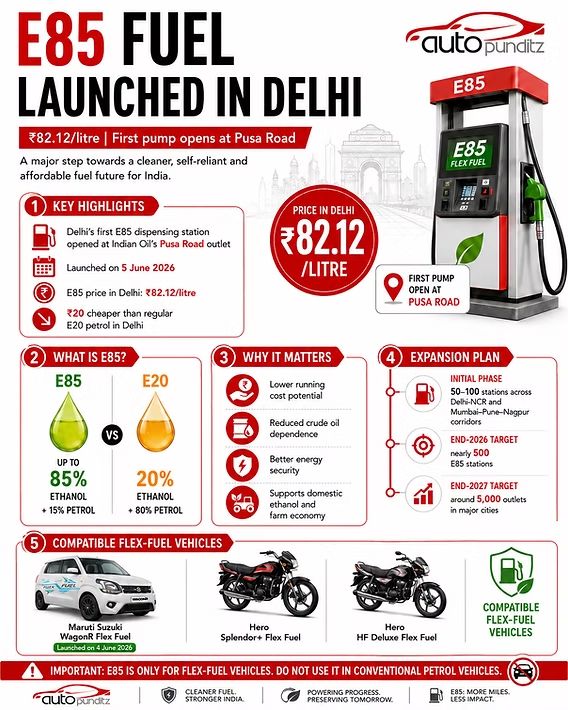
India has officially entered the flex-fuel era with the commercial launch of E85 petrol, priced at ₹82.12 per litre in Delhi—a ₹20 discount to regular petrol. Meant exclusively for compatible flex-fuel vehicles, the 85% ethanol blend aims to boost agricultural income and reduce crude imports across 5,000 planned stations by 2027.
NEW DELHI — In a landmark intervention for the national automotive and energy matrices, the Government of India has officially commenced the commercial rollout of high-blend ethanol fuel across the country. Unveiled on Friday, June 5, 2026, by Union Minister for Petroleum and Natural Gas, Hardeep Singh Puri, the newly introduced "E85 flex-fuel" is formulated with 85% domestically produced ethanol and 15% conventional petrol. Strikingly, the Ministry has structured the pricing mechanism to retail at an immediate discount, fixing the cost at ₹82.12 per litre in the national capital. The strategic pricing undercuts standard E20 petrol—which currently trades at ₹102.12 per litre—by exactly ₹20. Inaugurated at a flagship Indian Oil Corporation Limited (IOCL) pump on Pusa Road, New Delhi, the green fuel project aims to leverage local agricultural output to shield consumers from international energy shocks while accelerating the transition to eco-friendly mobility.
Restructuring the Retail Fuel Grid with Subsidized Pricing
According to official gazette declarations published by the Press Information Bureau (PIB), the financial structuring behind E85 flex-fuel is a conscious move to encourage fast consumer adoption. Because ethanol has a lower volumetric energy density than fossil petrol, vehicles consuming high-blend bio-ethanol experience a 25% to 35% reduction in mileage.
To offset this calorific gap and maintain an attractive total cost of ownership, the government has discounted the retail rate by nearly 20% compared to standard fuel options. This pricing strategy aims to incentivize car and motorcycle buyers to absorb the higher initial costs of purchasing newly manufactured, flex-fuel-compliant engines.
Phased Infrastructure Expansion to Cover Core Transit Corridors
Technical briefs archived by the Ministry of Petroleum and Natural Gas (MoPNG) indicate that the supply infrastructure will follow a tightly controlled, multi-stage expansion roadmap. The initial rollout starts immediately across 48 select retail outlets owned by public sector Oil Marketing Companies (OMCs) nationwide, focused heavily on the Delhi-NCR cluster and the high-traffic Mumbai-Pune-Nagpur expressway corridor.
According to government expansion goals, OMC engineering desks are tasked with upgrading pumping infrastructure to expand the network to 500 operational dispensing stations by December 2026, before scaling aggressively to 5,000 major urban retail hubs by the end of 2027.
Strict Warning Against Misuse in Conventional Vehicle Engines
With the high-octane fuel now commercially available, the Bureau of Indian Standards (BIS) and automobile manufacturers have issued strict notices regarding engine compatibility. Because ethanol is highly corrosive to standard rubber gaskets, fuel lines, and aluminum fuel injection hardware, E85 flex-fuel must not be filled into regular petrol cars or motorcycles.
The biofuel is designed exclusively for vehicles fitted with specialized flex-fuel engines. These units use reinforced fuel systems, anti-corrosive tank coatings, and intelligent Electronic Control Units (ECUs) capable of real-time sensing to adjust ignition timings automatically for fuel mixtures ranging anywhere from E20 up to E100.
"We have consciously structured the pricing to ensure that consumers are more than adequately compensated for any lack in calorific value by making E85 approximately ₹20 per litre cheaper than E20 blended fuel," stated Union Minister Hardeep Singh Puri during the launch event. "I am in support of electric vehicles too, but they require critical minerals that are largely imported. E85 is produced by the sweat and toil of Indian farmers, making it the cleanest and most self-reliant option in the Indian market today."
Official Sources Section
The pricing frameworks, infrastructural milestones, and vehicular engine limitations outlined in this energy report are verified through executive press releases issued by the Ministry of Petroleum and Natural Gas, infrastructure deployment logs archived by Indian Oil Corporation, and official technical vehicle certification indexes maintained by the Bureau of Indian Standards.
Why It Matters
The introduction of E85 flex-fuel is a major step forward for India's energy self-reliance and rural economy. By substituting a significant portion of imported fossil crude with ethanol made from domestic agricultural feedstocks like sugarcane and broken food grains, the country can protect its economy from global energy supply chain disruptions. For the farming sector, this transition creates a massive, predictable industrial demand channel, helping channel billions of rupees back into rural communities. For urban centers, the environmental benefits are immediate: vehicles running on E85 can cut lifecycle greenhouse gas emissions by up to 61% while drastically reducing tailpipe particulate matter, helping improve air quality in densely populated cities.
Key Facts at a Glance
Substantial Discount: New E85 flex-fuel is priced at ₹82.12 per litre in Delhi, offering an exact ₹20 discount over standard E20 petrol.
High-Ethanol Formula: The fuel blend consists of 85% domestically distilled ethanol and 15% traditional fossil petrol.
Phased Rollout: Sales have commenced across an initial batch of 48 public sector fuel stations, with a target of 5,000 operational pumps by December 2027.
Strict Engine Requirements: E85 can only be used in specially engineered flex-fuel vehicles; standard petrol engines risk severe internal fuel-line corrosion if misfueled.
Lower Emissions: The Ministry confirms that utilizing E85 reduces lifecycle greenhouse gas emissions by roughly 61% compared to traditional internal combustion engines.
FAQ Section
Why is E85 flex-fuel priced so much cheaper than regular petrol?
The government has deliberately set a lower price for E85 to compensate consumers for ethanol's lower energy density, which causes a 25-35% drop in mileage, and to make the transition financially attractive for early adopters.
Can I fill E85 flex-fuel into my standard petrol car or two-wheeler?
No. Standard petrol engines are not built to handle high concentrations of ethanol, which can corrode regular fuel lines and components. E85 must only be used in certified flex-fuel vehicles (FFVs).
Which vehicles currently on sale in India are compatible with E85 fuel?
Current compatible models include the newly launched Hero Splendor+ Flex Fuel, the Hero HF Deluxe Flex Fuel, and the Suzuki Gixxer SF 250 FFV, alongside passenger platforms like the Maruti Suzuki WagonR Flex Fuel commercial fleet.
How does this new fuel alter the mechanical performance of a compatible vehicle?
With a high Research Octane Number (RON) of approximately 108, ethanol provides excellent knock resistance. This allows compatible engines to run at higher compression ratios, optimizing ignition timing to deliver smoother power and better performance.
Source: Official operational bulletins published by the Ministry of Petroleum and Natural Gas, technical specification portfolios from Indian Oil Corporation, and retail network reporting from the Economic Times and Auto Punditz editorial desks.