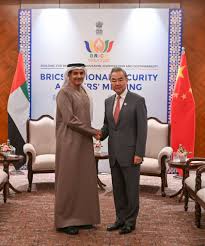
China’s top diplomat Wang Yi met with UAE Supreme National Security Council Secretary-General Ali Mohammed Hammad Al Shamsi in New Delhi. The leaders prioritized enforcing a permanent Middle East ceasefire, securing the Strait of Hormuz shipping lanes, and designing a regional security architecture to protect global supply chains.
NEW DELHI, India — China’s top diplomat Wang Yi met with Ali Mohammed Hammad Al Shamsi, the Secretary-General of the Supreme National Security Council of the United Arab Emirates (UAE), on Tuesday on the sidelines of an international security summit. The high-level encounter, hosted in the Indian capital during the 16th Meeting of BRICS National Security Advisors and High Representatives on National Security, focused strictly on stabilizing the Middle East following recent geopolitical volatility. This development carries immediate global importance today as major powers move to safeguard international shipping channels and solidify newly negotiated peace frameworks.
During the session, both officials conducted comprehensive reviews of their bilateral comprehensive strategic partnership. The dialogue concentrated heavily on establishing a sustainable security architecture across the Gulf zone, ensuring the unhindered flow of commercial trade, and monitoring the transitional move toward diplomatic dialogue following the recent United States-Israel-Iran conflict.
Strategic Priorities for Middle East Stabilization
A primary focal point of the bilateral discussion centered on the de-escalation of regional hostilities that have recently disrupted global supply chains. According to statements detailing the meeting, Wang Yi, who serves as a member of the Political Bureau of the Communist Party of China (CPC) Central Committee and Director of the Office of the Central Commission for Foreign Affairs, emphasized that while recent conflicts have shifted toward active dialogue, achieving a lasting peace requires unified systemic compliance from all participating nations.
The Chinese delegation outlined three immediate structural priorities to stabilize the regional landscape:
Ceasefire Enforcement: Relevant international and regional parties must commit to a permanent, comprehensive ceasefire and strictly implement the provisions of the recently signed memorandum of understanding (MoU).
Strait of Hormuz Navigation: Normal commercial navigation through the Strait of Hormuz must be fully restored and guaranteed immediately to maintain the essential maritime lifeline of global energy development.
New Security Architecture: Middle Eastern states need to actively draw lessons from repeated cycles of systemic turmoil, rebuild mutual trust, and explore a fresh regional security framework independent of major power rivalries.
Bilateral Commitments and Global Supply Chain Protection
In response, Secretary-General Al Shamsi affirmed that the relationship between Abu Dhabi and Beijing carries historical and strategic significance, labeling China as the UAE's most critical global partner and sincere friend. The UAE delegation expressed formal appreciation for China's expanding diplomatic role in brokering political settlements across complex Middle Eastern flashpoints.
The discussions underscored a mutual corporate and state interest in protecting international maritime corridors. As a premier global logistics hub, the UAE remains highly sensitive to disruptions across nearby maritime shipping lanes. Al Shamsi noted that the UAE is fully prepared to maintain close coordination with Beijing to safeguard international shipping parameters, secure industrial supply lines, and prevent the region from becoming an arena for external geopolitical containment strategies.
Official Sources Section
The diplomatic details, policy declarations, and regional security priorities featured in this report have been officially compiled from government releases distributed by the Ministry of Foreign Affairs of the People's Republic of China and verified via state media briefs published by the Emirates News Agency (WAM).
Quote Section
"According to officials reporting from the summit in New Delhi, the meeting highlights a joint effort by Beijing and Abu Dhabi to assume a more proactive role in filling regional security vacancies through direct diplomatic mediation rather than relying on external military interventions."
Why It Matters
The strategic coordination between China and the UAE yields immediate practical implications across multiple international sectors:
For Global Shipping and Commerce: Restoring and safeguarding normal transit through the Strait of Hormuz directly lowers maritime insurance premiums, stabilizing shipping costs for international freight forwarders and logistics firms.
For Energy Markets: Stabilizing the political environment in the Gulf mitigates the risk of sudden supply shocks, injecting predictability into global oil and natural gas pricing structures.
For Multilateral Alliances: The meeting reinforces the growing influence of the expanded BRICS mechanism as an active platform for the Global South to formulate independent security policies.
Key Facts at a Glance
Bilateral Summit: China's top diplomat Wang Yi met UAE Supreme National Security Council Secretary-General Al Shamsi in New Delhi.
Ceasefire Focus: The talks prioritized the strict execution of the newly signed memorandum of understanding terminating recent regional conflicts.
Maritime Security: Both nations formally called for the immediate restoration of unhindered commercial transit through the Strait of Hormuz.
Strategic Alignment: The UAE designated China as its most important partner and endorsed Beijing's diplomatic mediation framework for long-term peace.
FAQ Section
Where did the meeting between the Chinese and UAE officials take place?
The high-level meeting was hosted in New Delhi, India, where both officials were actively participating in the 16th Meeting of BRICS National Security Advisors and High Representatives on National Security.
What are the three priorities outlined by China during the talks?
The three priorities include committing to a permanent and comprehensive ceasefire, restoring normal commercial navigation through the Strait of Hormuz as quickly as possible, and establishing a new regional security architecture built on mutual trust.
What position does the UAE hold regarding China's role in the Middle East?
The UAE highly appreciates China's actions as a responsible major power and has formally thanked the Chinese government for its constructive role in promoting political settlements to complex regional conflicts.
Source: Ministry of Foreign Affairs of the People's Republic of China, Emirates News Agency (WAM)