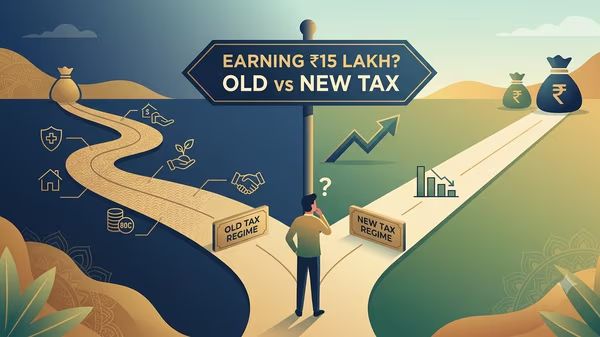
For an individual earning ₹15 LPA, the default new tax regime limits total tax liability to ₹97,500 by applying a ₹75,000 standard deduction. The old regime requires a higher outgo of ₹2,57,400 unless the filer can claim over ₹5.43 lakh in investment and rent deductions.
NEW DELHI — Salaried individuals earning an annual gross income of ₹15 lakh are facing a critical financial choice as they structure their declarations under the formal operationalization of the new Income Tax Act, 2025. Following the structural updates initially established by the Ministry of Finance, data verified by central tax planners on Wednesday, June 24, 2026, reveals that the default new tax regime offers a substantial, hassle-free tax reduction for middle-to-upper-middle-income brackets. However, standard mathematical modeling shows that the choice between the traditional tax track and the updated default framework depends heavily on a taxpayer’s ability to claim major localized exemptions.
The Default Mathematics: Zero Investment vs. Maximum Slabs
Under the direct tax updates maintained for the active financial year, the new tax regime continues to utilize expanded progressive slices that lower the immediate liability for general earners. For a corporate employee with a gross CTC of ₹15,00,000, the new framework automatically applies an enhanced standard deduction of ₹75,000.
This adjusts the net taxable baseline down to exactly ₹14,25,000. When processed through the modern, zero-deduction tax brackets, the total baseline tax accumulates to ₹93,750. After adding the mandatory 4 percent Health and Education Cess, the absolute outgo settles at ₹97,500.
Conversely, the old tax regime presents a much steeper tax progression for the exact same package if no savings investments are claimed. Factor in the old regime’s smaller ₹50,000 standard deduction, and the taxable income rests at ₹14,50,000. Because incomes above ₹10 lakh are taxed at a flat 30 percent in the older system, the total liability escalates to ₹2,47,500 before cess, translating to a final payment of ₹2,57,400. This means the new regime delivers an automatic, zero-effort saving of ₹1,59,900.
Finding the Inversion Point: The Deductions Needed to Win
For conservative investors who actively use long-term tax instruments, the old system can still yield favorable results—but only if total claims pass a specific financial tipping point. To help individuals visualize this cross-over threshold, financial advisors map out the exact volume of deductions needed to equalize both options.
To reduce the old regime tax liability down to or below the new regime's baseline of ₹97,500, a salaried professional must claim at least ₹5,43,750 in total personal deductions (excluding the standard deduction). If an individual's combined claims under Section 80C, Section 80D, House Rent Allowance (HRA), and home loan interest fall short of this amount, filing under the default new tax regime remains the more financially optimal choice.
Regulatory Simplification and Sector Impact
According to updates provided by the Income Tax Department, the ongoing push toward the new tax regime is part of a deliberate long-term strategy to phase out complex, multi-layered exemptions. The introduction of the simplified Income Tax Act, 2025, significantly trims down compliance workloads by consolidating the legal framework from over 700 sections down to 536 easily navigable provisions.
For the broader corporate and financial services sectors, this structural migration changes how employees approach compensation design. Human resource departments are increasingly restructuring flexible benefit plans to prioritize direct, cash-in-hand payouts over complex, itemized insurance or rent reimbursements, boosting monthly liquid savings across the middle-class workforce.
Quote Section
"The overarching goal of our direct tax evolution is transparency and predictability for individual earners," stated a senior direct tax policy official during a recent implementation briefing. "According to officials, the default framework removes the administrative burden of locking up personal liquidity in specific financial instruments purely to lower a tax bill. Organizers stated that the system is built to provide maximum disposable income to the consumer from day one."
Why It Matters
For salaried professionals, understanding the interplay between these two tax paths is essential for maximizing household savings and maintaining financial flexibility. Opting for the new tax regime gives individuals complete control over their cash flow, allowing them to route disposable funds into high-yield mutual funds or liquid equities rather than locking capital into low-yield, tax-saving instruments. For the broader economy, the resulting boost in take-home pay drives steady consumer demand across key consumer markets, including retail electronics, automobiles, and real estate.
Key Facts at a Glance
Default Framework Advantage: At a ₹15 LPA salary level, the new tax regime requires an absolute liability of just ₹97,500, with no investment requirements.
The Traditional Penalty: Failing to declare investments under the old tax system pushes the liability to ₹2,57,400 for the same income level.
High Tipping Point: Taxpayers must secure more than ₹5.43 lakh in eligible deductions to make the old regime more tax-efficient than the new system.
Enhanced Deductions: Salaried professionals filing under the new regime benefit from an upgraded standard deduction of ₹75,000.
Streamlined Compliance: The updated direct tax rules eliminate complex proof-submission workflows for the vast majority of active filers.
FAQ Section
Can I switch between the old and new tax regimes every year?
Yes. Salaried individuals who do not have business or professional income have the flexibility to choose their preferred tax regime on a yearly basis when filing their Income Tax Return (ITR).
Are popular deductions like Section 80C and HRA available under the new tax regime?
No. To offer lower tax rates across its income slabs, the new tax regime disallows almost all traditional exemptions and deductions, including Section 80C, Section 80D, HRA, and home loan interest on self-occupied property.
What is the exact standard deduction available for salaried individuals?
For the current tax year, salaried individuals are eligible for a standard deduction of ₹75,000 under the default new tax regime, and ₹50,000 if they explicitly opt for the old tax regime.
Source: Income Tax Department of India, Direct Tax Circulars via the Ministry of Finance, Official Budget Implementation Briefings (June 2026).