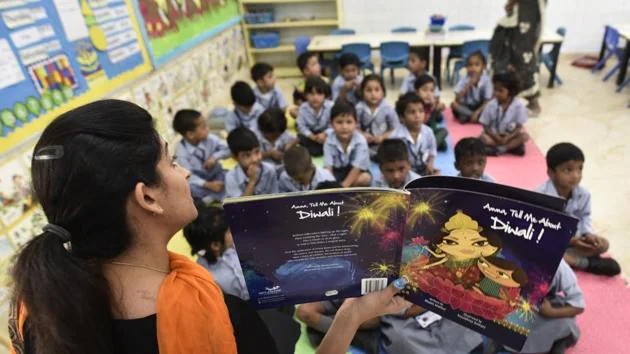
Delhi public schools face a severe 46% deficit in permanent Sanskrit teachers, leaving only 2,583 educators to handle approximately 800,000 students. This staffing shortage has triggered an operational logjam just as central directives from the CBSE and KVS mandate a strict three-language formula under NEP 2020, forcing schools to adopt stopgap measures such as deploying temporary guest teachers and using lower-grade textbooks for older cohorts due to delayed learning material distribution.
NEW DELHI — Delhi government schools are grappling with a severe logistical and personnel hurdle as nearly 46% of sanctioned regular Sanskrit teaching posts currently sit vacant. This critical shortage of qualified faculty emerges just as the Central Board of Secondary Education (CBSE) moves forward with a sweeping transition to make a native third language (R3) compulsory from Class VI onward under its newly amended Scheme of Studies. The administrative strain has sparked mounting concerns among educational administrators, teachers' unions, and parents regarding the capital’s preparedness to implement the structural curriculum shifts slated for the current academic session.
The Scale of the Staffing Crisis
Data compiled from official educational registries reveals a stark mismatch between student enrollment and the volume of permanent language faculty. Approximately eight lakh (800,000) students spanning Classes VI to X across Delhi's public school infrastructure are currently supported by only 2,583 regular Sanskrit teachers. This translates into a disproportionate student-to-teacher ratio of roughly 310:1.
The systemic deficit is most acute across specific teaching tiers:
Postgraduate Teachers (PGT): Out of 695 legally sanctioned senior positions required to lead higher-level language instruction, only 374 posts are occupied, leaving 321 vacancies.
Trained Graduate Teachers (TGT): Against a total sanctioned framework of 4,123 positions, only 2,209 permanent teachers are active. While 1,879 temporary guest teachers have been deployed to patch the gap, the system remains structurally short-staffed.
Compounding the problem, existing Sanskrit educators state that they are regularly diverted to handle primary classes, administrative paperwork, or unrelated proxy periods because school administrations treat them as surplus general staff.
Structural Alignment with NEP 2020
The crisis has been intensified by a pair of highly compressed regulatory directives issued by central authorities. On May 15, 2026, the Central Board of Secondary Education mandated that all affiliated institutions execute the National Curriculum Framework for School Education (NCFSE 2023) and the National Education Policy (NEP 2020) by enforcing a mandatory three-language formula.
Under Circular No. Acad-33/2026, students must study three languages, at least two of which must be native Indian languages. Foreign languages like French or German, which once enjoyed high enrollment in elite urban blocks, have been relegated to optional fourth-language or hobby-club statuses.
In tandem, the Kendriya Vidyalaya Sangathan (KVS) issued its own directive on May 29, 2026, ordering its 1,300+ central schools to establish at least one mandatory Sanskrit section per institution for Classes 6 and 9 to ensure academic continuity for children of transferable central government employees.
Because Sanskrit has long functioned as the foundational third-language framework across northern states, private and public institutions are defaulting to it to satisfy the "two native languages" requirement. This sudden surge in system-wide demand has transformed a chronic staffing shortage into an acute operational logjam.
Official Sources Section
According to official notifications released via the CBSE Academic portal and internal status reports compiled by the Directorate of Education (DoE) Delhi, individual schools are being forced to navigate a transitional strategy.
Due to delays in the publication of graded, NCFSE-aligned textbooks by the National Council of Educational Research and Training (NCERT), the CBSE has authorized an interim measure: schools must utilize existing Class VI editions to teach incoming Class IX cohorts for the initial cycles of the 2026–27 session. Boards have instructed all institutions to update their language configurations on the official OASIS tracker by June 30, 2026.
Quote Section
A senior representative from the Kendriya Vidyalaya Sangathan, speaking on condition of anonymity, noted the operational friction:
"The policy is deliberately designed to protect student interests and build regional linguistic bridges. While we acknowledge that specific zones face immediate teacher availability constraints, we are bridging the deficit via localized contractual employment, adjusted digital timetabling through our Samagam portal, and mixed-language section modules."
Conversely, a veteran TGT Sanskrit educator stationed at a Sarvodaya Kanya Vidyalaya in East Delhi voiced structural skepticism:
"The administration has spent years talking about the cultural value of Sanskrit, yet they have failed to fill the permanent vacancies. If you suddenly compel hundreds of thousands of additional students to take this subject, you cannot expect a single teacher to effectively manage 300-plus pupils without compromising the quality of education."
Why It Matters
The collision between aggressive curriculum timelines and deep vacancies alters the daily reality of the school ecosystem. Students face volatile timetables and substitute-driven classrooms where complex classical syntax is taught by unspecialized personnel. For parents, the sudden phasing out of foreign language pathways creates mid-stream friction, forcing children to adjust to entirely new scripts without preparatory padding. For the broader academic ecosystem, it highlights a recurring public policy gap: mandating complex, identity-focused curriculum adjustments before securing the underlying human infrastructure necessary to execute them.
Key Facts at a Glance
Deficit Severity: 46% of regular Sanskrit teaching positions in Delhi government schools are currently unoccupied.
Extreme Ratios: Current staffing dynamics subject language instructors to highly inflated loads, averaging one teacher per 310 active pupils.
The New Mandate: CBSE directives state that starting July 1, 2026, Class IX students must study three languages, ensuring two are native Indian options.
Stopgap Measures: Due to missing NCFSE textbooks, schools are legally sanctioned to utilize lower-grade learning materials as an interim tool.
KVS Integration: All Kendriya Vidyalayas must maintain a minimum of one active Sanskrit segment per institution for Classes 6 and 9.
FAQ Section
Q: Is Sanskrit completely compulsory for every student under the new rules?
A: No. The CBSE policy requires students to select a third language (R3) that must be a native Indian language distinct from their R1 and R2 choices. While schools are free to offer regional options like Punjabi, Urdu, or Tamil, many institutions choose Sanskrit as their default operational offering due to structural familiarity, thus narrowing the practical choice for students.
Q: How are schools handling the immediate absence of certified language teachers?
A: The CBSE has instituted a transitional waiver allowing schools facing severe resource constraints to temporarily utilize existing faculty from other subject areas who possess basic functional proficiency in the designated native language.
Q: Will the new third language require high-stakes Board Examinations?
A: To alleviate unnecessary psychological stress on students, the central board clarified that no formal external Board Examination will be administered for the R3 language at the Class X level. Assessments will be managed through internal, school-based grading structures.
Source: Central Board of Secondary Education Academic Unit, Kendriya Vidyalaya Sangathan Circulars Desk, Directorate of Education, Government of NCT of Delhi.