Indian equity benchmarks face a volatile trading session today as mixed global cues pull investors in opposing directions. Positive sentiment from lower U.S. inflation data is countered by rising crude oil prices due to renewed U.S.-Iran tensions, spotlighting banking stocks and institutional fund flows.
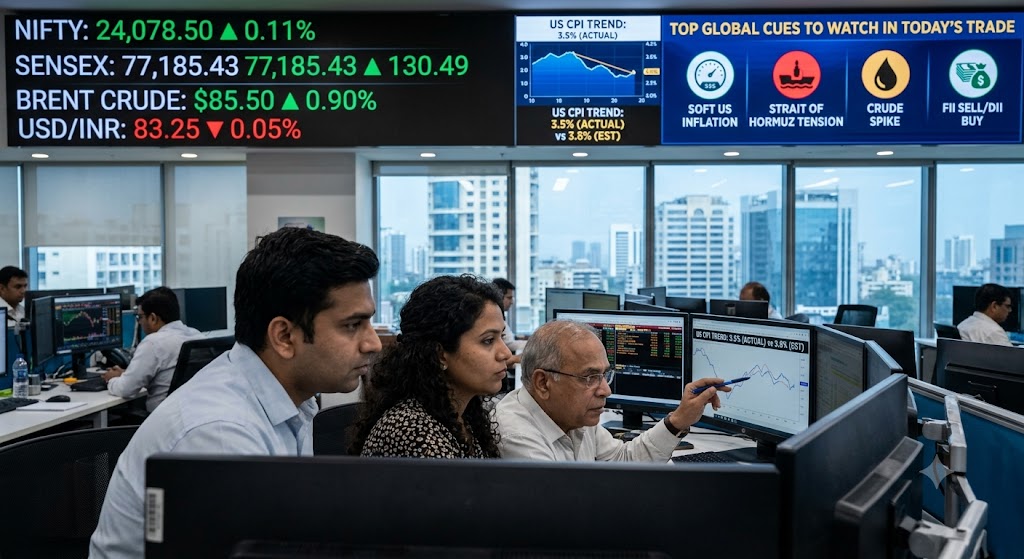
MUMBAI — Indian equity markets are bracing for a volatile opening session on July 16, 2026, as market participants digest a highly conflicting matrix of macroeconomic and geopolitical factors. Frontline financial indices are tracking mixed global cues after a sharp intraday retreat in the previous session highlighted persistent selling pressure at higher technical thresholds. While lower-than-expected U.S. inflation data has provided a structural cushion by reviving hopes of a more accommodative Federal Reserve monetary policy, an unexpected escalation in West Asia tensions—marked by a fresh closure of the strategically vital Strait of Hormuz—continues to cap broader market optimism.
On Wednesday, the 30-share BSE Sensex ended mildly higher by 130.49 points at 77,185.43, recovering from an initial 553-point surge that faded on institutional profit-booking. Similarly, the 50-share NSE Nifty settled at 24,078.50, up 0.11%, remaining vulnerable to high-altitude resistance.
Cool Inflation vs. Boiling Geopolitics
The principal anchor for global risk assets remains the newly released U.S. Consumer Price Index (CPI) report. According to government statistical updates, U.S. consumer price inflation eased to 3.5% year-on-year for June, printing comfortably below consensus market expectations of 3.8%. Furthermore, month-on-month consumer prices contracted by 0.4%, compared to expectations of a minor 0.1% decline. This softer trajectory has significantly reinforced bets that the Federal Reserve will adopt a less aggressive monetary stance in its upcoming policy meetings, providing immediate breathing room for global equities.
However, this macroeconomic optimism faces a massive hurdle from escalating military friction between the United States and Iran. Market sentiment took a severe hit during afternoon operations when Iran reasserted its block over the Strait of Hormuz, an essential transit pathway handling nearly a fifth of global petroleum liquid volumes. The supply threat drove global oil benchmark Brent crude higher to $85.50 per barrel, representing an approximate 0.90% increase. High energy costs traditionally weigh on Indian markets, given the country's extensive dependence on petroleum imports.
Sector Performance and Institutional Activity
The market internal structure exhibits stark divergence across primary sectors. Financial and banking stocks have emerged as the primary defensive line for the index. State Bank of India (SBI) emerged as a top performer in the previous session, rallying 1.45% to close at Rs 1,030.10 and reclaiming its 20-day exponential moving average (EMA). Bajaj Finance, Axis Bank, and UltraTech Cement also logged notable gains, while technology and metal indices faced significant headwind pressures. The Nifty IT index declined by 0.67%, weighed down by localized global technology adjustments.
From the fund flow perspective, provisional exchange data indicates that Foreign Institutional Investors (FIIs) remained net sellers, offloading equities worth Rs 739.69 crore. Conversely, Domestic Institutional Investors (DIIs) offered robust localized liquidity support, recording net equity purchases totaling Rs 2,927.71 crore.
Official Sources Section
According to official corporate updates from domestic exchanges and regulatory reports:
U.S. inflation data was officially verified via the Department of Labor's June Consumer Price Index release.
Local institutional trading volumes and net investment distributions were confirmed by provisional data statements from the National Stock Exchange (NSE) and Bombay Stock Exchange (BSE).
Energy price benchmarks were calculated according to Intercontinental Exchange (ICE) Brent crude futures settlements.
Quote Section
"Global cues turned relatively supportive overnight after softer-than-expected June CPI data reinforced hopes of a more accommodative Federal Reserve policy," stated Rajesh Palviya, Head of Research at Axis Direct.
"The softer-than-expected inflation reading has reinforced expectations that the Federal Reserve could adopt a less aggressive monetary policy stance, offering some relief to global risk assets despite the heightened geopolitical uncertainty," noted Ponmudi R., CEO of Enrich Money.
Why It Matters
For everyday retail investors and fund managers, today's trade setup highlights the thin line between cooling monetary policy and structural geopolitical risks. A prolonged blockade in the Strait of Hormuz could raise domestic input costs for logistics and manufacturing firms, forcing the Reserve Bank of India to maintain elevated domestic borrowing rates despite cooling global inflation trends.
Key Facts at a Glance
Index Status: Nifty holds above its critical 50-day moving average threshold of 23,830 despite fading from intraday highs.
Macro Catalyst: U.S. June CPI declined to 3.5% year-on-year, undershooting the 3.8% forecast value.
Energy Headwind: Brent crude surged toward $85.50 per barrel following renewed regional blockades.
Institutional Imbalance: Domestic institutional buying (Rs 2,927.71 crore) successfully offset FII outflows of Rs 739.69 crore.
FAQ Section
Q1: Why did the stock market rally fade in the previous session?
The initial rally, driven by positive U.S. inflation data, faded after reports emerged that Iran had closed the Strait of Hormuz, triggering immediate energy supply concerns and afternoon profit-taking.
Q2: What was the recorded U.S. inflation rate for June?
U.S. inflation cooled down to 3.5% year-on-year, coming in lower than the market projection of 3.8%.
Q3: Which sectors are currently showing the highest resilience?
Banking and financial services, particularly large caps like State Bank of India and Bajaj Finance, are showing high resilience, whereas IT and metals remain weak.
Source: National Stock Exchange of India (NSE), Bombay Stock Exchange (BSE), U.S. Bureau of Labor Statistics, Intercontinental Exchange crude data, and Geojit Financial Services market reports.