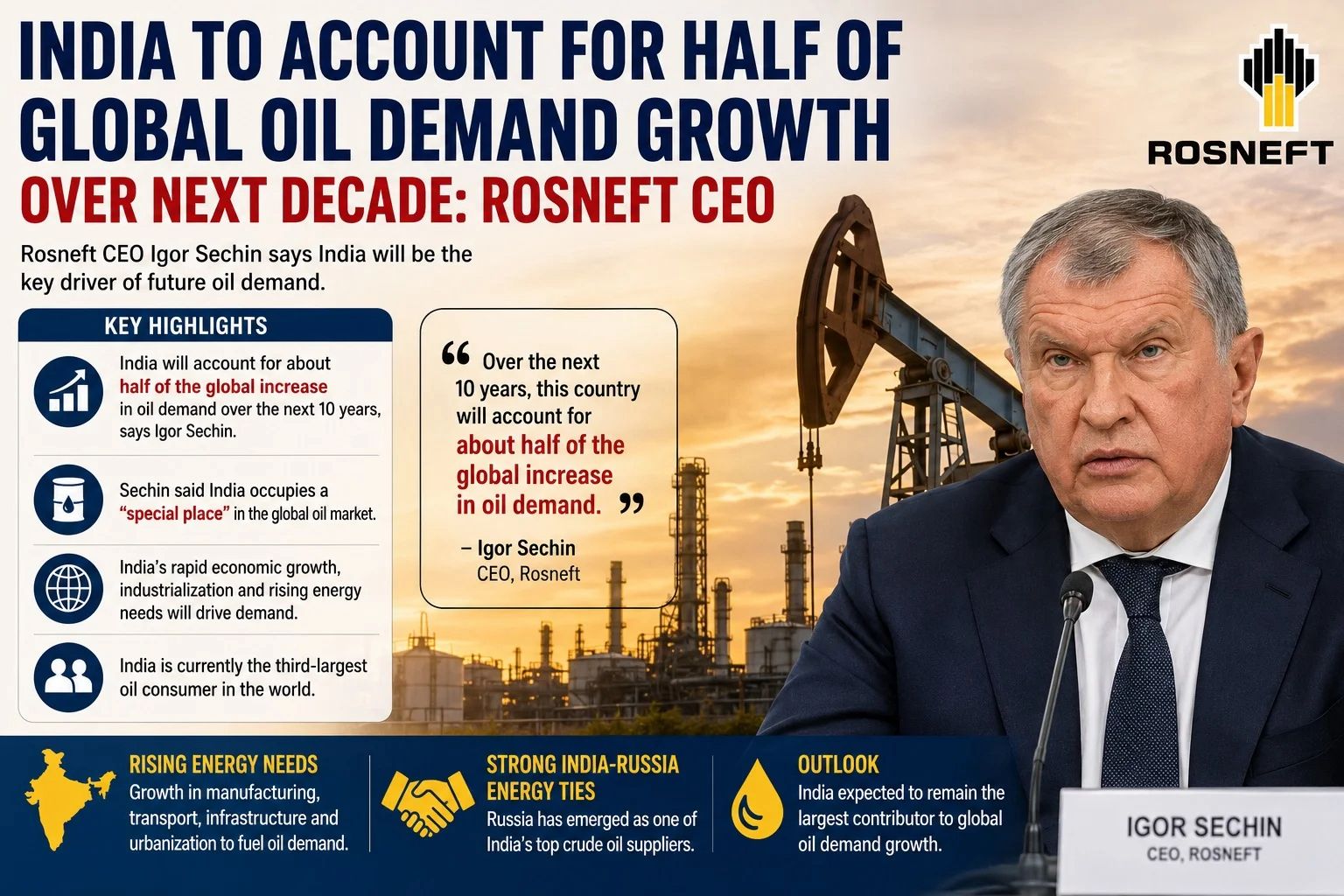
According to Rosneft CEO Igor Sechin, India will account for half of all global oil demand growth and 15% of electricity consumption increases over the next decade. Driven by industrialization, India's crude usage will climb 44% to 8 million bpd by 2035, reshaping global trade flows despite maritime chokepoint challenges.
ST. PETERSBURG — India has officially solidified its status as the structural focal point of the international energy market. Speaking at the high-level energy panel of the St. Petersburg International Economic Forum (SPIEF), Igor Sechin, Chief Executive Officer of Russian state oil major Rosneft, announced that India is projected to account for approximately half of all global oil demand growth over the next ten years.
The comprehensive data presentation outlines a profound structural shift in global energy dynamics. As macroeconomic activity and fuel consumption cool across mature Western markets and stabilize in China, India's rapid industrialization, expanding urban middle class, and aggressive infrastructure investments are positioning the South Asian nation as the primary catalyst for international fuel consumption. According to independent estimates aligned with the International Energy Agency (IEA), India's total oil consumption is on track to surge by 44%, reaching nearly 8 million barrels per day (bpd) by 2035, compared to an expected expansion of just 5% for the rest of the world combined.
The Decade-Long Surge in Crude and Power Consumption
The multi-year trajectory outlined by the Russian energy apparatus highlights that India's domestic expansion spans well beyond petroleum. The country's parallel electrical requirements are similarly primed to rewrite global infrastructure models.
According to figures compiled in the Rosneft executive report, India will simultaneously generate roughly 15% of the net worldwide increase in electricity consumption over the next decade. Driven by nationwide grid expansions and an unprecedented boom in industrial manufacturing, the subcontinental power demand is projected to soar by 80% to nearly 3,000 terawatt-hours, effectively approaching the current total power consumption thresholds of the entire European Union.
Geopolitical Bottlenecks and Chokepoint Risks
While India's long-term energy appetites offer unmatched trade potential for primary exporting states, the Kremlin-backed energy brief explicitly flagged immediate security threats to regional import channels.
The Strait of Hormuz Vulnerability
Because the Indian domestic economy remains heavily dependent on foreign energy supplies, maritime chokepoints present a persistent systemic risk. Sechin pointed directly to ongoing regional blockades and security escalations around the Strait of Hormuz as a primary threat to subcontinental supply lines.
The strategic risk analysis highlights four critical logistical vulnerabilities:
Freight and Insurance Spikes: Escalating drone and naval encounters in international waters continue to drive maritime hull insurance premiums higher for transport fleets.
Fertilizer Shipping Disruptions: Volatility across critical straits extends directly to chemical agriculture shipments, pushing global fertilizer prices up nearly 60% early this year.
Food Security Spills: Disruptions in key agricultural inputs heighten the long-term risk of food price inflation across vulnerable sectors in India, Southeast Asia, and Africa.
Refining Bottlenecks: Sudden raw crude delay patterns challenge the continuous operation of high-volume refining centers situated along India's western coast.
Strategic Dividends from the Moscow-New Delhi Energy Corridor
Despite tightening international sanctions regimes orchestrated by Western capitals, trade structures connecting Russian extraction fields directly to Indian refining networks have grown significantly deeper.
"According to organizers and trade attachés present at the economic summit, the bilateral energy partnership has yielded unprecedented fiscal discounts for subcontinental purchasing cartels. State-backed suppliers emphasize that Russia cannot be excluded from global supply architectures."
Quantifying the economic scale of this deep trade alignment, Sechin revealed that stable Russian crude oil shipments have generated massive financial windfalls for buyers outside the West. Since April 2022, the cumulative value of these economic benefits and pricing discounts enjoyed directly by corporate refiners across India and China has exceeded $40 billion, effectively shielding local retail markets from severe global price shocks.
Why It Matters
For ordinary consumers and vehicle owners, India’s commanding position as a driver of global oil demand growth underscores the vital importance of secure import partnerships. The discounted bilateral barrels provided by international suppliers help the government keep local retail fuel prices stable, preventing runaway domestic inflation.
For international energy investors, private industrial conglomerates, and commodity traders, this decade-long expansion establishes India as the ultimate volume market. As major domestic firms expand their localized refining capacities by an anticipated 1 million bpd, the subcontinent will increasingly dictate global oil pricing, refining trends, and chemical supply chains well beyond its geographical borders.
Key Facts at a Glance
The Growth Engine: India will drive approximately 50% of net global oil demand growth over the next ten years.
Petroleum Peak: India’s domestic oil consumption is projected to rise 44% to near 8 million barrels per day by 2035.
Electrical Surge: Subcontinental electricity demand will jump 80% to 3,000 terawatt-hours, matching the current size of the EU power market.
Economic Windfall: Bilateral discount arrangements on Russian crude have saved India and China over $40 billion since April 2022.
Frequently Asked Questions
Why is global oil demand growth shifting so heavily toward India?
As energy consumption slows down in advanced Western nations and flattens out in China, India's rapid urbanization, industrial expansion, and rising transportation needs make it the world's fastest-growing energy consumer.
What specific maritime risks could disrupt India's energy security?
As highlighted by Rosneft, ongoing geopolitical conflicts near critical naval chokepoints like the Strait of Hormuz create major risks for crude delivery, raise shipping insurance rates, and can drive up global fertilizer costs.
How does India’s expanding refining system impact other parts of the world?
By expanding its crude distillation capacities by over 1 million barrels per day, India is transforming into a dominant global hub for exporting refined transport fuels across Asia and the Atlantic Basin.
Sources:
Keynote energy sector report presented by CEO Igor Sechin at the St. Petersburg International Economic Forum (SPIEF 2026).
Global consumption and production databases managed by the International Energy Agency (IEA).
Bilateral trade data and import volume logs maintained by the Ministry of Petroleum and Natural Gas, Government of India.
Official diplomatic statement archives released by the Russian state-run TASS News Agency.