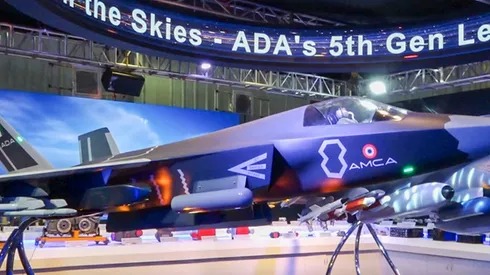
India's Ministry of Defence has invited bids from private sector companies to build prototypes of the Advanced Medium Combat Aircraft (AMCA), the country's first indigenous fifth-generation stealth fighter jet. The move marks a landmark shift in India's defence industrial policy, throwing open one of its most ambitious aerospace programmes to private players beyond the state-owned Hindustan Aeronautics Limited (HAL).
A Historic Pivot In Defence Procurement
The Request for Proposal (RFP) issued for the AMCA prototype marks the first time India has formally invited private sector participation in a cutting-edge, next-generation military aviation programme. Traditionally dominated by HAL, India's fighter jet development ecosystem is now being widened to attract Tata Advanced Systems, Mahindra Defence, L&T and other capable private defence manufacturers. The decision reflects New Delhi's broader Aatmanirbhar Bharat and defence indigenisation agenda, where private industry is increasingly seen as a co-creator rather than a sub-contractor.
About The AMCA Programme
What India is building
The AMCA is a twin-engine, stealth-capable, fifth-generation multi-role combat aircraft being developed by the Aeronautical Development Agency (ADA) under the Defence Research and Development Organisation (DRDO). It is designed to carry internal weapons, feature a reduced radar cross-section, supercruise capability, and advanced avionics placing it in the same class as the US F-22 Raptor and China's J-20. The aircraft is envisioned as the backbone of the Indian Air Force's future strike and air superiority fleet, supplementing the Tejas LCA and Rafale squadrons already in service.
Prototype phase and private sector role
The government has now sought bids specifically for manufacturing five AMCA prototypes, which will be used for flight testing, avionics integration and weapons trials before series production begins. Private firms are expected to compete or form consortiums to build the airframe, integrate sub-systems and meet exacting manufacturing tolerances required for stealth aircraft. The eventual production contract, expected to cover over 100 aircraft, represents a multi-billion-dollar opportunity for the selected partner.
Why The Private Sector Matters Here
India's defence industrial base has historically struggled with delays, cost overruns and technology gaps when projects were concentrated in public-sector entities. By introducing private competition at the prototype stage, the government aims to inject efficiency, innovation and accountability into the programme while also building a deeper private aerospace supply chain for the long term. The move is also expected to attract foreign technology partnerships and joint ventures, further accelerating AMCA's development timeline.
Key Highlights
- Ministry of Defence issues RFP inviting private sector bids for AMCA fifth-generation fighter jet prototypes
- AMCA is India's first indigenous stealth, twin-engine, fifth-generation multi-role combat aircraft
- Five prototypes to be built for flight testing, avionics trials and weapons integration
- Private defence firms including Tata, Mahindra and L&T expected to bid independently or as consortiums
- Programme developed by ADA-DRDO; production contract expected to cover 100+ aircraft
- Move signals India's shift from HAL-centric model to broader private-sector defence manufacturing
- Aligns with Aatmanirbhar Bharat and India's ambition to become a top-five global defence producer
Sources: Ministry of Defence announcements, DRDO-ADA project updates, contemporary defence journalism