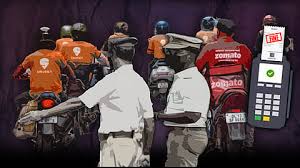
Indian traffic police and labor regulators have cracked down on quick-commerce platforms promising 10-minute delivery due to rising road accidents and worker exploitation. Outlining strict standard operating procedures, authorities have banned time-bound speed incentives, mandated police clearances for riders, and directed platforms to replace hyper-fast taglines with safety-first logistics.
MUMBAI — Law enforcement agencies and regulatory bodies across major Indian metropolitan hubs have initiated a coordinated crackdown on quick-commerce platforms promising 10-minute delivery to urban consumers. Citing an exponential increase in dangerous traffic violations, localized road accidents, and extreme psychological stress imposed on gig workers, regional traffic police departments have issued formal directives mandating that digital aggregators halt all time-bound delivery guarantees. The intervention marks a dramatic shift in the governance of India’s booming quick-commerce market, forcing public and private digital firms to restructure their core advertising and logistical systems.
Law Enforcement Establishes Strict Operating Protocols
The operational crackdown intensified following a series of high-level administrative reviews led by senior urban transit officials. According to data released by the Mumbai Traffic Police Department, law enforcement personnel penalized more than 8,300 delivery riders over a two-week window for severe on-road offenses, including driving on the wrong side of the road, jumping electronic signals, over-speeding, and operating vehicles without protective helmets.
In a comprehensive directive delivered to online grocery and food aggregators, Satyanarayan Choudhary, Joint Commissioner of Police (Traffic), confirmed that a binding Standard Operating Procedure (SOP) has been established. Under these fresh guidelines, public sector oil marketing networks, food portals, and quick-commerce operations are required to actively dismantle their time-bound reward matrices.
Furthermore, law enforcement has mandated that all active aggregators secure official Police Clearance Certificates (PCC) for their entire fleet of delivery riders. To ensure long-term compliance, authorities announced that any two-wheelers found operating with multiple unresolved electronic traffic challans (fines) will be subject to immediate physical seizure by field officers.
National Labor Interventions and the End of the Speed Tagline
The regulatory pushback extends beyond localized transit enforcement. The Union Ministry of Labour and Employment stepped directly into the dispute following nationwide flash strikes organized by delivery worker unions, who logged off their platforms to protest unsafe and punitive working conditions.
Union Labour Minister Mansukh Mandaviya convened emergency regulatory meetings with top executives representing major digital aggregators, including Blinkit, Zepto, and Swiggy Instamart. Formal updates archived by the ministry indicate that platforms were explicitly instructed to prioritize the physiological safety of their partners over aggressive marketing slogans.
Following these official ministerial interventions, prominent platforms began modifying their core consumer interfaces. Market data tracks indicate that Zomato's Blinkit service changed its long-running promotional tagline from "10,000+ products delivered in 10 minutes" to a less time-sensitive alternative emphasizing doorstep variety. Despite these visual changes, labor rights groups caution that algorithmic pressures—such as automated rating downgrades and hidden financial penalties for delayed drops—must be systematically audited under the provisions of India's updated labor codes to ensure lasting systemic transparency.
Official Sources Section
The statutory guidelines, field enforcement statistics, and vehicular seizure mandates are based directly on standard operating disclosures published by the Mumbai Traffic Police Department and associated regional transport offices. Details concerning inter-ministerial executive orders, platform compliance responses, and the registration of gig workers on welfare databases mirror formal announcements issued by the Ministry of Labour and Employment.
Quote Section
"According to officials from the traffic department, the implementation of arbitrary, ultra-fast delivery targets forces young delivery partners to compromise basic road rules, directly endangering their own lives and the safety of ordinary pedestrians."
"Labor union representatives stated that while removing the 10-minute tagline from consumer applications improves public optics, regulatory bodies must monitor hidden algorithmic parameters that continue to penalize riders for traffic delays."
Why It Matters
The regulatory clampdown on platforms promising 10-minute delivery carries significant economic implications for urban consumers, gig economy workers, and institutional investors. For years, the rapid growth of the quick-commerce sector relied on satisfying consumer demands for instant gratification via localized "dark stores."
By forcing a structural pivot away from absolute speed, the government's intervention shields hundreds of thousands of gig workers from preventable road accidents. For the broader industry, this transition demands a reallocation of capital toward enhanced backend warehouse efficiencies, robust rider safety training, and realistic logistics scheduling rather than relying on high-speed on-road transit.
Key Facts at a Glance
Direct Police Ban: Traffic authorities have formally ordered quick-commerce platforms to halt time-bound delivery guarantees and speed-based worker rewards.
Mass Enforcement: Law enforcement agencies penalized over 8,300 delivery riders for hazardous driving violations within a 16-day tracking window.
Mandatory Background Verification: Aggregators must now systematically secure formal Police Clearance Certificates (PCC) for all active fleet partners.
Tagline Removal: Following direct consultations with the Union Labour Ministry, prominent platforms like Blinkit have removed explicit 10-minute delivery claims from their public advertisements.
Frequently Asked Questions
Why are traffic police departments targeting quick-commerce platforms?
Authorities intervened after identifying a direct statistical correlation between unrealistic 10-minute delivery deadlines and a surge in reckless driving, signal jumping, and severe road accidents involving delivery riders.
Will consumers still receive their orders quickly under the new rules?
Yes. Deliveries will continue to arrive quickly due to the proximity of neighborhood dark stores, but platforms are legally barred from guaranteeing a fixed, hyper-short timeline or penalizing riders for traffic delays.
What penalties do companies face for non-compliance?
Firms failing to audit their riders' profiles risk having vehicles with pending electronic traffic fines seized, alongside potential statutory penalties under updated national labor and transport codes.
Sources: