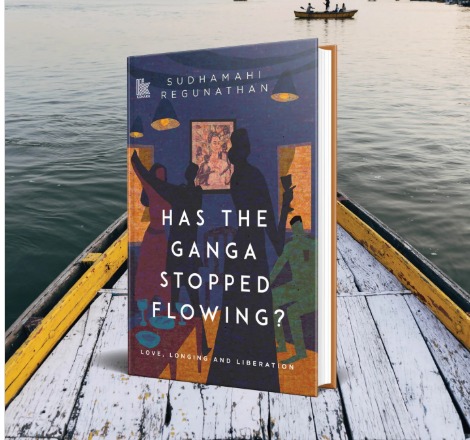
Author Sudhamahi Regunathan has launched her newest short story collection, 'Has the Ganga Stopped Flowing? Love, Longing and Liberation'. Comprising 18 sensitive stories published by Konark Publishers, the book skillfully uses the sacred Ganges river and regional Indian folklore to explore human endurance, memory, and domestic relationships in pre-technological India.
NEW DELHI — Accomplished author, translator, and academic Dr. Sudhamahi Regunathan has officially released her highly anticipated short story collection, titled 'Has the Ganga Stopped Flowing? Love, Longing and Liberation'. Published by Konark Publishers, the new literary anthology features 18 distinct narratives that examine the convergence of memory, myth, and human resilience. The official launch introduces readers to a carefully preserved social landscape of an India existing just before the rapid expansions of modern consumer technology, establishing a critical record of evolving national traditions and social customs.
The Intersect of Metaphor and Human Resilience
The collection moves across varied geographical and social settings, guiding readers through traditional villages, bustling railway platforms, sacred temples, formal courtrooms, and quiet domestic areas. Review metrics and literary data compiled by The Tribune India highlight how the anthology avoids single-themed categorization, opting instead to unpack the multi-layered complexities of isolation, love, displacement, and mortality with deep emotional awareness.
In the title story, 'Has the Ganga Stopped Flowing?', Regunathan uses the sacred river as an enduring metaphor for human continuity when confronted by personal betrayal and deep suffering. Rather than presenting the watercourse merely as a geographical entity, the narrative reimagines the river as an internal moral compass, pushing its characters to stand firmly and withstand external hardships.
Mythological Backdrops and Subverted Norms
A major structural pillar of the text is its deep familiarity with Indian spiritual traditions and its willingness to challenge conventional cultural expectations. In the short story 'Undying Fire', the narrative focuses heavily on a character named Hariparshad Tiwari and his intense pursuit of securing the sacred fire at Varanasi’s iconic Manikarnika Ghat.
According to formal publishing data from Konark Publishers, this specific story draws directly from historical folklore, integrating legends of King Harishchandra, the local Dom community, and the spiritual practices of Aghoris. Through this deliberate framing, the book transforms a physical search into a broader meditation on human dignity after death.
Concurrently, the collection actively subverts traditional social hierarchies. In 'The Village Hero', a story set against the isolated landscape of Ladakh, the text redefines accepted ideas of traditional masculinity. By following a dialogue regarding a woman's choice to enter a nunnery, the story demonstrates how highly visible public admiration can frequently mask deep, unresolved private grief within traditional families.
Official Sources Section
The corporate distribution details, physical book specifications, and thematic breakdowns are drawn directly from the official publication releases provided by Konark Publishers. The critical analysis of the text's narrative arcs, plot structures, and regional backdrops conforms directly to literary evaluations archived by major regional literary review panels, including The Tribune India book editorial desk.
Quote Section
"According to officials at Konark Publishers, the 188-page fiction anthology explores the subtle, often unspoken emotions shaping human relationships before the sweeping structural changes brought by digital technology."
"Reviewers and literary organizers stated that the collection is highly effective at transforming ordinary domestic suffering into quiet tragedy, using names and generational memory as primary repositories of affection and gratitude."
Why It Matters
The release of 'Has the Ganga Stopped Flowing?' carries distinct value for cultural historians, students of South Asian literature, and general readers tracking the evolution of contemporary Indian fiction. By capturing the social fabric of pre-technological India, the book preserves an invaluable record of how communities managed domestic conflict, grief, and faith before mobile connectivity altered interpersonal communication. Furthermore, it highlights the continued relevance of classical mythology in explaining modern psychological struggles.
Key Facts at a Glance
Anthology Scope: The new book consists of 18 meticulously crafted short stories spanning 188 pages.
Core Themes: The text explores mortality, memory, social customs, faith, and the quiet resilience of individuals.
Author Background: Dr. Sudhamahi Regunathan is an experienced translator and the former Vice Chancellor of the Jain Vishva Bharati Institute.
Geographical Diversity: The narrative backdrops transition seamlessly between the river ghats of Banaras, the high-altitude terrains of Ladakh, and formal urban spaces.
Frequently Asked Questions
Who wrote the new book 'Has the Ganga Stopped Flowing?'
The collection was written by Dr. Sudhamahi Regunathan, an acclaimed Indian author, translator, and the former Vice Chancellor of the Jain Vishva Bharati Institute in Ladnun.
What is the primary focus of the short story collection?
Across 18 independent fictional stories, the book explores the deep complexities of human connections, focusing heavily on how memory, traditional myths, and personal resilience shape human survival.
When was the book officially published?
The paperback edition of the book was officially brought to market by Konark Publishers in the first half of 2026.
Why does the book focus on a pre-technological India?
The setting allows the narrative to focus directly on raw, uninterrupted human interactions and traditional communal customs before digital devices changed daily communication.
Sources: