A four-tonne, school-bus-sized upper stage of a SpaceX Falcon 9 rocket is believed to have unintentionally crashed into the Moon's Einstein Crater at 5,400 mph. Drifting in deep space since January 2025, solar activity and gravity pushed the spent booster onto an unsteerable lunar trajectory, providing a rare scientific study opportunity.
Driven by solar activity and deep space gravity, a discarded SpaceX rocket stage has reportedly completed an unintentional high-speed collision with the lunar surface.
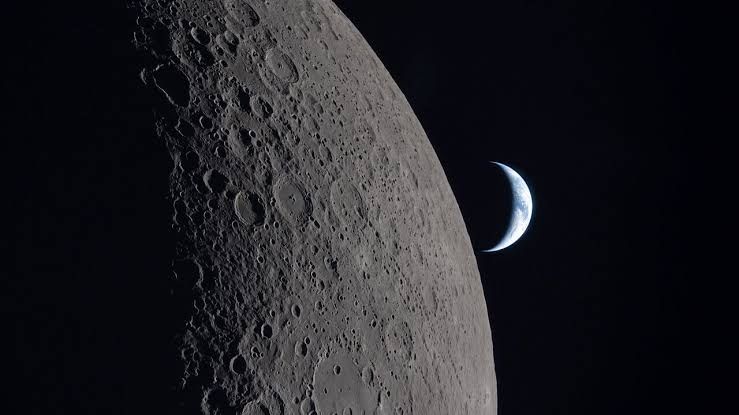
In a rare cosmic collision tracked closely by international astronomers, a four-tonne upper stage of a SpaceX Falcon 9 rocket is believed to have unintentionally crashed into the Moon. The impact occurred on August 5, 2026, sending the school-bus-sized metal body slamming into the lunar crust near the Einstein Crater at a staggering velocity of 5,400 miles per hour (8,690 km/h). Originally launched in January 2025 to deploy commercial lunar landers, the spent booster had been drifting through orbital space for over a year. Captured by a complex interplay of solar radiation pressure and gravitational forces, the unsteerable hardware crossed paths with the Moon, offering planetary scientists a unique opportunity to examine high-velocity impact mechanics.
Orbital Mechanics and the Journey to the Moon
Unlike standard rocket stages that execute controlled re-entry burns to burn up in Earth's atmosphere or splash down safely in remote ocean basins, deep-space lunar missions require significant terminal energy. This leaves upper stages stranded on eccentric heliocentric or Earth-intersecting orbits.
According to tracking data and orbital analysts, key factors behind the lunar intercept include:
Extended Drift Duration: The hardware remained in space for 18 months following its early 2025 dual-lander mission carrying payloads for American and Japanese aerospace ventures.
Fuel Depletion: Having exhausted its propellant during initial deployment phases, the stage possessed zero onboard propulsion capability or remote maneuverability.
Gravitational Tug-of-War: Gradual shifts driven by solar particle pressure and Earth-Moon gravitational fields modified its path over months into a direct intersection trajectory.
Impact Force: Planetary calculations indicate the strike released kinetic energy equivalent to roughly three tonnes of TNT, gouging a crater estimated to be dozens of feet wide.
Impact on Space Debris Tracking, Science, and Future Missions
While the incident poses zero structural or physical threat to Earth, it has renewed global discourse among space agencies regarding cislunar traffic management. With NASA’s upcoming crewed Artemis deployments and international lunar base initiatives moving forward, tracking uncontrolled objects near the Moon has become an urgent priority. Scientists plan to use orbiting instruments—including NASA’s Lunar Reconnaissance Orbiter (LRO) and South Korea’s Danuri spacecraft—to photograph before-and-after surface conditions, analyzing the ejected subsurface regolith and measuring the dimensions of the newly formed crater.
Why It Matters
As commercial and government missions to the Moon accelerate, monitoring discarded hardware becomes critical for planetary protection. This unplanned impact provides scientists with empirical data on how artificial materials interact with the lunar regolith, while emphasizing the growing necessity for sustainable orbital housekeeping.
Key Facts at a Glance
Object Involved: Four-tonne upper stage of a SpaceX Falcon 9 rocket (approximate size of a school bus).
Impact Date: August 5, 2026.
Impact Speed: 5,400 miles per hour (8,690 km/h).
Location: Near the Einstein Crater on the Moon's western limb.
Earth Safety: Zero threat or danger to terrestrial infrastructure.
FAQ Section
Did the SpaceX rocket intentionally crash into the Moon?
No, the collision was entirely unintentional; the spent rocket stage had exhausted its fuel and drifted unguided for months before solar and gravitational forces altered its orbit.
Did the impact pose any danger to people on Earth?
No, space agencies confirmed that the lunar collision presented zero physical or structural risk to Earth.
How do scientists plan to study the crash site?
Orbiting spacecraft such as NASA's Lunar Reconnaissance Orbiter and South Korea's Danuri probe are scheduled to capture high-resolution imagery comparing the lunar surface before and after the impact.
Where can readers track future updates on cislunar space debris?
Detailed orbital reports and agency updates are accessible via the NASA Science Portal and astronomical monitoring networks like Project Pluto.
Source: The Guardian, The Economic Times, Project Pluto, Times of India