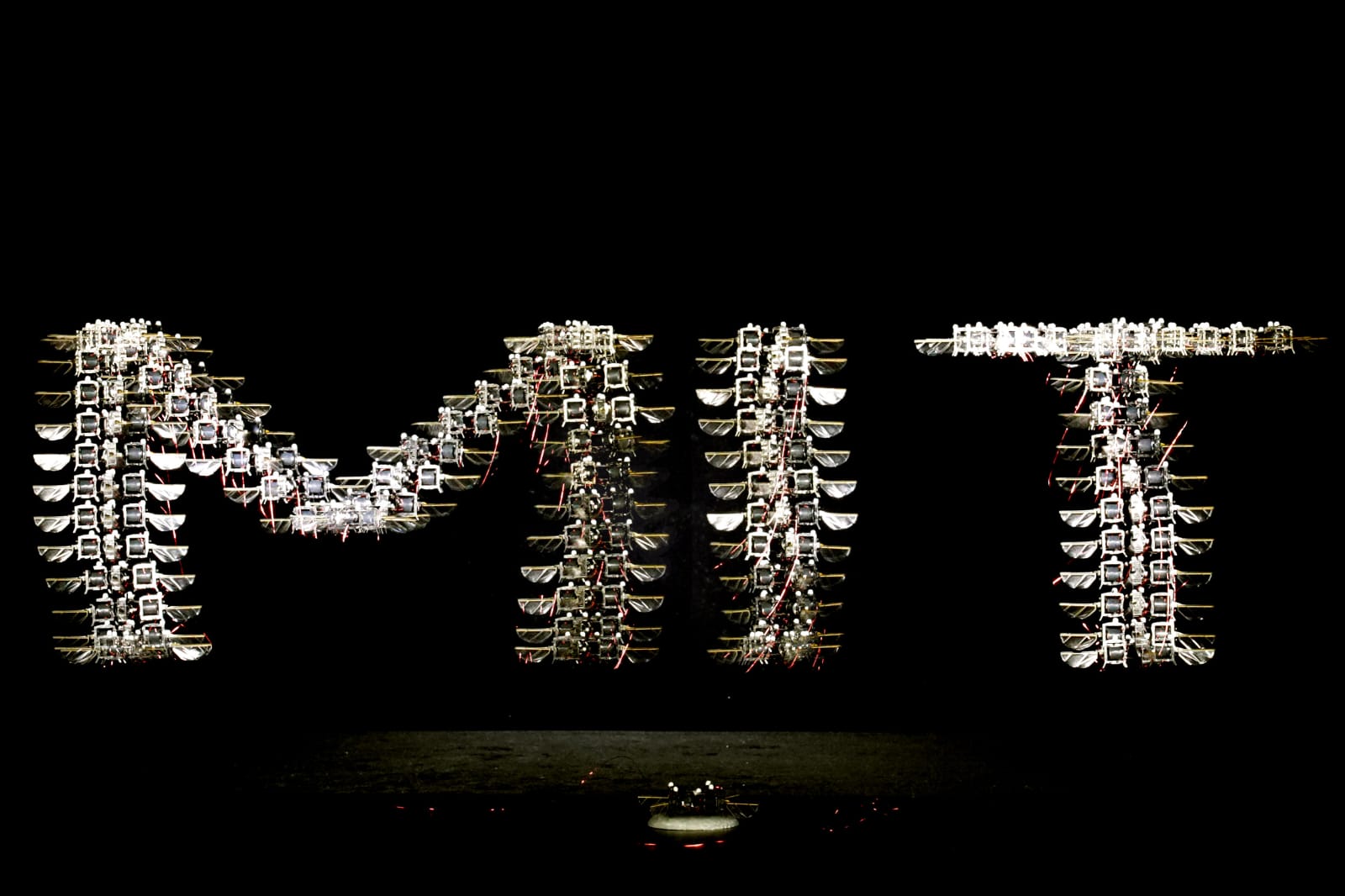

MIT researchers have developed a microrobot that flies as fast and agile as a bumblebee, using soft artificial muscles and advanced AI control. This tiny device can perform complex aerial maneuvers, withstand turbulence, and could soon revolutionize search-and-rescue missions, environmental monitoring, and even pollination efforts with its insect-like flight capabilities.
MIT researchers have unveiled a groundbreaking aerial microrobot capable of flying with the speed and agility of a real bumblebee. This tiny device, lighter than a paperclip, demonstrates unprecedented maneuverability and sets the stage for revolutionary applications in search-and-rescue and environmental monitoring.
Breaking the Speed Barrier
The latest iteration of MIT’s microrobot is equipped with larger, flapping wings powered by soft artificial muscles. These wings enable the robot to achieve rapid movements and execute complex aerial maneuvers, including rapid turns, aggressive body tilts, and even consecutive somersaults. In experiments, the robot reached speeds up to 447 percent faster and acceleration up to 255 percent greater than previous models, staying within a few centimeters of its intended trajectory even during challenging wind conditions.
Key Highlights
-
Insect-Like Agility: The microrobot can perform gymnastic flight paths such as continuous body flips, mimicking the flight behavior of real insects.
-
Advanced AI Control: A two-part control system, combining a model-predictive planner and a deep-learning policy, allows the robot to make real-time flight decisions and execute intricate maneuvers.
-
Robust Design: The new controller is designed to consider force and torque constraints, minimizing the risk of collisions and enabling stable flight even in turbulent environments.
-
Saccade Movement: The robot can replicate the rapid pitch and stop behaviors seen in insects, which could be crucial for navigation and sensor-based applications.
-
Future Applications: With further enhancements, these robots could be deployed for search-and-rescue missions in disaster zones, pollination of crops, or even exploration in confined spaces.
Real-World Potential:
MIT’s breakthrough signals a major step toward practical, real-world deployment of microrobots. The team plans to integrate sensors and cameras, allowing the robots to operate outdoors without relying on motion-capture systems. This could open up new possibilities for coordinated swarms of microrobots, capable of navigating complex environments with insect-like precision.
Source: MIT News, Science Advances, Modern Mechanics 24