Union Commerce Minister Piyush Goyal has urged the leather and footwear industry to target $15 billion in exports within five to six years. To achieve this three-fold growth, he emphasized utilizing new Free Trade Agreements, expanding workforces, and adopting robotics, artificial intelligence, and sustainable manufacturing practices.
NEW DELHI, India — Union Minister of Commerce and Industry Piyush Goyal has called upon the domestic leather and footwear industry to scale up operations and target at least $15 billion in cumulative exports over the next five to six years. Speaking in New Delhi, the minister outlined an aggressive roadmap to achieve a three-fold expansion from the country's current outbound trade baselines.
The mandate comes at a critical juncture for India's consumer goods manufacturing sectors, as the central government aggressively rolls out newly negotiated bilateral trade packages. Capitalizing on alternative global supply chains, the government is positioning traditional craftsmanship sectors to transition into automated, high-volume international export hubs capable of addressing premier consumer demand.
Free Trade Agreements to Unlock Access Across 38 Countries
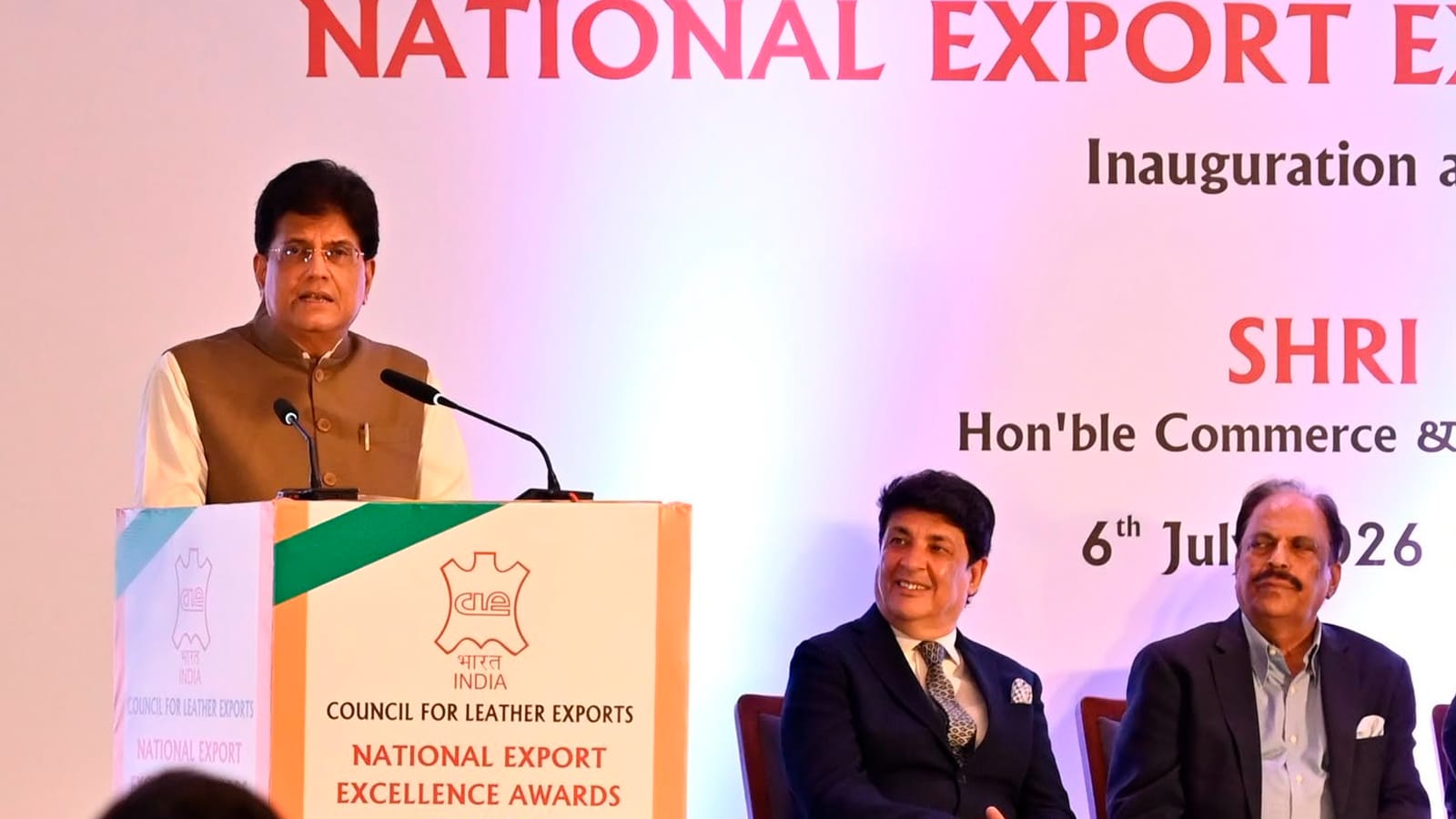
Addressing the Council for Leather Exports National Export Excellence Awards ceremony for 2024–25, Minister Goyal emphasized that enabling global trade conditions have been systematically put in place. The commerce ministry confirmed that India's active Free Trade Agreements (FTAs) have successfully opened up direct, tariff-relaxed institutional access to 38 developed international markets.
A series of imminent timeline milestones were disclosed by the ministry to facilitate this market push:
India-UK FTA: The comprehensive trade agreement is officially scheduled to come into force on July 15, 2026.
India-EU FTA: The definitive legal review and scrub between negotiators are on track to conclude within the next 15 to 20 days.
Upcoming Diplomatic Delegations: Minister Goyal announced an executive tour to Brussels, Spain, and Finland on July 14 and 15, accompanied by a senior delegation of Indian business leaders to pitch domestic goods directly to European buyers.
Exporters were strongly urged to immediately diversify their shipping logs beyond historic destination corridors. Government data indicates that a concentrated 77 percent of India's current leather exports are funneled into just 15 countries. Exporters have been encouraged to look past traditional bulk buyers in the United States, Germany, and Italy to capture premium, high-margin consumer demand in smaller developed economies.
Technical Integration and Workforce Expansion Targets
The target outlined by the Ministry of Commerce and Industry requires a structural overhaul of existing manufacturing methodologies. The sector, which currently generates approximately $4 billion to $4.5 billion in annual export revenues, must build up its domestic design, packaging, and testing architectures to match global parity rules.
To achieve this, the ministry recommended formal collaboration matrices across multiple apex national oversight bodies:
The National Institute of Design (NID): To innovate high-end product design and leverage artificial intelligence to revive traditional patterns.
The Indian Institute of Packaging: To implement resilient, internationally compliant consumer presentation designs.
The Bureau of Indian Standards (BIS) & Quality Council of India (QCI): To update cluster-level testing facilities and expand strict regulatory certification systems.
The ministry further highlighted that shifting from manual processing to advanced mechanics—including robotics, artificial intelligence for demand forecasting, and clean energy setups—will drive immediate productivity gains. From an employment standpoint, transforming the manufacturing base is projected to scale the industry’s workforce from 40 lakh employees up to more than one crore workers nationwide.
Logistical Assistance and Product Diversification
The state will actively support this transition via specialized operational frameworks. Under the Export Promotion Mission, the government is providing institutional backing for overseas warehousing setups and business delegations. The logistical strategy includes exploring international distribution models similar to the 'Bharat Mart' facility in Dubai to enable efficient, just-in-time delivery mechanisms in distant zones.
Furthermore, the minister highlighted that industrial growth must extend beyond traditional footwear manufacturing. The manufacturing pipeline is expected to scale up across a broad portfolio of consumer applications, covering luxury travel goods, handbags, apparel, horse saddles, sports equipment, and premium upholstery for institutional furnishings.
Official Sources Section
The statistics, international trade timelines, and institutional guidelines presented in this report are based on the official transcripts and announcements released by the Press Information Bureau and the Ministry of Commerce and Industry. The policy brief was delivered live during the Council for Leather Exports National Export Excellence Awards session held in New Delhi.
Quote Section
The specific industrial scale required to meet international demand was emphasized directly by leadership.
"If I was in your shoes, or in your leather shoes, if I may say so, I would not aspire for anything less than a 3x outcome in the next five to seven years," stated Union Minister Piyush Goyal during his address to industry stakeholders.
Regarding the historical legacy and economic promise of Indian craftsmanship, the minister added:
"According to officials, we can become a global champion in leather and footwear exports by leveraging research and development and our traditional craftsmanship with modern technology."
Why It Matters
For small-scale artisans, regional manufacturing clusters, and trade investors, a three-fold increase in export targets promises substantial inward capital flows and technological modernization. For the broader labor market, expanding the employment pool to one crore workers offers high-density employment opportunities, particularly within rural and semi-urban manufacturing corridors. Ultimately, leveraging the upcoming July 15 trade treaty with the United Kingdom enables domestic manufacturers to bypass heavy import duties, rendering Indian consumer goods highly competitive against global peers.
Key Facts at a Glance
Export Objective: The central government has set a definitive target of $15 billion for leather and footwear exports within the next 5 to 6 years.
Current Baseline: India's outbound trade in the leather segment currently hovers around $4 billion to $4.5 billion annually.
FTA Implementation: The highly anticipated India-UK Free Trade Agreement will formally enter into force on July 15, 2026.
Employment Multiplier: The proposed industrial expansion aims to increase sector employment from 40 lakh to one crore workers.
Strategic Partnerships: Manufacturers are directed to integrate operations with apex bodies like NID, BIS, QCI, and the Indian Institute of Packaging.
Frequently Asked Questions (FAQ)
What is the new export target set for India's leather and footwear industry?
The Ministry of Commerce and Industry has directed the sector to triple its current export volume, aiming for at least $15 billion in international sales within the next five to six years.
When will the new India-UK Free Trade Agreement take effect?
The India-UK FTA is fully scheduled to come into force on July 15, 2026, opening up immediate zero-duty or reduced-tariff access for Indian exporters.
How will technology change traditional leather manufacturing under this plan?
Exporters are being urged to integrate robotics and artificial intelligence to refine demand forecasting, optimize modern packaging formats, and implement sustainable waste recycling setups.
Sources: IBEF, DD India