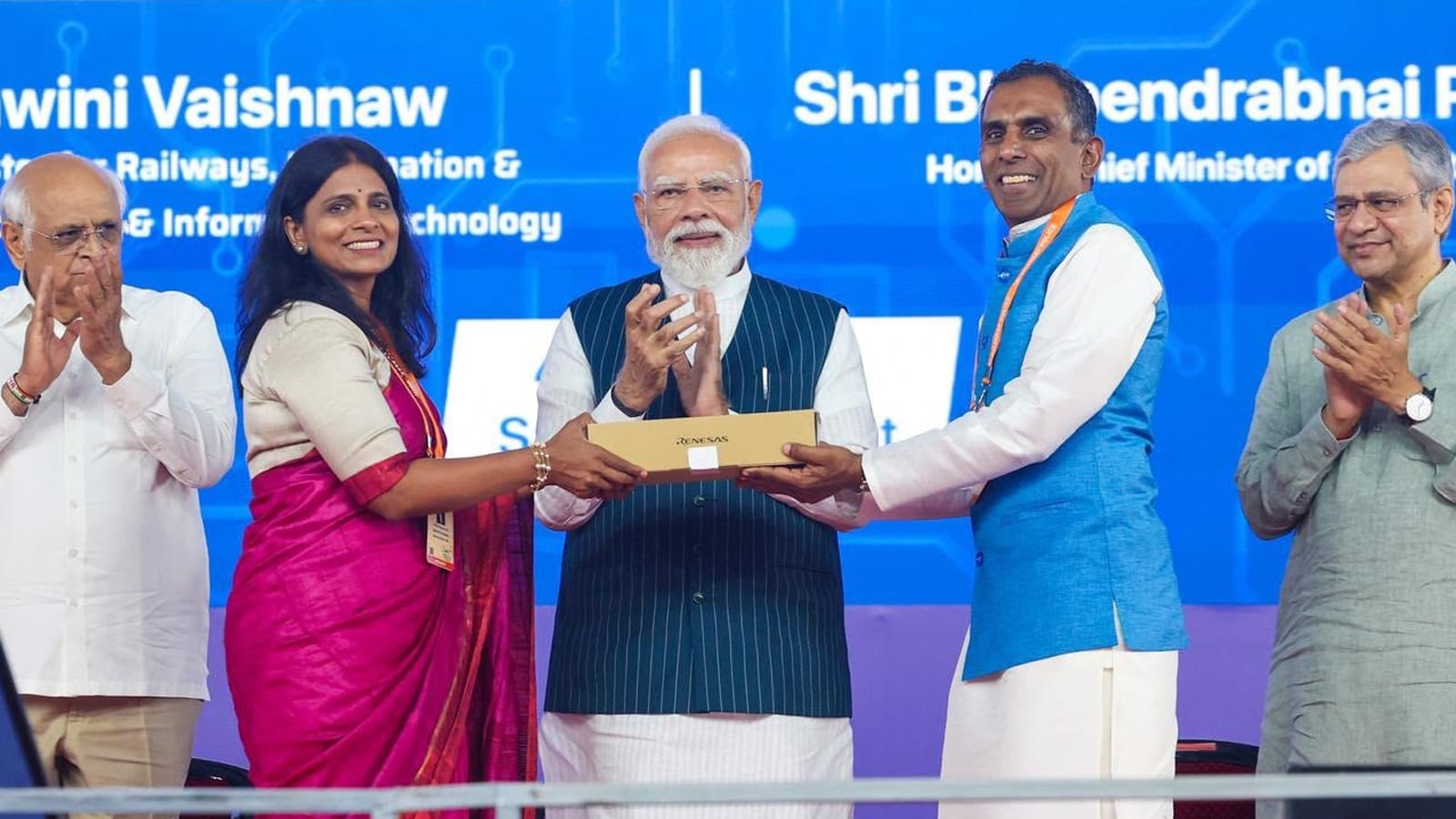
Prime Minister Narendra Modi inaugurated the ₹7,600-crore CG Semi OSAT semiconductor facility in Sanand, Gujarat. Operating through a joint venture with Japanese and Thai partners, the plant will produce up to 500 crore chips annually. The launch establishes a complete electronics manufacturing ecosystem, positioning India’s youth to lead global AI and robotics innovation.
SANAND, India — Prime Minister Narendra Modi officially inaugurated commercial production at the CG Semi Outsourced Semiconductor Assembly and Test (OSAT) facility in Sanand, Gujarat, on Saturday. Speaking at the launch of the ₹7,600-crore state-of-the-art plant, Modi declared that India's youth will power the AI, robotics and next-generation technology revolution with Made-in-India chips. The event marks a major transition for the country from an electronics assembler to a foundational semiconductor manufacturer, establishing an end-to-end domestic supply chain as part of the country's "Viksit Bharat" roadmap.
Establishing the Next Phase of 'Make in India'
The newly operational Sanand facility is a joint venture between India’s CG Power and Industrial Solutions Limited, Japan’s Renesas Electronics Corporation, and Thailand’s Stars Microelectronics. It has already commenced operations with an initial capacity to produce 20 crore (200 million) semiconductor units annually, with a long-term goal to scale up to 500 crore (5 billion) chips per year.
According to government statements, this rollout completes the industrial chain for electronics manufacturing within the country. "First products, then components, and now semiconductors," Prime Minister Modi stated during his address. He added that the development of specialized technology clusters is crucial, comparing Sanand’s rapid transformation to international tech hubs such as Silicon Valley in the United States and the Hsinchu Science Park in Taiwan.
The plant has already dispatched its first commercial shipment of packaged chips to the global customers of its Japanese partner, Renesas, signaling India's formal entry into the international semiconductor export market.
Global Collaboration and Local Upskilling
The operationalization of the CG Semi facility highlights a growing trend of global technological partnerships. Industry data shows that over 75 semiconductor specialists from the United States, Malaysia, South Korea, and the Philippines worked alongside Indian engineers to bring the facility in line with global qualification standards.
A significant portion of the newly hired workforce consists of young women recruited from remote and tribal regions across India. After completing foundational training at domestic Industrial Training Institutes (ITIs), many of these workers underwent advanced technical training programs in Malaysia to master precise chip packaging and testing procedures.
Union Minister for Electronics and Information Technology, Ashwini Vaishnaw, confirmed that the semiconductors packaged at the facility will cater to multiple critical high-growth sectors, including automotive, telecommunications, 5G networks, industrial electronics, and the Internet of Things (IoT).
Why It Matters
For global tech markets, India's entry into chip packaging offers a strategic alternative to traditional supply hubs, reducing the vulnerability of supply chains to regional disruptions.
For domestic citizens and the economy, this industrial expansion creates high-value engineering, logistics, and technical employment. The emergence of a semiconductor ecosystem directly accelerates research and development fields, allowing local startups and developers to build AI and robotics applications using locally sourced hardware.
Key Facts at a Glance
Total Project Investment: A ₹7,600-crore state-of-the-art plant established under the India Semiconductor Mission.
Production Targets: Currently operating at 20 crore chips annually, with an ultimate target of 500 crore chips per year (1.5 crore chips per day).
International Consortium: Built as a joint venture involving CG Power (India), Renesas Electronics (Japan), and Stars Microelectronics (Thailand).
Target Sectors: Localized chip supply will support global industries across automotive, 5G telecommunications, AI infrastructure, and consumer electronics.
Frequently Asked Questions
What is an OSAT facility?
An OSAT (Outsourced Semiconductor Assembly and Test) facility takes raw silicon wafers manufactured by semiconductor fabrication plants and performs the precise tasks of dicing, packaging, and testing them to turn them into finished chips ready for electronic devices.
Which sectors will use the chips produced in Sanand?
The chips will supply components for automotive systems, telecommunications infrastructure, 5G modules, industrial automation, consumer electronics, and high-performance computing setups managing artificial intelligence.
How does this impact jobs for India's youth?
The facility opens up skilled positions across specialized fields such as hardware design, quality testing, factory automation, and supply chain logistics, moving beyond basic manual electronics assembly.
Sources: Official press releases from the Ministry of Electronics and Information Technology, official updates from the Chief Minister's Office (CMO) Gujarat, and corporate project filing declarations by CG Power and Industrial Solutions.