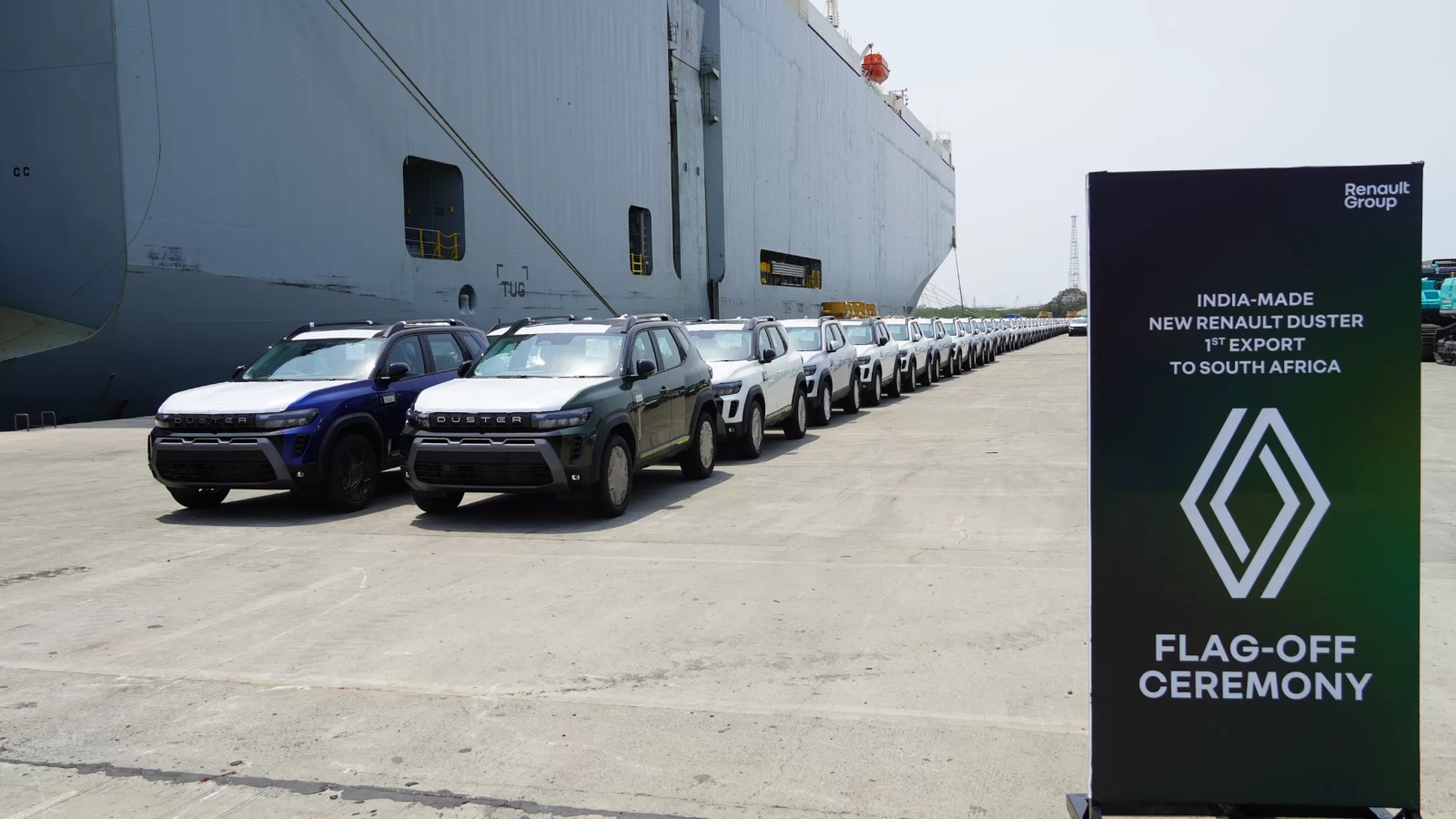
Renault India has officially kicked off its international export program for the all-new Duster SUV, dispatching an initial batch of 750 vehicles from Chennai's Ennore Port to South Africa. The milestone supports the company’s strategic goal of achieving €2 billion in annual export revenues from India by 2030.
CHENNAI, INDIA — Renault India has officially commenced international export operations for its highly anticipated, next-generation Duster SUV. The automaker confirmed on Monday, June 22, 2026, that an inaugural maritime batch consisting of 750 vehicles successfully departed from Chennai's Ennore Port (Kamarajar Port) bound for South Africa. This initial delivery signifies the formal deployment of an expanded right-hand-drive and left-hand-drive vehicle export program, with several additional global destination markets slated to join the logistics pipeline in the coming months.
The automotive milestone underscores India's rapidly growing structural importance within the French automaker's international industrial framework. Driven by specialized multi-million dollar plant modernizations, the export kickoff highlights the brand's long-term corporate initiative to turn its southern Indian asset base into a central manufacturing anchor for emerging cross-border economies.
Strategic Shift Capitalizes on Upgraded Modular Architecture
According to operational updates distributed by the manufacturer's corporate office in Chennai, the newly shipped vehicles represent the third-generation iteration of the Duster marquee. The premium model is the first vehicle in the domestic portfolio to be constructed on the newly deployed Renault Group Modular Platform (RGMP). This modular platform allows the Oragadam facility near Chennai to streamline production lines and handle highly adaptable powertrain configurations.
The vehicles prepared for the South African consumer grid have been engineered to match strict international safety paradigms, including achieving an early five-star rating under the domestic Bharat NCAP safety assessment guidelines. For overseas markets, the SUVs are fitted with specific engine options, including advanced 1.0-litre and 1.3-litre turbo-petrol configurations. This engine mix is designed to balance highway torque requirements with strict regional emission compliance standards.
Global Focus Targets €2 Billion Annual Revenue Pipeline by 2030
The export push aligns directly with Renault’s long-term "futuREady India" structural strategy. Under this investment roadmap, which began with a joint $600 million (₹5,300 crore) capital commitment alongside alliance partner Nissan, the manufacturing group aims to turn India into one of its top three global markets by the end of the decade. The broader corporate plan targets generating €2 billion (approximately ₹18,000 crore) in annual revenues from vehicle exports, international component sourcing, and joint R&D operations over the next five years.
The high-volume shipments leaving Ennore Port will help maximize capacity utilization at the 600-acre Oragadam assembly plant. Historically, the alliance factory has exported over 1.15 million vehicles to more than 108 international destinations, spanning Sub-Saharan Africa, Latin America, and the Middle East. Adding the modular next-gen Duster to this existing export engine provides critical revenue cushion against cyclical fluctuations within the domestic passenger vehicle sector.
Official Sources Section
The underlying production logs, shipping frameworks, and technological investments have been officially verified through active corporate statements and exchange filings.
Corporate Issuer: Renault Group India Executive Office.
Port Authority Logistics: Kamarajar Port Limited (Ennore Port) Cargo Manifests.
Industrial Alliance Tracker: Renault Nissan Automotive India Private Limited (RNAIPL) Board Registry.
Why It Matters
For Indian manufacturing, the smooth rollout of advanced automotive exports demonstrates that domestic plants can consistently deliver precision engineering that matches rigorous international safety and quality standards. For global consumers, the expansion of the Chennai manufacturing hub ensures a steady, cost-effective supply of highly durable right-hand-drive vehicles. This reliable pipeline helps shield international distribution networks from unexpected supply chain blockages or localized labor shortages in European factories.
Key Facts at a Glance
Inaugural Batch Volume: Comprises a precise shipment of 750 vehicles sent in the initial maritime tranche.
Primary Destination: Shipped directly to South African distributor networks.
Core Architecture: Built entirely on the advanced, multi-powertrain Renault Group Modular Platform (RGMP).
Logistics Chokepoint: Dispatched from Chennai's deep-water Ennore Port (Kamarajar Port).
Long-Term Strategy Goal: Backs a wider corporate initiative aiming for €2 billion in annual export revenues by 2030.
FAQ Section
Which specific vehicle model makes up the 750-unit Ennore shipment?
The initial batch consists entirely of the third-generation, all-new Renault Duster SUV, which was reintroduced to the market with a fresh design language and updated safety tech.
Will the exported Duster models differ from the versions sold inside India?
While the structural chassis and core modular platform remain identical, the export versions feature minor cabin changes and specific engine calibrations tailored to match South African fuel regulations and climate needs.
What other vehicle models does Renault currently manufacture and export from Chennai?
Alongside the newly launched Duster, Renault’s Chennai production lines produce the sub-four-meter Triber compact vehicle and the Kiger compact SUV for both domestic buyers and international export networks.
Source: