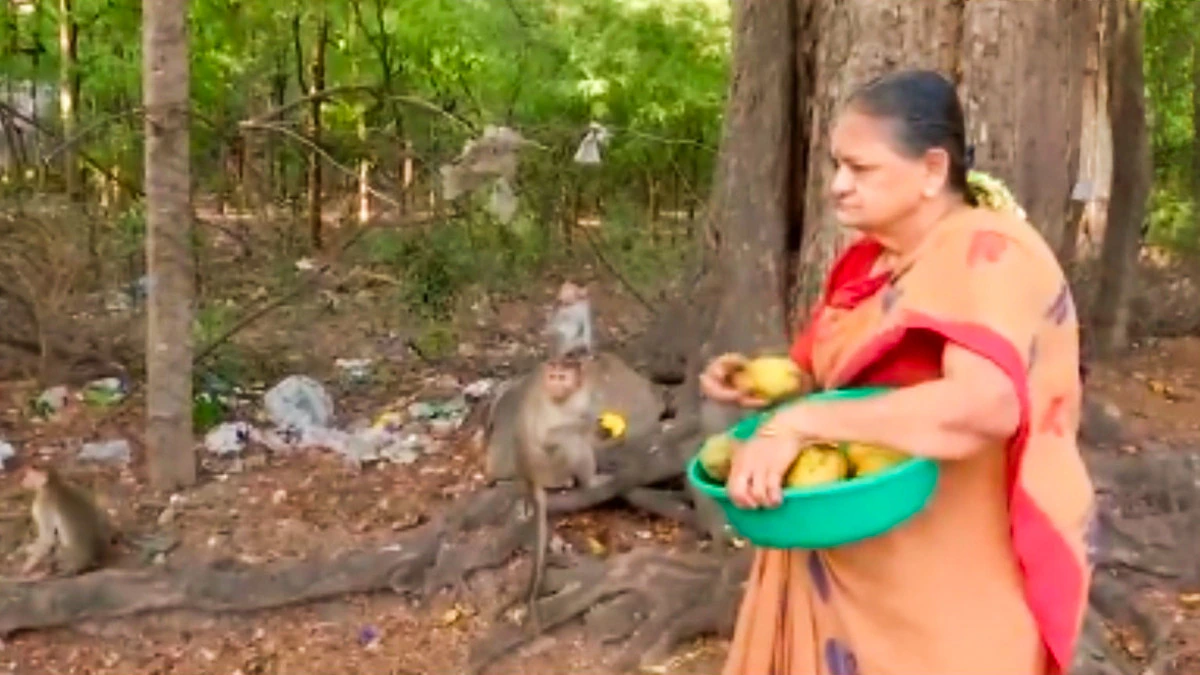
A 76-year-old retired police officer in the Madurai district of Tamil Nadu is drawing widespread civic admiration for spending a major portion of her monthly government pension to feed hundreds of wild monkeys. According to field reports and official statements documented on Tuesday, June 23, 2026, the veteran officer, identified as Malathi, has sustained this self-funded wildlife welfare routine for over a decade. Her targeted interventions focus heavily on the ecologically stressed and tourist-heavy zones of the Tirupparankundram region.
MADURAI — A 76-year-old retired police officer in the Madurai district of Tamil Nadu is drawing widespread civic admiration for spending a major portion of her monthly government pension to feed hundreds of wild monkeys. According to field reports and official statements documented on Tuesday, June 23, 2026, the veteran officer, identified as Malathi, has sustained this self-funded wildlife welfare routine for over a decade. Her targeted interventions focus heavily on the ecologically stressed and tourist-heavy zones of the Tirupparankundram region.
The ongoing initiative addresses a critical wildlife interface issue inside the temple town. Environmental officers note that the local rhesus macaque and bonnet macaque populations face severe natural foraging deficits due to urban encroachment on nearby forested hillsides. By distributing healthy food supplies every weekend, Malathi’s efforts temporarily bridge an ecological gap, reducing human-wildlife conflict near historic pilgrimage structural complexes.
A Decade of Systematic Civic and Wildlife Service
Malathi's long-term commitment follows a diverse career in public service. Before retiring from active service in 2010, she served for 33 years within the Tamil Nadu Police Department. Her professional history also includes terms as the Director of Physical Education at Gandhigram University and a physical training instructor at an international school in the hill station of Kodaikanal.
According to tracking documentation, Malathi transitioned into her wildlife feeding routine in 2015 after observing that massive numbers of monkeys surrounding the Tirupparankundram Murugan Temple were displaying signs of malnutrition and entering residential areas in search of food. While she originally performed the food distributions on a daily basis, advancing age and musculoskeletal health challenges have forced her to restructure her schedule. She now conducts a highly organized feeding run every Saturday afternoon.
Logistical Scale of the Weekend Wildlife Route
Despite physical limitations, Malathi travels every Saturday at 3:30 p.m. to six specific, high-density primate zones across the Tirupparankundram topography. According to local wildlife trackers, between 350 and 400 monkeys regularly assemble at these designated meeting spots upon hearing her vocal call.
The weekly feeding operation covers several distinct ecological and cultural zones:
The Tirupparankundram Murugan Temple Premises
The Saravana Poigai Temple Tank Environs
The Palchunaikanda Subramaniam Temple Grounds
Mayil Thoppu (The Peacock Grove Reserve)
The Historic Cave Temple Zone (housing roughly 150 monkeys)
The Ancient Fort Hills Area (housing roughly 200 monkeys)
The food packages distributed consist primarily of fresh fruits, nuts, and easily digestible grains chosen to complement the natural dietary requirements of the wild primates. The monthly financial overhead for procuring hundreds of kilograms of fresh produce is drawn directly from her state police retirement pension allocations.
Ecological and Public Implications for Madurai
Local forestry and municipal administrators emphasize that Malathi's sustained wildlife feeding campaign carries broader social implications for residents and temple visitors. In many religious towns across India, the depletion of natural forest canopies forces wild monkey populations to scavenge from open trash receptacles or actively snatch food items from pilgrims, leading to accidental bites and disease transmission risks.
By centralizing the feeding spots at specific, predictable field points away from primary pedestrian corridors, the intervention helps keep wild troops habituated to safe spaces. However, environmental experts also suggest that while individual compassion helps animal welfare, long-term regional solutions require the restoration of natural fruiting trees within the reserved forest hills surrounding the Madurai district to ensure permanent ecological independence.
Official Sources Section
The biographical records, geographic coordinates, and operational schedules detailed in this report are corroborated by verified field coverage from the news agency Asian News International (ANI) and municipal tracking logs across temple admin boards under the Tamil Nadu Hindu Religious and Charitable Endowments Department.
Quote Section
"These monkeys live in forested and hilly regions and struggle daily to find food... For many years, I visited the area every day. However, I am now 76 years old, and due to health issues, walking long distances has become difficult. Even so, I continue my service every Saturday."
— Malathi, retired Tamil Nadu Police Officer, during an official press briefing in Madurai.
Why It Matters
For municipal administrators and conservationists, Malathi's long-term project underscores the growing challenges of urban wildlife management in expanding Indian cities. Her individual action prevents aggressive foraging behavior in public zones, highlighting the direct link between animal welfare, community safety, and the preservation of biodiversity around historic heritage sites.
Key Facts at a Glance
The Individual: Malathi, a 76-year-old resident of Madurai and a 33-year veteran of the Tamil Nadu Police Department.
The Mission: Utilizing her own government pension to purchase and distribute fresh food to hundreds of wild monkeys since 2015.
The Scale: Feeding between 350 and 400 monkeys every Saturday across six locations in Tirupparankundram.
The Locations: Covers high-density heritage spots including the Cave Temple, Peacock Grove, and Saravana Poigai.
The Benefit: Reduces human-wildlife conflict by preventing monkeys from scavenging in crowded pedestrian areas.
FAQ Section
Q: What motivated the retired police officer to start feeding monkeys in Madurai? A: Malathi started the initiative in 2015 after witnessing large troops of monkeys around the Tirupparankundram hills struggling to find adequate food in their natural forest habitats, which often led them into conflict zones with temple pilgrims.
Q: How is the procurement of food for 400 monkeys funded? A: The entire operation is completely self-funded by Malathi, who allocates a significant portion of her monthly retirement pension received from her 33 years of service with the Tamil Nadu Police Department.
Q: How often does the feeding take place given her health constraints? A: While she initially carried out the feeding route on a daily basis for nearly a decade, age-related mobility issues have led her to transition the routine to a structured weekly run every Saturday afternoon.
Source: Tamil Nadu HR&CE Department, ANI National News Registry.