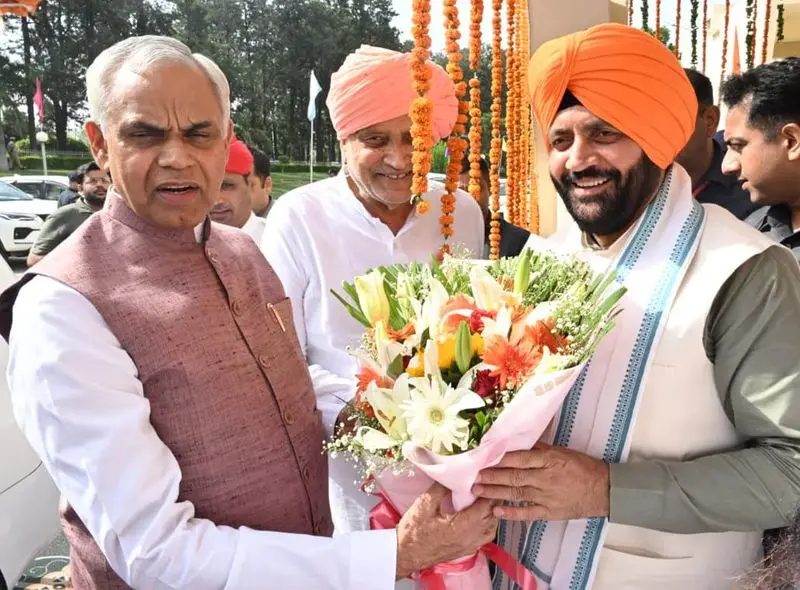
Union Minister Jitendra Singh announced that India's space economy is on track to expand fivefold, reaching $45 billion over the next seven to eight years. Driven by bold regulatory updates, 100% automatic FDI, and an expanding network of 400 private startups, the sector is transforming into a global commercial aerospace hub.
NEW DELHI — India’s space economy is projected to undergo a dramatic multi-billion-dollar transformation, expanding from its current valuation of approximately $9 billion to an estimated $45 billion over the next seven to eight years. The structural growth roadmap was officially detailed by Union Minister of State for Space and Atomic Energy, Dr. Jitendra Singh, during a press briefing in the capital on Sunday, June 7, 2026.
Reflecting on the long-term institutional changes implemented under Prime Minister Narendra Modi's administration, Singh emphasized that the projected fivefold economic surge is directly tied to recent policy liberalizations. By systematically breaking down legacy regulatory barriers, the government has successfully transitioned the country's space infrastructure from a closed public monopoly into an integrated, market-driven ecosystem capable of capturing a substantial share of the global commercial aerospace market.
Dismantling the Closed-Door Policy: The Rise of Private Space
For several decades, India's sophisticated outer-space programs operated behind strict institutional doors, tightly managed under the direct oversight of state-run agencies. According to policy data reviewed during the ministerial brief, the real turning point occurred following structural space sector reforms introduced in 2020. These modifications legally enabled non-government entities (NGEs) to independently manage end-to-end space exploration and commercial launch operations.
The operational transition outlines a distinct structural shift in the aerospace ecosystem:
To support this open architecture, the Cabinet instituted the Indian Space Policy 2023 alongside the creation of the Indian National Space Promotion and Authorisation Centre (IN-SPACe). Operating as an autonomous, single-window approval gateway, IN-SPACe ensures that private enterprises, researchers, and early-stage entrepreneurs face zero bureaucratic friction when using public launch pads and laboratories.
Tracking the Startup Explosion and Economic Scale
The commercial result of these regulatory interventions is highlighted by the rapid multiplication of private tech firms. Singh noted that India’s space startup ecosystem has experienced a massive leap, growing from a single-digit metric just a few years ago to approximately 400 active, verified entities in 2026. Notably, the sector recently celebrated its first corporate startup achieving full "unicorn" status, crossing the coveted $1 billion private valuation mark.
The broader macroeconomic data showcases an aggressive growth curve across the high-tech sector:
| Industrial Sector Indicator | 2014 Baseline Data | 2026 Audited Operational Metrics |
| National Space Economy Value | Negligible Open Value | ~$9 Billion US Dollars (Current) |
| Projected 2033-2034 Valuation | N/A | $45 Billion US Dollars (Targeted) |
| Active Space Startups | Fewer than 10 Entities | Approximately 400 Enrolled Firms |
| Total Nationwide Startups | 350 – 400 Registeries | Over 230,000 Verified Operations |
| Employment Generated | Baseline Industrial Pools | 2.4 to 2.5 Million Technical Jobs |
The democratization of these modern opportunities is structurally evident across domestic demographics. Government registries confirm that nearly 50% of these newly emerged tech entities are operating directly within Tier-II and Tier-III cities, while roughly 35% to 39% of the innovative startup operations are actively led by female entrepreneurs.
Deep-Tech Capital Incentives and Public Engagement
To sustain this commercial momentum, the government has deployed key financial tools. Recent changes allow up to 100% Foreign Direct Investment (FDI) via the automatic route for satellite manufacturing, sub-component assembly, and ground segment systems development. Furthermore, the newly approved ₹1 lakh crore (approx. $11.1 billion) Research, Development, and Innovation Scheme provides low-interest financing for commercial tech applications that have achieved high technology readiness levels.
This technical progress has also generated immense public interest across the nation. Official launch logs from the Indian Space Research Organisation (ISRO) note that recent orbital missions, such as the historic Chandrayaan-3 soft landing near the Moon's south pole, drew over 10,000 physical spectators and 1,500 international media personnel to the launch facilities, turning complex aerospace engineering into a source of shared national pride.
Official Sources Section
The financial projections, startup volume tallies, demographic distributions, and corporate foreign direct investment guidelines outlined in this news report are directly based on public media announcements from the Press Information Bureau (PIB), ministerial data summaries from the Ministry of Science and Technology, and legal policy updates indexed by the Indian National Space Promotion and Authorisation Centre (IN-SPACe).
Quote Section
"The change of mindset that has happened in the last 12 years under Prime Minister Narendra Modi is one of the biggest hallmarks," Minister Jitendra Singh stated during the media briefing. "The kind of aspirational surge that has happened—the feeling that 'I can also do it'—was simply not there earlier. India's development journey will require deeper public-private collaboration, stronger participation of women and youth, and continued expansion of emerging sectors."
Why It Matters
The rapid growth of India’s space economy has direct practical implications for commercial businesses, tech consumers, and scientific professionals. For private industry, the open-door policy unlocks massive revenue streams in high-demand fields like satellite-based data analytics, agricultural crop monitoring, and regional disaster management. For tech workers and engineering graduates, the influx of private capital creates thousands of premium, highly skilled aerospace jobs outside of traditional metros, positioning India as a highly competitive, low-cost hub for global satellite launch services.
Key Facts at a Glance
Fivefold Target: India's space economy is projected to scale aggressively from $9 billion to $45 billion over the next seven to eight years.
Startup Growth: The country's space startup network has grown from a single-digit figure to nearly 400 active companies, including its first valuation unicorn.
Decentralized Innovation: Nearly half of all newly registered tech startups are thriving in Tier-II and Tier-III cities, with up to 39% being women-led.
FDI Liberalization: The implementation of 100% automatic foreign direct investment for satellite systems has significantly accelerated private international capital inflows.
Socioeconomic Footprint: Modern satellite data applications are now deeply integrated into national infrastructure planning, supporting projects like PM Gati Shakti and Svamitva land mapping.
FAQ Section
1. What is driving the projected growth of India's space economy to $45 billion?
The expansion is primarily driven by opening the aerospace sector to private firms, introducing 100% automatic Foreign Direct Investment (FDI) for satellite components, and a massive surge in local deep-tech startups providing low-cost launch services and advanced data analytics.
2. What exactly is IN-SPACe, and what role does it play in the industry?
The Indian National Space Promotion and Authorisation Centre (IN-SPACe) is an autonomous, single-window clearing agency under the Department of Space. It acts as a bridge to promote, authorize, and share state-run ISRO infrastructure and facilities with private space entrepreneurs.
3. How does India's space program directly benefit everyday citizens?
Close to 70% of domestic space applications are designed to improve ease of living. Satellite technology is actively used for highly accurate weather forecasting, real-time agricultural crop assessments, rural land mapping through the Svamitva project, and national infrastructure coordination.
Source: Press Information Bureau (PIB) Government Releases, Indian National Space Promotion and Authorisation Centre (IN-SPACe) Policy Portals, and Indian Space Research Organisation (ISRO) Industrial Archives.