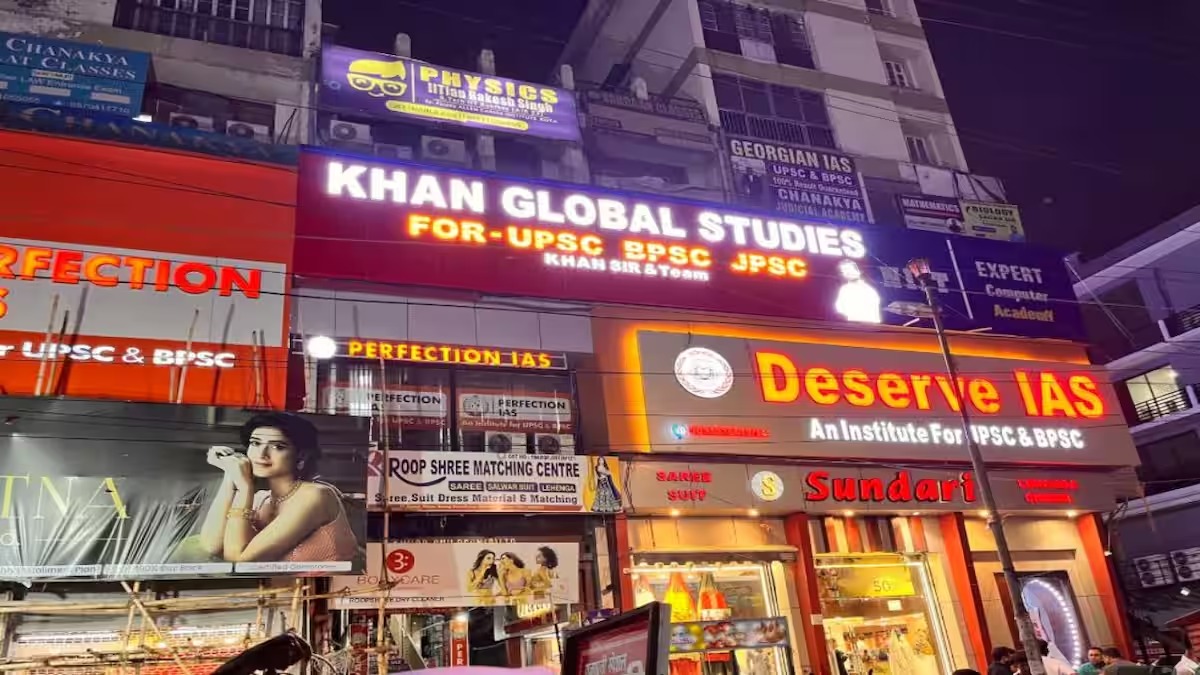
Patna's parallel education economy has transformed into a massive ₹15,000-crore coaching industry, drawing over two lakh outstation students annually. Driven by an intense demand for secure Group C and D government jobs, neighborhoods like Musallahpur Haat have evolved into prominent educational hubs, though recent corporate rivalries are prompting stricter state regulatory enforcement.
PATNA — The landscape of formal education across eastern India has fundamentally shifted as Patna transforms student aspirations into a massive, self-sustaining ₹15,000-crore coaching industry. According to regional registration databases and urban commercial mapping compiled on Monday, June 8, 2026, the capital city of Bihar now hosts over 1,200 active, independent coaching academies. These facilities attract more than 200,000 outstation students annually from across Bihar, Jharkhand, Uttar Pradesh, and West Bengal. This concentrated migration has turned historical residential areas into hyper-dense commercial zones dedicated entirely to competitive examination preparation.
The Economics of Hyper-Concentrated Student Hubs
The rapid scaling of Patna's coaching market centers primarily around the neighborhoods of Musallahpur Haat and Bhikhna Pahari. Unlike traditional elite training centers in other states that prepare candidates exclusively for high-tier engineering or premium civil services, Patna's parallel system specializes heavily in mass-application competitive exams. This includes rigorous preparation modules for Indian Railways, state banking, staff selection commissions, and low-level police or paramilitary positions categorized under Group C and Group D federal hiring panels.
The financial scale of the system relies heavily on mass enrollment models:
Individual institutes frequently enroll between 2,000 and 5,000 active students simultaneously within high-capacity lecture halls.
Monthly tuition fees are kept structurally low, fluctuating between ₹300 and ₹400 per student, making the programs universally accessible to rural households.
High volume creates immense capital accumulation, allowing celebrity tutors to scale operations onto prominent digital and streaming networks.
Secondary Service Ecosystems Transformed by Student Inflows
The financial footprint of the coaching industry extends far beyond lecture hall cash flows, serving as the dominant driver for Patna's localized real estate and retail service sectors. Over the past decade, residential properties in central districts have completely transitioned into multi-tenant student lodges, private guest houses, and high-density paying guest (PG) accommodations. Local land values and commercial rental premiums within active student zones have effectively doubled, and in some areas tripled, since 2016.
This continuous influx of consumer demand supports an expansive network of ancillary small businesses. Thousands of street-side food stalls, low-cost diners, regional transit operators, and specialized academic bookstores handling massive volumes of used reference textbooks operate entirely within the student economy. Data indicates that approximately 52.5% of all active students throughout Bihar utilize some form of private academic coaching, far exceeding the national average of 27%.
Official Sources Section
The expansion, fiscal size, and evolving regulatory boundaries of this secondary education market are tracked closely by state and regional departments:
Government of Bihar Statistics: Verified that the wider state territory now contains approximately 6,383 operational private coaching centers, with Patna functioning as the primary base.
Patna Police and District Administration: Confirmed that multi-agency enforcement teams are tightening operational compliance audits following recent territorial disputes between competing local academic groups.
Quote Section
"According to officials from the Bihar Education Department, the state is strictly enforcing the provisions of the Coaching Institute Regulation Act, which mandates formal state registration, standardized safety protocols, and clear pricing matrices to protect rural families from exploitative enrollment practices."
Why It Matters
The growth of Patna's massive coaching footprint highlights several long-term structural realities across the regional economy:
For Real Estate & Small Businesses: The consistent arrival of hundreds of thousands of student consumers guarantees baseline commercial revenues for property owners, logistics providers, and local commodity retail networks.
For Rural Households: The availability of hyper-affordable, high-volume coaching allows lower-income students a realistic avenue to compete for secure public employment without relocating to expensive national hubs.
For State Regulators: The sheer velocity of capital moving through these unregulated networks creates an immediate need for stringent oversight regarding structural fire safety, consumer fraud prevention, and anti-monopoly enforcement.
Key Facts at a Glance
Market Valuation: Experts and industry tracking data estimate Patna's direct and indirect coaching ecosystem at approximately ₹15,000 crore annually.
Concentrated Footprint: Out of 6,383 verified coaching institutions scattered across Bihar, a dense cluster of 1,256 centers operates explicitly within Patna city limits.
Mass Target Market: The core of Patna's coaching infrastructure specializes in preparing students for high-volume Group C and Group D public sector employment tests.
Low-Cost Scale: Average monthly fees are maintained at a modest ₹300 to ₹400, offset by enormous classroom capacities reaching up to 5,000 students per instructor.
Ancillary Growth: The high density of long-term student residents has caused regional land and rental prices to appreciate by 200% to 300% across central student neighborhoods.
FAQ Section
Why has Patna emerged as a major coaching hub compared to cities like Kota?
While Kota focuses primarily on high-cost, highly specialized engineering and medical entrance tests, Patna caters to a massive market for mid-and-lower-tier government employment exams. By keeping tuition fees incredibly low, it targets millions of rural aspirants who cannot afford premier national institutes.
How does the coaching industry impact the local economy of Patna?
The sector acts as a massive urban multiplier. It provides direct employment to thousands of educators, administrative staff, and counselors, while indirectly funding a massive real estate, hospitality, transport, and book-publishing ecosystem that relies on student spending.
What measures are state authorities taking to regulate these centers?
Under established regional legislation, the Bihar government enforces mandatory center registrations, sets maximum student-to-space limits, imposes standardized fee transparency rules, and levies heavy fines—up to ₹1 lakh—on unregistered operations to maintain student safety.
Source: Educational market analysis reports distributed via ABP News Bihar, institutional regulatory compliance notices published by the Government of Bihar, and regional business registries maintained by the Patna District Administration.