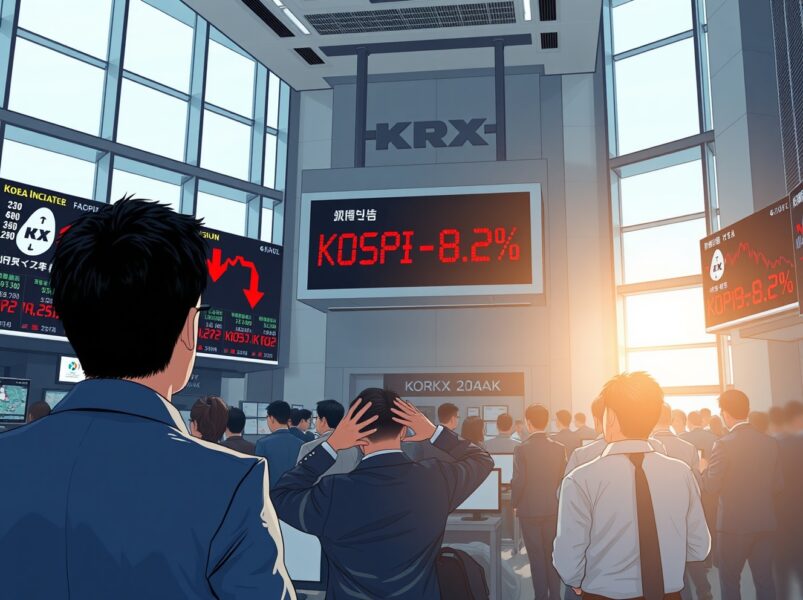
The Korea Exchange temporarily halted all cash equity and derivative trading on the benchmark KOSPI index on Monday, June 8, 2026. A rapid 8% plunge triggered Level 1 circuit breakers. The automatic 20-minute trading freeze was implemented to curb panic selling amid heightened global economic and regional security concerns.
SEOUL — The Korea Exchange (KRX) enacted emergency regulatory measures on Monday, June 8, 2026, triggering Level 1 market-wide circuit breakers on the benchmark KOSPI index. The automated intervention occurred during morning trading after the index plummeted over 8% below its previous closing value. The sharp decline forced a mandatory 20-minute suspension of all cash equity transactions and related derivative programs. This development marks the most volatile trading session observed on the Seoul bourse in years, as institutional funds reacted swiftly to compounding international macroeconomic pressures and expanding technological supply chain vulnerabilities across East Asia.
Market-Wide Halts Try to Contain Severe Panic Selling
The automated execution of the Level 1 market safeguard reflects the intense velocity of the morning sell-off. Under established Korea Exchange regulatory protocols, a continuous drop of 8% or more that sustains for over one minute automatically triggers an instantaneous block on order execution.
The freeze is intended to give brokerage desks, retail participants, and algorithmic funds a brief operational cooling-off window to evaluate changing pricing data rationally.
Financial data providers indicated that the downward spiral was heavily concentrated within large-cap technology, automotive, and electronic memory manufacturing stocks.
Analysts noted that as automated stop-loss programs were triggered simultaneously across major global funds, the sheer volume of sell orders temporarily overwhelmed normal liquidity channels, making the trading halt structurally necessary to prevent a disorderly market collapse.
Global Factors and Supply Chain Strains Force Capital Flight
The sudden capital flight from the Seoul bourse is tied closely to broader international economic shifts. Market strategists pointed to a combination of unexpected interest rate decisions by major central banks, weaker-than-expected industrial consumption metrics from Western import economies, and localized logistical disruptions at primary container shipping hubs.
Furthermore, South Korea's heavy reliance on technology exports left its benchmark index uniquely exposed to targeted sell-offs:
Leading semiconductor and advanced display hardware manufacturing companies saw single-day stock valuations slide by up to 9.5%.
International institutional investors offloaded local equity positions in favor of liquid, safe-haven instruments such as gold and short-term United States sovereign debt certificates.
The South Korean Won experienced parallel downward pressure, trading significantly weaker against the U.S. Dollar.
Official Sources Section
The current regulatory measures, trading data, and financial stabilization policies are tracked and authenticated by central economic bodies:
Korea Exchange (KRX): Released the precise chronological logging of the Level 1 circuit breaker activation and confirmed the exact timings of the subsequent market restart.
Financial Services Commission (FSC): Issued a joint advisory outlining plans to monitor potential non-compliant short-selling practices and maintain financial system stability.
Ministry of Economy and Finance: Declared that economic authorities are prepared to step into currency and capital markets with emergency liquidity buffers if international market pressures continue to build.
Quote Section
"According to officials from the Korea Exchange, the automated system performed exactly as designed, providing a critical 20-minute window to stabilize electronic order books and prevent asymmetric price routing during a period of extreme institutional capital flight."
Why It Matters
The activation of circuit breakers on the KOSPI index introduces direct, practical effects across multiple sectors of the economy:
For Investors: The trading halt blocks immediate equity exits, temporarily locking asset liquidity but preventing destructive retail panic selling that could wipe out retirement and portfolio values.
For Technology Businesses: The sudden compression of equity market capitalizations restricts the immediate ability of major manufacturing corporations to raise fresh capital via secondary stock offerings.
For Global Supply Chains: A sustained depression in South Korean high-tech equities signals deep institutional anxiety regarding upcoming electronics component availability and global smartphone or automotive production targets.
Key Facts at a Glance
Trading Halt: The Korea Exchange officially suspended all equity trading on the KOSPI index for 20 minutes following an 8% drop.
Trigger Rule: The Level 1 circuit breaker was activated automatically under standing safety regulations meant to curb panic selling.
Tech Compression: The underlying market drop was driven by heavy institutional offloading of large-cap semiconductor and electronics components stocks.
Regulatory Watch: The Financial Services Commission has initiated enhanced monitoring of international algorithmic fund behaviors to prevent market manipulation.
Currency Correlation: The stock drop occurred alongside a notable decline in the value of the South Korean Won against global reserve currencies.
FAQ Section
What exactly is a stock market circuit breaker?
A circuit breaker is an automated regulatory mechanism designed to temporarily halt trading on a financial exchange. It is used to curb extreme panic selling, restore orderly pricing, and provide market participants time to review information during severe downward spirals.
What happens after a Level 1 circuit breaker finishes its 20-minute halt?
Once the 20-minute suspension expires, the exchange opens a short window for price discovery before resuming normal matching operations. However, if the index continues to fall and hits a 15% drop, a Level 2 circuit breaker will trigger another halt.
Can individual retail investors continue trading during a market-wide halt?
No. When a market-wide circuit breaker is triggered by the exchange, all trading activities are frozen across the board. This includes transactions initiated by large institutional funds, high-frequency algorithms, and individual retail brokerage accounts.
Source: Official market data aggregated via the Korea Exchange Trading Operations Portal, financial stability directives published by the Financial Services Commission, and economic policy briefings released by the Ministry of Economy and Finance.