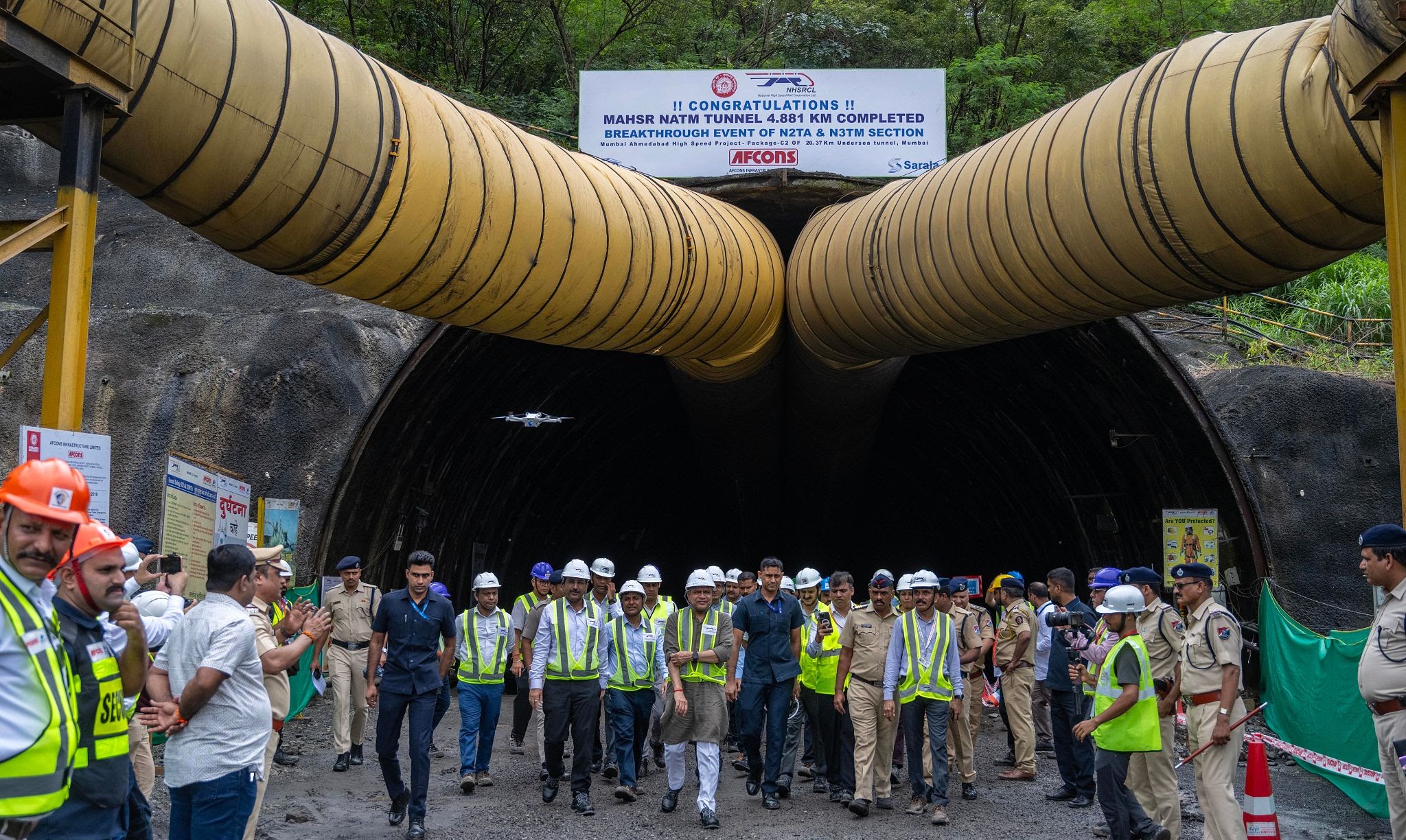
Union Railway Minister Ashwini Vaishnaw has officially launched the tunnel excavation work for the Mumbai-Ahmedabad Bullet Train project. The milestone marks the start of boring on a 21-kilometer underground section, featuring India's first 7-kilometer undersea rail corridor beneath Thane Creek, using advanced mega Tunnel Boring Machines.
MUMBAI — Union Minister for Railways, Information & Broadcasting, and Electronics & Information Technology Ashwini Vaishnaw will officially launch the tunnel excavation work for the Mumbai-Ahmedabad Bullet Train project on Saturday, July 4, 2026. The high-profile infrastructure milestone involves commencing operations on a 21-kilometer underground corridor, which features India's first-ever 7-kilometer undersea rail tunnel running beneath Thane Creek. This technical phase represents the most challenging engineering component of the country's inaugural high-speed rail network, aimed at connecting the commercial centers of Maharashtra and Gujarat while establishing cutting-edge tunneling benchmarks for future mega-projects across South Asia.
Technical Feat of India's First Undersea Rail Tunnel
The initiation of the tunnel boring phase marks a significant technological leap for the domestic transport engineering sector. The 21-kilometer underground segment stretches between the underground terminal station at Bandra-Kurla Complex (BKC) and Shilphata in the Thane district.
According to project blueprints released by the National High Speed Rail Corporation Limited (NHSRCL), engineers are deploying three massive, state-of-the-art Tunnel Boring Machines (TBMs) alongside advanced New Austrian Tunneling Method (NATM) architectures to cut through complex rock strata. The TBMs, possessing cutter head diameters of roughly 13.1 meters, rank among the largest machinery assemblies ever brought into the country for transit construction. The 7-kilometer undersea portion beneath Thane Creek will place the high-speed tracks at a maximum depth of nearly 56 meters below the high-tide sea level, requiring specialized single-tube twin-track configurations to withstand extreme underwater hydrostatic pressures.
Overcoming Logistical Hurdles in the Maharashtra Segment
The formal launch of the Mumbai-Ahmedabad Bullet Train tunnel work arrives after years of extended administrative delays, land acquisition disputes, and regulatory bottlenecks that historically slowed down the Maharashtra leg of the corridor. While structural work in Gujarat progressed at a rapid pace with elevated viaducts and station pillars visible across multiple rural sectors the Mumbai entry points faced severe gridlocks over plot handovers at BKC and environmental clearances within local mangrove belts.
To speed up execution timelines, the ministry restructured the project management framework:
Shaft Excavation Completion: Construction crews successfully finished the deep excavation of three critical structural shafts at BKC, Vikhroli, and Sawli (near Ghansoli), enabling the immediate launch and assembly of the massive TBM cutter heads.
NATM Access Tunneling: Engineers completed an additional 214-meter auxiliary access tunnel at Parsik Hill, which will allow for concurrent excavation using traditional drilling and blasting methods.
Environmental Mitigation: Integrated electronic monitoring systems have been deployed across the Thane Creek Flamingo Sanctuary zones to ensure that continuous heavy excavation vibrations do not disrupt regional marine life or migratory avian patterns.
Economic and Strategic Impact on Transit Markets
The systematic realization of the hyper-scale bullet train project carries far-reaching practical implications for global infrastructure investors, commercial enterprises, and daily commuter demographics:
Real Estate and Corporate Integration: Shifting the Mumbai terminal to an advanced underground footprint at BKC links the high-speed rail network directly into the city's premier financial district, boosting commercial real estate valuations along the transit lane.
Industrial Logistics Convergence: Commuters traveling the full 508-kilometer length between Mumbai and Ahmedabad will witness transit times drop from over six hours on traditional broad-gauge lines to just 2 hours and 7 minutes on limited-stop bullet trains, drastically increasing regional productivity.
Sovereign Capital Inflows: The execution of high-tier Japanese Shinkansen technology under strict central timelines provides strong long-term predictability for international development funds, paving the way for foreign direct investment (FDI) into subsequent high-speed corridors planned across India.
Official Sources Section
Technical dimensions, project outlays, and engineering schedules detailed across this comprehensive report are compiled directly from administrative updates published by the National High Speed Rail Corporation Limited (NHSRCL), operational briefs distributed by the Ministry of Railways, and official press portfolios hosted on the Press Information Bureau (PIB) India database.
Quote Section
Central project directors have pointed out that managing this deep underground construction without disrupting dense urban surface grids requires highly meticulous geo-technical tracking.
According to statements released by the National High Speed Rail Corporation Limited ahead of the launch:
"The commencement of the tunneling work using advanced Tunnel Boring Machines represents a defining moment for the Mumbai-Ahmedabad Bullet Train project. Constructing a 21-kilometer underground channel, including the country's first undersea rail passage, pushes the boundaries of modern civil engineering and positions India among an elite group of nations capable of executing hyper-scale sub-sea transit infrastructure."
Railway Minister Ashwini Vaishnaw highlighted the strategic scaling of the high-speed network during a recent progress review:
"Our main focus is the deployment of world-class technology to modernize Indian transit systems. The technical learnings gained from the Thane Creek undersea excavation will serve as the baseline blueprint for all upcoming high-speed and semi-high-speed rail corridors planned across the country."
Why It Matters
The rollout of the underground excavation phase provides major practical implications for the modernization of India's transport infrastructure. By executing complex sub-sea engineering maneuvers domestically, the state effectively validates its large-scale project execution capabilities. A fast-moving, high-capacity bullet train framework de-risks inter-state commercial travel, lowers regional carbon footprints by providing an alternative to short-haul domestic flights, and reassures global technology partners that India maintains a robust, highly predictable ecosystem for executing advanced multi-billion-dollar infrastructure developments.
Key Facts at a Glance
The Milestone: Union Minister Ashwini Vaishnaw is officially launching the tunnel boring phase for the high-speed rail network in Mumbai.
The Underground Scope: A 21-kilometer underground corridor stretching between BKC and Shilphata using three specialized mega TBMs.
The Undersea Corridor: Features India's initial 7-kilometer undersea rail tunnel constructed nearly 56 meters below Thane Creek's high-tide line.
Speed Capabilities: Upon complete commissioning, the bullet train will link Mumbai and Ahmedabad in 2 hours and 7 minutes at speeds of 320 km/h.
FAQ Section
Q: Why was the decision made to build an undersea tunnel rather than a traditional bridge over Thane Creek?
A: A bridge structure would have caused severe, long-term environmental disruptions to the protected mangrove ecosystems and the nesting grounds within the Thane Creek Flamingo Sanctuary. The underground approach completely bypasses surface wildlife habitats.
Q: When is the first commercial phase of the Bullet Train expected to open to the public?
A: Based on current construction schedules managed by NHSRCL, the initial trial section connecting Surat and Bilimora in Gujarat is on track for commissioning by late 2026, with the full corridor following in subsequent phases.
Q: What safety mechanisms are built into the 21-kilometer underground section?
A: The tunnel features a single-tube twin-track design integrated with automated ventilation shafts, continuous seismic tracking grids, localized drainage pumps, and dedicated emergency escape passages to ensure passenger safety.
Source: Official technical briefs and structural design manuals published by the National High Speed Rail Corporation Limited (NHSRCL), corporate press releases from the Ministry of Railways, and media alerts archived on the Press Information Bureau (PIB) India portal.