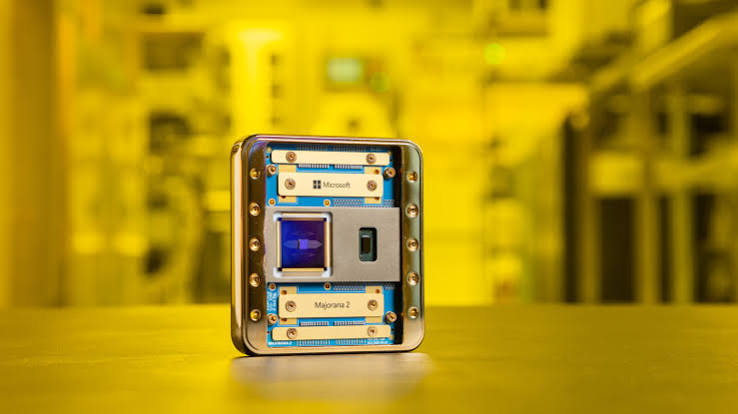
Engineers have developed the world's first portable, room-temperature, diamond-powered quantum computer. Utilizing nitrogen-vacancy centers in synthetic diamonds, the breakthrough eliminates costly cryogenic cooling systems, allowing robust 100+ qubit processors to operate out of standard server racks and field edge cabinets.
LEIPZIG — In a major technical milestone for the computing sector, European quantum developers have successfully engineered the world's first portable, room-temperature, diamond-powered quantum computers. Spearheaded by firms such as SaxonQ—a spin-out of Leipzig University—and industry peers like Quantum Brilliance, the breakthrough bypasses the massive, multi-million-dollar cryogenic cooling tanks required by traditional quantum systems.
Announced through commercial rollouts and industrial disclosures, the new systems utilize nitrogen-vacancy (NV) center technology embedded in synthetic diamond chips. Operating stably at standard ambient temperatures (293 K) and plugging directly into a standard wall outlet, the architecture allows quantum processors to scale out of specialized underground laboratories and into standard server racks, edge-computing cabinets, and mobile field installations.
The Physics of Diamond-Based Qubits
Traditional quantum hardware built by tech giants relies on superconducting circuits that must be chilled close to absolute zero (−273°C) using liquid helium and complex dilution refrigerators. By contrast, diamond-powered quantum technology utilizes the rigid, tightly bound carbon lattice of a diamond crystal.
Engineers implant single nitrogen atoms next to a vacant lattice site to create an atomic-scale "nitrogen-vacancy center". According to technical documentation released by developers:
Thermal Stability: The electron and nuclear spins of these NV centers act as reliable qubits that remain stable at normal room temperatures.
CMOS Compatibility: Standard semiconductor fabrication techniques and ion-implantation tools can position qubits with nanometer precision, enabling high-yield manufacturing.
Plug-and-Play Integration: Units like SaxonQ’s newly commercialized 128-qubit (SXQ128) systems operate entirely without liquid nitrogen or dilution hardware, drawing power from standard facility electrical grids.
Commercial Scaling and Field Deployment
The transition from academic proofs-of-concept to commercial availability marks a turning point for practical quantum acceleration. Industrial partners and research institutions, including the German Aerospace Center (DLR) and Fraunhofer institutes, have begun integrating these compact processors into hybrid computing workflows.
For businesses, defense entities, and aerospace organizations, the form factor eliminates physical infrastructure bottlenecks. Portable quantum accelerators can now be co-located directly with classical high-performance computing (HPC) stacks or deployed in environments subject to extreme vibrations and remote conditions—such as autonomous vehicles, aerospace navigation arrays, and edge AI networks.
Official Sources Section
Quote Section
According to institutional leadership statements from project engineering teams:
"Developing a mobile quantum computer that runs in real-world environments—without cryogenic cooling and powered by a simple wall plug—proves that we can run reliable quantum operations on-site, moving out of specialized laboratories and into everyday industrial environments."
Why It Matters
By removing the heavy cryogenic infrastructure constraint, portable diamond-powered systems democratize access to quantum computing. Enterprises can integrate quantum acceleration directly into existing data centers and field operations without redesigning physical facilities, drastically accelerating real-world adoption across logistics, material science, and secure communications.
Key Facts at a Glance
Operating Temperature: Stable at 293 K (room temperature) with zero cryogenic cooling requirements.
Core Technology: Nitrogen-vacancy (NV) centers engineered within synthetic diamond lattice structures.
Power Source: Standard wall outlet compatibility (230V ambient infrastructure).
Commercial Milestone: Deployment of commercial systems exceeding 100 physical qubits (such as the SXQ128).
FAQ Section
How does a diamond-powered quantum computer work without cooling?
The system uses nitrogen-vacancy centers trapped inside a rigid carbon diamond crystal lattice. Because diamond's atomic bonds are exceptionally stable, the spin-state qubits do not suffer from thermal decoherence at room temperature, eliminating the need for absolute-zero cryogenics.
Are these systems available for commercial purchase?
Yes. Developers have opened commercial orders for rack-mountable, multi-qubit room-temperature quantum systems targeting industrial data centers and edge deployment.
Can these computers fit into vehicles or mobile units?
Yes. Because they operate on standard electrical power and lack heavy vacuum pumps or liquid helium tanks, they are rugged enough for aerospace, automotive, and defense field integration.
Do these systems use physical or error-corrected logical qubits?
Current portable units rely on advanced physical qubits configured via CMOS-compatible manufacturing, serving as high-speed quantum accelerators that work alongside classical computers.
Source: SaxonQ, Quantum Brilliance, Quantum Machines